



Scrub Typhus Surge in Angul Sparks Calls for Urgent Preventive Actions in Neighbouring Districts| Special Report
Key Points
Bhubaneswar: A sudden cluster of scrub typhus cases in Angul's forest-bordering Sanbagdhari village has triggered a larger public-health concern: could the current hotspot develop into a wider belt of cases across neighbouring districts if preventive surveillance is not stepped up immediately?
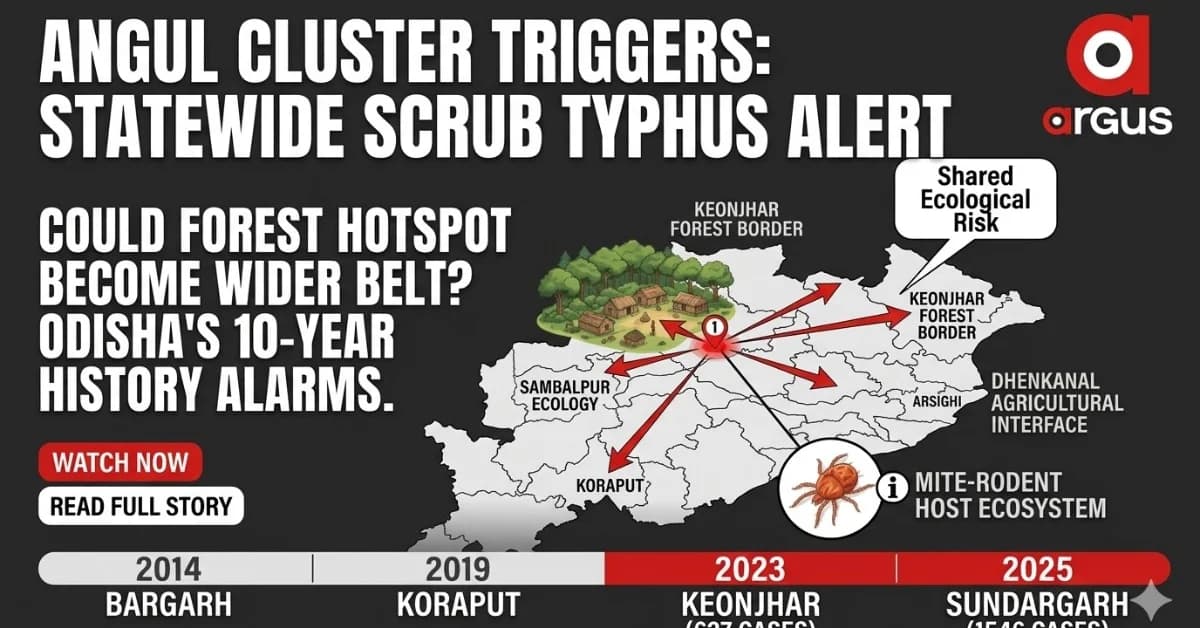
The concern is rooted not in person-to-person transmission, but in Odisha's own decade-long scrub typhus history. The disease has repeatedly emerged in clusters across districts sharing similar forest, agricultural and post-monsoon ecological conditions, with major spikes recorded in 2014, 2019, 2023 and 2025.
The latest alert comes from Sanbagdhari village under Pallahara block, where health teams screened 130 villagers and detected 22 new rapid-test positive cases on Sunday. The patients are currently being treated at home under medical supervision. However, the district administration has cautioned that rapid diagnostic kits can produce false positives.
In fact, seven people who had earlier tested positive through rapid kits subsequently tested negative through the more accurate ELISA method. The 22 latest positives are therefore scheduled for confirmatory ELISA testing.

📱 Get Argus News App
✨Why Angul's Location Matters
Sanbagdhari's geography makes the latest cluster particularly important from a surveillance perspective.
The village lies close to the Angul-Keonjhar forest border, where forests, scrub vegetation, agricultural fields and rodent habitats form a continuous ecological landscape. Chiggers—the larval mites responsible for transmitting scrub typhus – do not recognize administrative boundaries.
This means that even though scrub typhus does not spread from person to person, the environmental conditions supporting transmission can exist simultaneously on both sides of a district border.
People moving between villages and districts for farming, forest-product collection, livestock grazing and markets can also be exposed to infected chiggers and return to their home locations.
Therefore, a case detected in Angul should not automatically be interpreted as the disease "spreading" to Keonjhar or other districts. But it should be treated as an epidemiological warning for neighbouring areas sharing the same ecological corridor.
Odisha's 10-Year Scrub Typhus Timeline Raises the Red Flag
Odisha's experience over the last decade provides a compelling reason for early intervention.
Bargarh recorded a major documented outbreak in 2014, marking one of the early high-volume phases of the disease in western Odisha.
The next important milestone came in 2019, when Koraput and Nabarangpur witnessed prominent increases. The growing recognition of the disease subsequently pushed the health system towards strengthening diagnostic capacity in tribal and high-risk districts.
But 2023 emerged as the critical statewide milestone.
Keonjhar recorded around 627 confirmed cases within a few months, making it one of the largest single-year district spikes reported in the State. Bargarh recorded six confirmed deaths, while Sundargarh and Kalahandi also emerged as important hotspots.
The 2023 surge coincided with prolonged post-monsoon humidity and favourable conditions for chigger activity across agricultural and forest-edge landscapes.
Then came 2025, when Sundargarh reported a historic 1,546 detected cases. But this figure also carries an important lesson: a rise in reported cases does not necessarily mean an equivalent rise in transmission.
The massive Sundargarh number was associated with an expansion of confirmatory IgM ELISA testing, bringing to light infections that may previously have been classified simply as seasonal or unexplained fever.
The Testing Factor: More Cases Can Also Mean Better Detection
This is perhaps the most important distinction in interpreting Odisha's scrub typhus numbers.
For years, scrub typhus could remain hidden behind the broad clinical category of fever. Patients could be suspected of having malaria, dengue or another seasonal infection.
As surveillance and laboratory capacity improved, more patients began being tested specifically for scrub typhus.
Consequently, the upward trend in districts such as Sundargarh, Keonjhar, Bargarh and Kalahandi is likely to represent a combination of two factors: genuine transmission in favourable ecological conditions and improved case detection.
The current Angul situation demonstrates the same problem.
Rapid kits can quickly identify suspected cases during mass screening, but their results need to be interpreted carefully. ELISA confirmation is crucial before drawing conclusions about the actual size of the cluster.
Angul Could Become a Surveillance Test for the State
The immediate question, therefore, is not whether Angul is witnessing a massive outbreak- it is whether the State can detect and prevent a larger cluster before it becomes one.
The current response includes door-to-door surveillance, medical teams camping in the affected village, home-based treatment, confirmatory testing and village sanitisation, including clearance of vegetation and weeds.
But the epidemiological argument goes beyond Sanbagdhari.
Neighbouring blocks in Keonjhar, Dhenkanal, Deogarh and Sambalpur share varying degrees of forest-agriculture interfaces and population movement with the broader risk landscape. These areas do not need to wait until they record their own cluster before increasing vigilance.
What Should Happen Now
The State could consider a preventive surveillance ring around the Angul hotspot, particularly in adjoining blocks.
First, Community Health Centres and primary-level facilities in neighbouring high-risk blocks should intensify syndromic surveillance of unexplained fever, with doctors specifically looking for the characteristic eschar – the painless dark scab that can appear at the site of a chigger bite.
Second, health facilities in these areas should maintain adequate diagnostic capacity and ensure that suspected rapid-test positives can be referred for confirmatory ELISA testing.
Third, grassroots workers, particularly ASHAs and ANMs, should be mobilised for targeted awareness among farmers, forest workers and communities living close to forest edges.
Fourth, rural health facilities should maintain adequate stocks of recommended antibiotics for confirmed or clinically suspected scrub typhus, so treatment is not delayed while patients deteriorate.
And fifth, prevention messaging needs to be practical: people entering fields or forest areas should wear long clothing and enclosed footwear, use appropriate insect repellents, avoid sitting directly on grass or bare soil, and wash exposed clothing and the body after returning from high-risk areas.
The Bigger Health Warning
Scrub typhus is not a new disease in Odisha. What has changed is the State's ability to see it.
The timeline – from the 2014 Bargarh episode to the 2019 southern Odisha surge, the major 2023 multi-district wave and the 2025 Sundargarh testing-driven spike – shows that scrub typhus has evolved from an under-recognised seasonal illness into a significant surveillance priority.
The Angul cluster is therefore less about panic and more about timing.
There are no officially attributed scrub typhus deaths from the present Sanbagdhari cluster so far, and several rapid-test positives still await confirmation. But the location of the cluster, the district's forest-agriculture interface and Odisha's previous pattern of multi-district seasonal surges provide enough justification for preventive action.
The
lesson from Odisha's past is clear: when one forest-edge district
lights up, neighbouring districts sharing the same ecology should not
wait for their own cases to rise before switching on surveillance.
Also Read: Odisha Tops Nation in Malaria; Child Fatalities Sound Alarm for Govt| Special Report
Related Topics
Explore more stories