



Odisha Tops Nation in Malaria; Child Fatalities Sound Alarm for Govt| Special Report
Key Points
Bhubaneswar: Odisha’s fight against malaria is facing a difficult paradox.
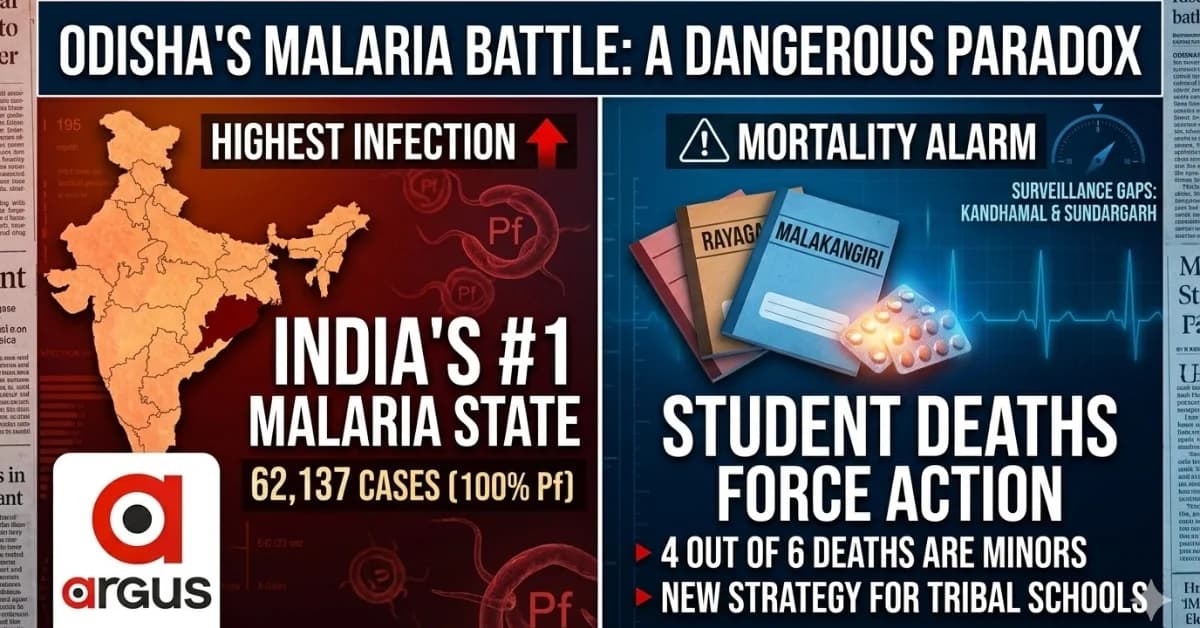
The state has emerged as India’s number one in malaria cases, with 62,137 infections in 2025, yet it has kept malaria deaths remarkably low.
But the age profile of those deaths – and fresh concerns flagged by the Centre over surveillance gaps – appear to have finally jolted the state health machinery into a course correction.
The latest data of the National Centre for Vector Borne Diseases Control (NCVBDC) places Odisha at the top of India’s malaria burden, ahead of Jharkhand, Chhattisgarh, Maharashtra and West Bengal.

📱 Get Argus News App
✨What makes the Odisha situation more worrying is that 100 per cent of the reported cases were caused by Plasmodium falciparum (Pf), the more dangerous form of the malaria parasite.
The Centre’s 2025 malaria reports, however, also point to chinks in Odisha’s surveillance architecture.
Districts such as Kandhamal and Sundargarh were flagged for a decline in active malaria surveillance, raising concerns that the state could be developing “blind spots” even while its health system continues to tackle a massive disease burden.
The alarm has now acquired a sharper human dimension: 3 children in Rayagada and Malakangiri succumbed to Malaria in 2026 so far, this when seen in the backdrop of how children accounted for four of Odisha’s six malaria deaths in 2025.
Odisha Tops India’s Malaria Burden
According to the NCVBDC’s state-wise annual data, Odisha reported 62,137 malaria cases, followed by:
Jharkhand: 42,236 cases
Chhattisgarh: 28,836 cases
Maharashtra: 23,821 cases
West Bengal: 19,840 cases
Odisha’s burden was concentrated heavily in its tribal and southern districts. Kalahandi reported the highest 13,034 cases, followed by Rayagada with 10,913, Kandhamal with 8,342, Koraput with 6,950, Malkangiri with 6,544 and Mayurbhanj with 4,995 cases.
At the other end, coastal districts such as Jagatsinghpur and Bhadrak recorded relatively low case numbers.
The concentration of cases in tribal and difficult-to-reach regions underlines the geographical challenge before the state: malaria transmission remains entrenched in areas where access to testing, treatment and sustained vector control can be difficult.
The Odisha Paradox: Highest Cases, But Low Deaths
There is, however, one major positive in the data.
Despite recording the highest malaria caseload among all states, Odisha reported only six deaths, translating into a case fatality rate of about 0.0097 per cent.
The contrast with other high-burden states is striking. Maharashtra, with less than half of Odisha’s caseload, reported 23 deaths, while Chhattisgarh reported 12 deaths from 28,836 cases.
This suggests that Odisha’s system of early diagnosis and treatment has been relatively successful in preventing malaria infections from progressing into fatal cases.
But that success is not enough to conceal the larger public health challenge.
The fact that all 62,137 reported cases in Odisha were Pf infections means the state is fighting a highly concentrated but potentially dangerous form of malaria. Any delay in detection or treatment can turn fatal.
Children Are the New Alarm Bell
The biggest concern in Odisha’s mortality profile is the vulnerability of children.
Of the six malaria deaths recorded in the state:
One child aged between 1 and under 5 years died
Three children aged between 5 and under 15 years died
Two deaths were among persons aged 15 years and above
In other words, nearly 67 per cent of Odisha’s malaria deaths were among children below 15 years.
The 5-15 age group alone accounted for three deaths, emerging as the most vulnerable age bracket in the state’s mortality data.
This pattern has assumed greater significance following reports of malaria-related student deaths in tribal residential schools in southern Odisha. The recent deaths of students in areas covering Rayagada and Malkangiri have reinforced concerns that the vulnerability identified in the 2025 national data was already translating into a fresh crisis on the ground.
For a state that has managed to keep its overall malaria mortality low, the deaths of school-going children represent a serious warning: the battle may be improving for the average patient, but the most vulnerable population remains exposed.
Centre Flags Surveillance Chinks
The NCVBDC’s October 2025 malaria situation assessment added another layer of concern.
While Odisha continued to remain in the high-endemicity category, the Centre flagged Kandhamal and Sundargarh for a critical decline in active malaria surveillance.
This is particularly significant in Kandhamal, which reported 8,342 malaria cases during the year.
The warning points to a potential structural problem in the malaria programme.
High case numbers can draw government attention and resources, but a decline in active surveillance can mean infections are going undetected, delaying treatment and allowing transmission to continue.
The national monitoring framework emphasises the need for adequate blood examination rates, uninterrupted availability of rapid diagnostic tests and anti-malarial drugs, and strong coverage of vector-control measures such as insecticide-treated nets and indoor residual spraying.
For Odisha, the challenge is therefore no longer confined to treating reported patients. It is increasingly about ensuring that the health system does not lose track of patients who are not being tested at all.
State Finally Moves to Plug the Gaps
The Odisha government has now launched a renewed strategy to overhaul malaria control in the wake of the emerging concerns.
A state-level technical task force, involving experts and institutions including WHO and RMRC, is being used to strengthen hotspot-specific interventions. A special focus is being placed on high-risk tribal areas and rapidly evolving disease situations, including Malkangiri.
The government has also moved to standardise monitoring by directing partner agencies and field organisations to use a state-approved integrated monitoring format. The objective is to reduce fragmented reporting and improve coordination between different agencies involved in surveillance and malaria control.
The fresh strategy also gives special emphasis to tribal residential schools, where children have emerged as a particularly vulnerable group.
This is where the latest government response appears to be directly reflecting the Centre’s data: high-burden districts require targeted intervention, surveillance gaps must be closed and children can no longer be treated as just another demographic category in the malaria programme.
The Real Test: From Treatment Success to Transmission Control
Odisha’s malaria data presents both a success story and a warning.
The state has demonstrated that even with the country’s highest malaria caseload and a 100 per cent Pf infection profile, it can keep the number of deaths low through early diagnosis and treatment.
But the bigger failure is the continued scale of transmission.
With 62,137 people infected in a single year, Odisha remains the biggest malaria challenge in India. And with children accounting for four of its six recorded deaths, the state cannot afford to take comfort in its low case fatality rate.
The Centre’s surveillance warnings and the recent student deaths appear to have forced a sharper policy response.
The next phase of Odisha’s malaria battle will therefore be judged not only by how many lives its hospitals save, but by whether the state can reduce infections in tribal hotspots, eliminate surveillance blind spots and protect children before the disease reaches a hospital bed.
Related Topics
Explore more stories