



Odisha’s Toxic ‘Baby Cure’ Crisis: Why Desperate Childless Couples Are Dying For Miracles | Exclusive
Key Points
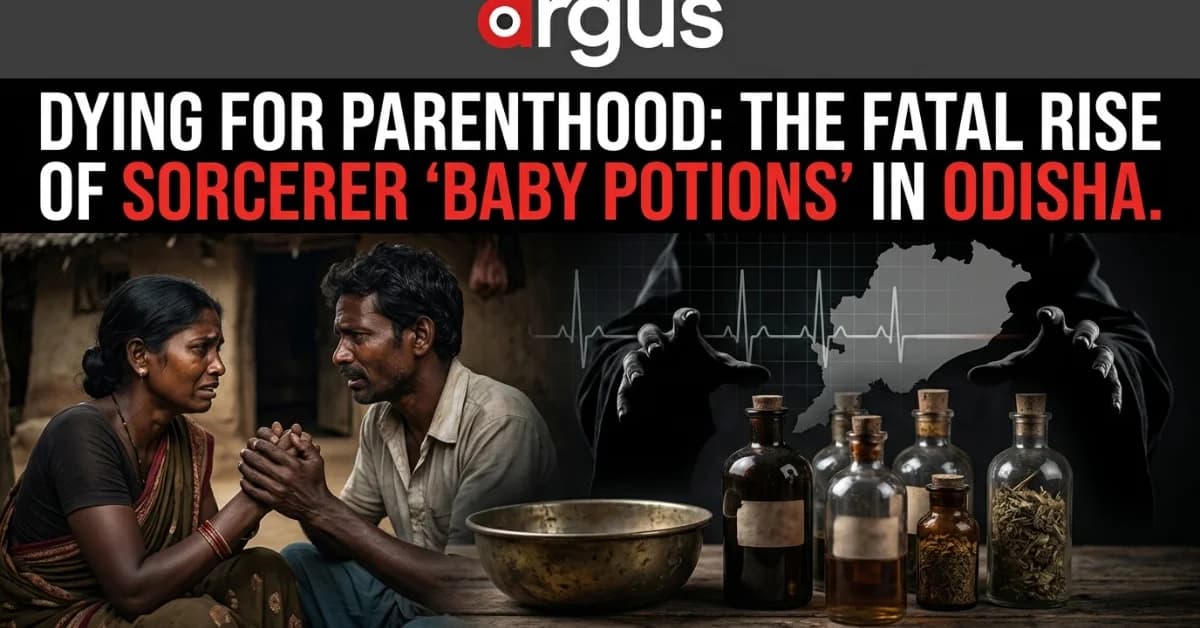
Bhubaneswar: In a distant Kandhamal hamlet, where basic healthcare itself can often seem like a distant promise, a childless couple was not thinking of IVF clinics or fertility specialists. For them, even a government-backed public fertility clinic was beyond the horizon.
So they fixed a date with a sorcerer.
The promise was simple: take the “magical cure” and conception would follow.
The couple trusted the cure, consumed the potion with faith – and within hours, the body began to collapse.

📱 Get Argus News App
✨What began as a desperate search for a child ended in multiple-organ failure, a frantic medical battle at Berhampur’s MKCG Medical College and Hospital, and finally death.
This is not the story of one couple – Lalita Kanhar and Kanhu Kanhar, residents of Nedipanga village in Kandhamal.
Years after years, similar tragedies have kept surfacing across Odisha: childless couples or women under enormous social pressure seek a “miracle cure”, consume an unlabelled potion supplied by a sorcerer, Gunia or quack, and land in hospital with poisoning, organ failure – or worse.
Yet, the response has remained almost predictable. A death occurs. Police register a case. The accused is arrested and forwarded to court.
The tragedy, however, has already happened.
A Decade-Long Pattern: From Kandhamal to Mayurbhanj, the ‘Miracle Cure’ Hotspots
The Kandhamal tragedy is part of such cases, which a compilation of cases over the past decade indicate is a recurring pattern in Odisha’s tribal and remote regions. The geography is striking.
Kandhamal, Mayurbhanj, Keonjhar and Rayagada emerge as the major hotspots involving childless couples seeking conception through occult or unregulated “traditional” remedies. Nabarangpur and Ganjam have also figured in reports involving dangerous fertility-related concoctions and hospitalisation after consumption of such substances.
The pattern is almost mechanical.
A couple remains childless for years. Social and family pressure intensifies. Scientific fertility treatment appears either physically inaccessible, financially unaffordable or socially embarrassing.
A local healer promises a solution. The medicine comes without a label, dosage standard, toxicology report or medical supervision.
Then comes the medical emergency.
Sample the cases that point to a grim chronology: a reported fatality in Nabarangpur in 2017, a similar case in Mayurbhanj in 2019, reported concerns around childbirth-related occult treatment in Keonjhar in 2021, a fatal case in Rayagada in 2023, and now the Kandhamal tragedy in 2026.
The recurrence suggests that this is not merely an isolated superstition-linked crime, but a chronic public-health and healthcare-access failure hidden beneath the language of blind faith.
The most disturbing feature is that many such episodes may never enter public records unless the victim dies or police intervene. A poisoning treated quietly at a hospital may never be identified as a case of “fertility quackery”.
And that is why the visible cases may be only the tip of the iceberg
Why Odisha Third in This Disturbing National Trend
A study of nation wide such cases put Odisha at No. 3, after Uttar Pradesh and Madhya Pradesh, when the focus is narrowed specifically to reported cases involving dangerous occult or unverified fertility potions rather than the broader universe of witch-hunting or superstition-related crimes.
The ranking, however, should be read as a case-based compilation rather than an official national government ranking.
What makes Odisha particularly vulnerable is the convergence of three factors: geography, desperation and secrecy.
In remote tribal belts, a Gunia can function as a parallel, informal health system. For a childless couple living far from a specialist facility, the local healer is accessible. He offers privacy. He does not ask the couple to undergo a battery of medical tests. And most importantly, he offers something that medical science cannot guarantee in a single consultation: certainty.
“Take this, and you will have a child.”
That promise is powerful enough to override fear.
Also, as infertility remains deeply stigmatised, particularly for women, the pressure to produce a child can turn a medical condition into a social emergency.
In such an environment, even an expensive private fertility treatment may be beyond reach, while a so-called miracle cure becomes a desperate gamble.
The economic gap is stark
A private IVF cycle can cost between Rs1.5 lakh and Rs3 lakh, apart from repeated travel and related expenses, making formal fertility care inaccessible for many low-income families.
The alleged Kandhamal exploitation itself illustrates how desperation can become a business model.
That is the central paradox of this trend: a poor family unable to afford structured fertility care can still be driven to spend its life savings on an unregulated potion.
What Government Must Do: Stop Waiting for Death, Build an Alternative
Arresting a sorcerer after a person dies is not prevention.
If Odisha wants to break this cycle, it has to stop treating every such case merely as a police-and-superstition story. This is also an economic and healthcare-access crisis masquerading as a superstition crisis.
1. Create public fertility clinics in the vulnerable belt
The government should establish dedicated and subsidised fertility and reproductive health services in government medical colleges and district headquarters hospitals, particularly in high-risk districts such as Kandhamal, Keonjhar, Mayurbhanj and other remote tribal belts.
Couples should not have to travel to Bhubaneswar, Cuttack or a private metropolitan clinic simply to get a basic infertility investigation.
Even basic facilities for diagnosis, counselling and lower-cost procedures such as IUI could create a credible medical alternative before families fall into the hands of quacks.
2. Bring infertility screening to the village level
Odisha already has an enormous grassroots health network. ASHAs, Anganwadi workers and primary health workers can become the first line of intervention.
They should be trained to identify and discreetly counsel couples facing infertility. The objective should not be intrusive surveillance, but ensuring that a couple knows where to go before a Gunia reaches them first.
Specialised mobile reproductive-health units can also be deployed in inaccessible blocks, bringing gynaecological and fertility consultations closer to remote communities.
3. Use Mission Shakti and Panchayats as the social firewall
Odisha has a powerful institutional network that can reach places where specialist doctors cannot always remain.
Mission Shakti groups, Gram Panchayats and community leaders should be mobilised to spread one simple message: infertility is a medical issue, not a curse, and a childless couple should not be pushed into secrecy or shame.
Panchayat-level vigilance can also help flag cases where vulnerable families are being financially exploited by self-styled healers selling “baby cures”.
4. End the automatic blame on women
Perhaps the most important intervention is social.
Infertility must stop being seen as a woman’s failure. Medical problems related to conception can involve either partner or both. Unless this understanding reaches the family level, women will continue to face pressure to consume anything – from unidentified roots to chemical mixtures – in the hope of saving a marriage or satisfying a family.
Public campaigns should therefore speak directly about male infertility, shared diagnosis, scientific treatment and the dangers of unverified cures.
The lesson from Kandhamal is brutally simple. Desperation cannot be arrested after death. It has to be intercepted before a bottle of poison is placed in a hopeful couple’s hands.
The only sustainable way to end the market for a cheap “miracle cure” is to give people a safe, affordable and dignified alternative.
Until fertility care reaches the poor and the remote, every crackdown will remain reactive. The police may arrest one Gunia. Another desperate couple may still be waiting for the next one.
And
in that gap between hope
and healthcare,
the miracle cure will continue to claim lives.
Also Read: Don’t Give Your Toddler That 'Branded' Cold Syrup: Why a Once-Recommended Medicine Was Finally Restricted in 2026| Explainer
Related Topics
Explore more stories