



Don’t Give Your Toddler That 'Branded' Cold Syrup: Why a Once-Recommended Medicine Was Finally Restricted in 2026| Explainer
Key Points
Bhubaneswar: For years, a runny nose, sneezing and blocked nose in a toddler could mean a quick visit to the medicine cabinet for a popular cold syrup. But that advice has now changed.
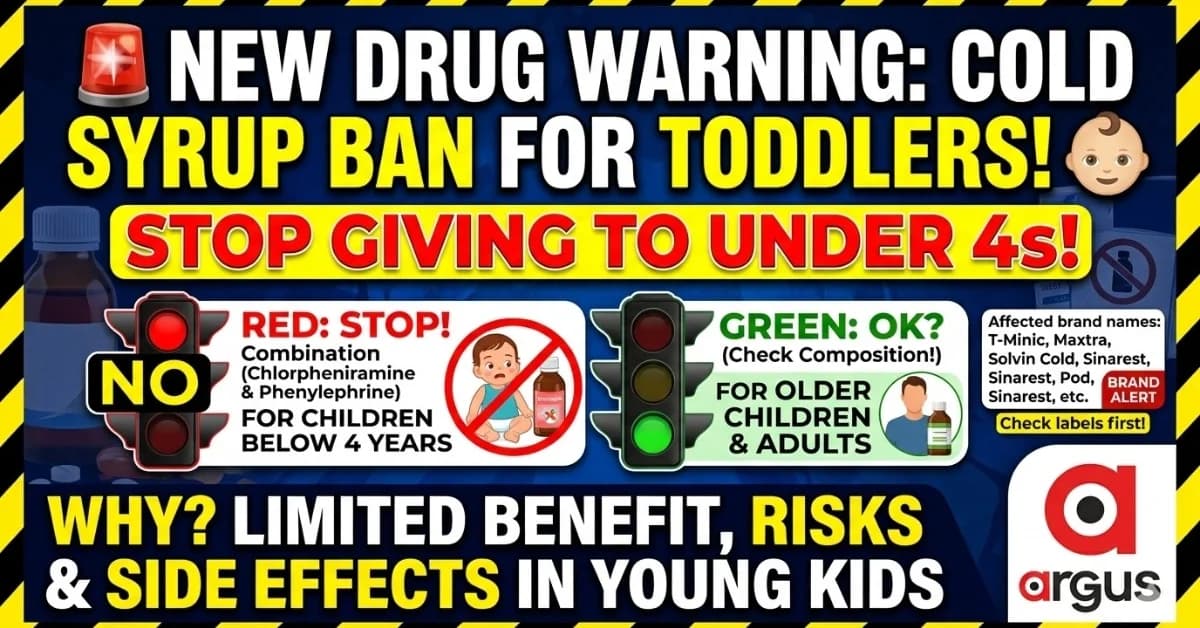
The Indian drug regulator has tightened restrictions on the fixed-dose combination of chlorpheniramine maleate and phenylephrine hydrochloride, directing that medicines containing the combination must not be used in children below four years of age. The move covers all formulations, including syrups, drops and liquid suspensions.
The reason is simple: these medicines may offer symptom relief to adults, but the benefit-risk equation changes sharply in toddlers. A growing body of clinical evidence found little evidence that the combination meaningfully improves common-cold symptoms in very young children, while the risks of serious side effects and accidental dosing errors remain significant.
The restriction affects several familiar brands, depending on their formulation and composition, including T-Minic, Maxtra, Ascoril Flu, Solvin Cold/Solvin Cold AF, Sinarest Pediatric, Wikoryl AF, Febrex Plus/Febrex Plus AF and Delcon. However, parents should check the composition on the specific product pack because brand formulations can vary.

📱 Get Argus News App
✨How the combination works in adults
The fixed-dose combination brings together two different medicines.
Chlorpheniramine maleate is an antihistamine. It works by blocking histamine receptors, helping reduce a runny nose, sneezing and watery eyes. In adults, it can provide noticeable relief from these symptoms, although drowsiness is a common side effect.
Phenylephrine hydrochloride is intended to act as a decongestant by constricting blood vessels in the nasal passages, theoretically reducing swelling and easing nasal blockage. But recent clinical evaluations have raised a major question over how well oral phenylephrine actually works, with modern reviews finding it may be no more effective than placebo for nasal congestion when taken orally.
That means the combination is not a cure for the common cold. The medicines do not kill the virus or shorten the life of the infection. They are designed only to provide temporary relief from symptoms while the body's immune system clears the viral infection.
Why toddlers are different
The problem is not simply that toddlers receive a smaller dose.
Young children process medicines differently, and multi-ingredient cold preparations can create risks that are disproportionate to their limited benefit. Chlorpheniramine can cause excessive sedation and, in severe cases, central nervous system and breathing problems. In some children, antihistamines can also trigger paradoxical agitation or convulsions.
Phenylephrine, meanwhile, can stimulate the cardiovascular system and may lead to rapid heart rate and blood-pressure fluctuations. The risks become more complicated when multiple ingredients are packed into one liquid medicine, increasing the possibility of confusion and accidental overdose.
For toddlers, therefore, the central question became: why expose a child to multiple active drugs when studies show little evidence of meaningful improvement in an uncomplicated common cold?
The studies that changed the debate
The regulatory rethink did not happen overnight.
Systematic reviews, including a Cochrane review of antihistamine-decongestant-analgesic combinations for the common cold, found insufficient evidence of effectiveness in young children. The evidence suggested that any possible benefit in adults did not translate into a meaningful clinical advantage for toddlers.
Earlier randomised clinical trials had also reached a similar conclusion. In one cited trial involving young children with acute colds, children receiving an antihistamine-decongestant combination did not show clinically significant improvement over those receiving placebo or no treatment.
Global regulatory reviews added another layer of concern. Safety assessments highlighted serious adverse events in young children, with multi-ingredient formulations also creating a greater risk of dosing mistakes. The concern was therefore not just whether the medicines worked, but whether their limited benefits justified their potential harms.
From recommended use in 2015 to tighter restrictions in 2026
The combination of chlorpheniramine maleate and phenylephrine hydrochloride was officially approved for use in India in 2015 and subsequently became widely used for common-cold and allergy symptoms, including in paediatric formulations.
But the regulatory approach gradually changed as safety and efficacy concerns mounted.
In December 2023, CDSCO issued a major safety advisory warning against the use of specific strengths of the combination in children below four years.
In April 2025, the government issued a formal notification further restricting specific configurations of the combination for toddlers.
By August 2026, the latest restriction was extended across formulations, including oral drops and liquid suspensions, effectively closing the remaining gaps for children below four years.
In other words, a medicine combination that had been accepted and widely used for years was gradually reassessed as clinical evidence and safety concerns forced regulators to re-examine whether toddlers were actually benefiting from it.
Not a ban on adults – but a clear warning for parents
The restriction does not mean that every medicine containing these ingredients has disappeared from the market. Such formulations may still be available for older children and adults, subject to approved indications and labelling.
But for children below four, the message is now clear: a fixed-dose combination of chlorpheniramine maleate and phenylephrine hydrochloride should not be used.
Manufacturers are required to carry the warning that the fixed-dose combination shall not be used in children below four years of age.
For parents, the safest first step is to check the composition, not just the brand name, on a cold or cough syrup bottle. If both chlorpheniramine maleate and phenylephrine hydrochloride are listed, it should not be given to a child below four. Parents should instead consult a paediatrician for age-appropriate treatment.
The larger lesson is that common cold medicines can make an adult feel better without curing the virus – and a drug combination that may be acceptable for an adult is not automatically safe or useful for a toddler.
Related Topics
Explore more stories