



Odisha Floods Close 500 Schools, Anganwadis: Nutrition Safety Net Disrupted for 30,000-40,000| Special Report
Key Points
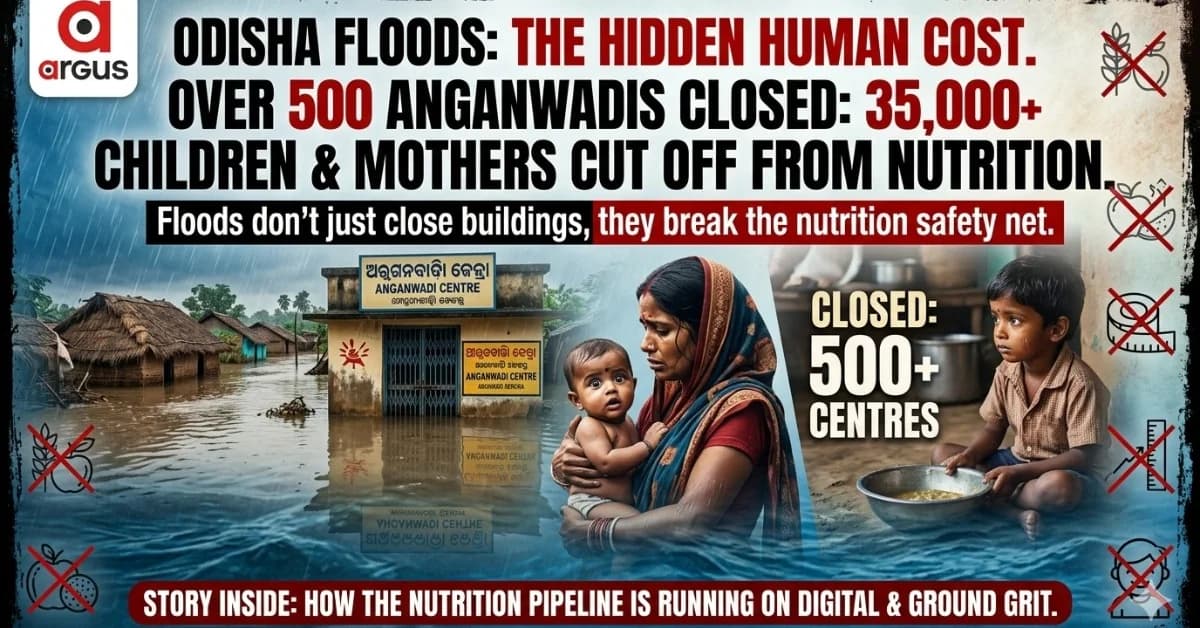
Bhubaneswar: Floodwater does not merely close a building. When an Anganwadi shuts its doors, it can also interrupt a chain that delivers nutrition, health tracking, growth monitoring and early childhood care to some of the most vulnerable families in a village.
That is the hidden impact of the flood-triggered closure of more than 500 schools and Anganwadi Centres across Odisha's worst-hit districts.
Using the standard beneficiary structure of the Integrated Child Development Services (ICDS), the disruption could potentially affect between 30,000 and 40,000 direct beneficiaries across 500 closed centres, with the estimated average impact hovering around 35,000 people.
The affected population is not a uniform mass. It includes infants whose growth has to be monitored, preschool children dependent on supplementary nutrition and early learning, and pregnant and lactating mothers who require regular nutritional and health support.

📱 Get Argus News App
✨The 500-Centre Disruption: Who Gets Hit?
A typical rural or tribal Anganwadi Centre generally serves around 60 to 80 core beneficiaries. Applied across 500 disrupted centres, the estimated impact looks like this:
|
Beneficiary group |
Estimated average per centre |
Estimated impacted cohort across 500 centres |
Key service disrupted |
|---|---|---|---|
|
Infants and young children |
25-30
12,500-15,000
Growth monitoring and supplementary nutrition
Pre-school children
25-35
12,500-17,500
Supplementary nutrition and early childhood education
Pregnant and lactating mothers
10-15
5,000-7,500
Nutritional support and maternal monitoring
Total
60-80
30,000-40,000
Multiple layers of the institutional safety net
The numbers underline why the flood impact cannot be measured only by the number of submerged roads, damaged houses or closed schools.
For thousands of vulnerable families, the closure of an Anganwadi means temporary disruption of the nearest institutional point for nutrition and child development services.
Bhadrak At The Centre Of The Shutdown
The impact is particularly pronounced in Bhadrak, where the district administration ordered the closure of Anganwadi Centres amid severe waterlogging. The district had already witnessed sequential mass closures, including 265 centres simultaneously across Bhadrak, Tihidi, Chandbali and Dhamnagar blocks.
At least 69 centres in deeply inundated pockets of Tihidi and Chandbali were also set to remain closed on August 26.
In Nabarangpur, flooding had earlier led to a blanket closure of schools and Anganwadi Centres. In Jajpur, Balasore and Sundargarh, extensive flooding and damaged local connectivity have also disrupted access to schools and village-level Anganwadi services.
The closure of over 500 educational and child-care institutions collectively may therefore have a far wider human impact than the physical count suggests.
The First Casualty Is Continuity
The biggest challenge is not necessarily the permanent loss of nutrition support, but the break in continuity.
A flood may close a centre for safety reasons, but the nutritional needs of children and mothers do not close with it.
For young children, the immediate risks include disruption in the regular distribution of supplementary nutrition, interruption in growth monitoring and difficulties in reaching routine health services.
For preschool children, the closure also means a temporary halt in the early childhood learning environment. In flood-hit villages, home-based or digital alternatives have limited utility when families have been displaced, electricity supply is erratic and mobile connectivity is disrupted.
For pregnant and lactating women, the stakes are even higher. Many may need regular follow-up, nutritional support and tracking. Floods also increase the possibility that some women could become temporarily cut off from routine frontline services.
There is another social impact. For poor and daily-wage households, Anganwadi Centres often provide a structured daytime support system. Their closure can increase the care burden on mothers, particularly in villages where adults must simultaneously deal with evacuation, damaged homes, livestock and loss of livelihood.
How The Government Is Trying To Keep The Nutrition Pipeline Running
The government's central challenge now is to shift the service from the building to the beneficiary.
That means a closed Anganwadi cannot automatically mean a closed nutrition service.
The first layer of this response is the Poshan Tracker digital system. Since routine beneficiary data is digitally recorded by frontline workers, district administrations can use the database to identify registered children and mothers in flood-affected areas even when physical records or Anganwadi buildings are inaccessible.
The digital lists can help officials identify:
children requiring supplementary nutrition;
pregnant and lactating mothers;
families shifted to relief shelters;
beneficiaries in marooned villages; and
high-risk children requiring closer monitoring.
The second layer is ground verification by Anganwadi Workers and ASHA workers.
The digital database may provide the names, but the flood changes locations. Families may have moved to relief camps, relatives' homes or temporary shelters. This is where local frontline workers become crucial.
They can cross-map registered beneficiary lists with evacuation and relief-shelter records to locate children and mothers who have been displaced from their normal habitation.
Relief Kitchens Become A Temporary Bridge
The flood response is also moving from fixed service points to centralized emergency distribution.
In Bhadrak, 122 centralized free kitchens have been deployed to handle immediate food requirements in affected areas. Across the wider flood response, centralized and temporary feeding arrangements are being used to provide meals to displaced populations.
For the Anganwadi beneficiary network, however, the critical task is to ensure that the most vulnerable groups are not lost within the broader relief operation.
A general community kitchen can provide food, but infants, young children and pregnant women have different nutritional requirements. The administration's challenge is therefore to ensure that supplementary nutrition, take-home rations and maternal support reach the identified ICDS beneficiaries in addition to general relief meals.
The likely operational model is a combination of:
Digital beneficiary identification → frontline worker verification → relief shelter mapping → ration or nutrition distribution → health follow-up.
The Weakest Link Is The Last Mile
The government's emergency framework can prevent the disruption from turning into a complete nutritional breakdown. But it cannot eliminate every gap.
The real difficulty is reaching families in marooned pockets.
A closed Anganwadi is visible. A child who does not receive nutrition for several days may not be.
Flood-hit families can also face practical barriers. Parents may be unable to travel to collection points. Roads may be cut off. Boats may be required for delivery. And relief centres may not always be close to the original Anganwadi catchment area.
This is why the role of Anganwadi Workers and ASHA workers is likely to be critical during the flood phase. Their local knowledge can help identify whether a beneficiary has:
reached a relief shelter;
moved elsewhere;
been cut off inside a village; or
missed a scheduled nutrition or health intervention.
For the most vulnerable groups, particularly severely malnourished children and high-risk pregnant women, the response may require direct tracking rather than waiting for beneficiaries to come to a relief point.
A 35,000-Person Nutrition Test
The closure of more than 500 schools and Anganwadi Centres has therefore created an emergency challenge that is larger than an institutional shutdown.
If the estimated beneficiary count of 30,000 to 40,000 holds across the affected centres, Odisha's flood response is now facing a major nutrition continuity test.
The government has the basic architecture to respond: digital beneficiary records, Anganwadi Workers, ASHA networks, relief shelters, centralized kitchens and emergency distribution channels.
But the effectiveness of the response will depend on the last-mile question: whether nutrition can reach the beneficiary even when the beneficiary can no longer reach the Anganwadi Centre.
For
now, the floodwater has forced the doors of hundreds of centres shut.
The real test is whether the nutritional safety net attached to those
centres can remain open.
Also Read: Odisha Flood Threat: Fresh Low Pressure on August 29 to Trigger Severe Multi-Basin Crisis, Know the Critical Districts| Exclusive
Related Topics
Explore more stories