



H1N1 Grips Delhi, Karnataka; Odisha Sees Low Count;But Winter Holds the Big Threat for State| Special Report
Key Points
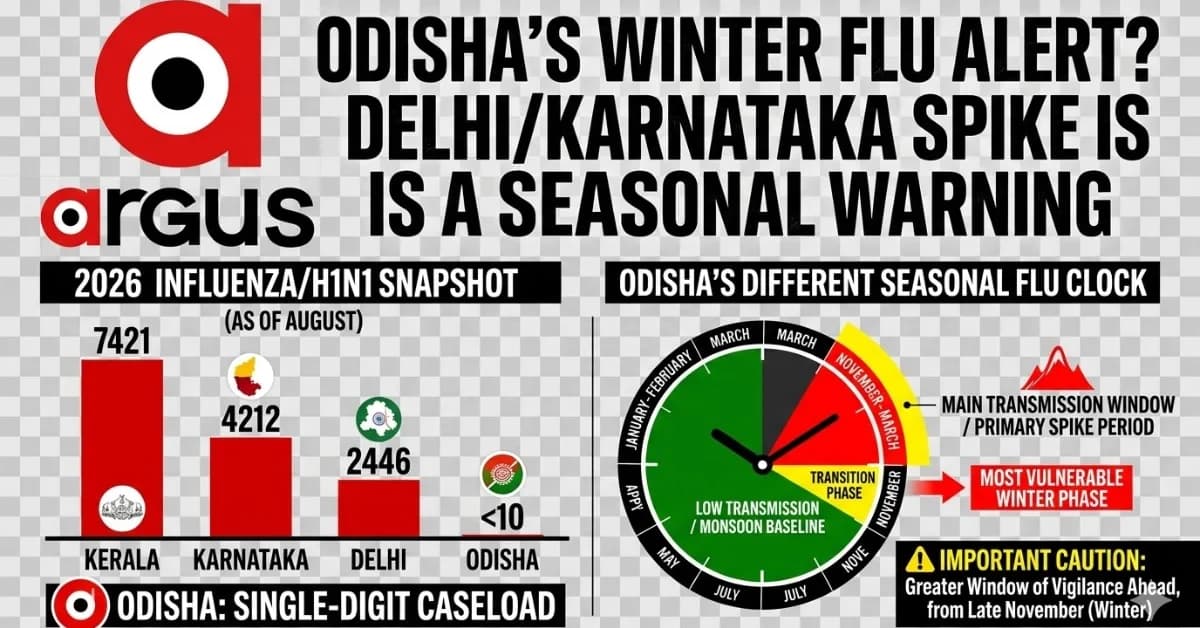
Bhubanewar: While Delhi and Karnataka are reporting a sharp rise in influenza A (H1N1) cases during the ongoing monsoon season, Odisha has so far remained largely untouched, recording only a single-digit caseload. But the low count may be less a sign of permanent immunity and more a reflection of Odisha's distinct influenza seasonality.
The key difference lies in the calendar of transmission. While Delhi, Karnataka and other high-burden states are witnessing their seasonal spike during the rainy season, historical surveillance indicates that Odisha's more significant H1N1 transmission window comes later – during the post-monsoon and winter months, broadly between November and March.
In other words, if the current surge in Delhi is being treated by experts as a seasonal influenza wave rather than a new public-health emergency, Odisha may simply be on a different seasonal clock.
Delhi, Karnataka Spike; Odisha Remains at Low Baseline
The contrast is striking. Delhi has reported around 2,446 confirmed H1N1 cases in 2026 up to late August, while Karnataka has recorded about 4,212 laboratory-confirmed influenza cases, with a significant H1N1 component. Odisha, by comparison, has remained in the single-digit range, with fewer than 10 reported H1N1 cases and no deaths.

📱 Get Argus News App
✨2026 Influenza/H1N1 Snapshot
|
State |
2026 Reported Cases |
Current Pattern |
|---|---|---|
|
Delhi |
2446 H1N1 cases |
Sharp active seasonal surge |
Karnataka
4,212 influenza cases
High burden; major concentration in Bengaluru
Kerala
7,421 influenza cases
Major seasonal surge with high overall burden
Maharashtra
350+ H1N1/influenza cases
Active monsoon transmission
Odisha
<10 H1N1 cases
Low seasonal baseline; no major clusters
However, direct comparison needs caution. States do not always report influenza data in the same format. Delhi's numbers more clearly isolate H1N1, while Karnataka and Kerala often report broader laboratory-confirmed influenza pools that may include H1N1, H3N2 and Influenza B.
That distinction aside, the larger epidemiological contrast remains clear: while several parts of India are currently dealing with a monsoon-season influenza wave, Odisha is still in its relatively quiet phase.
The Odisha Factor: A Different Seasonal Clock
Historical H1N1 surveillance suggests that Odisha follows a distinct seasonal pattern. The state may record sporadic infections at different points of the year, but its more prominent transmission period has traditionally been concentrated during the post-monsoon and winter season.
Odisha's Seasonal H1N1 Pattern
|
Period |
Historical Transmission Pattern |
Seasonal Status |
|---|---|---|
|
May–June |
Sporadic rise possible |
Minor/pre-monsoon activity |
|
July–October |
Low transmission |
Monsoon baseline |
|
Late October–November |
Cases may begin rising |
Transition phase |
|
November–March |
Main seasonal transmission window |
Primary spike period |
|
January–February |
Historically most vulnerable winter phase |
Potential peak window |
This means Odisha's current low H1N1 count in August broadly fits the state's historical epidemiological pattern.
Why Could Odisha's Spike Come in Winter?
The answer lies in a combination of climate and human behaviour.
During the winter months, lower temperatures and relatively drier conditions can improve the environmental stability and transmission efficiency of influenza viruses. People also tend to spend more time indoors, often in relatively poorly ventilated spaces. Greater indoor congregation can further facilitate respiratory virus transmission.
Thus, while the present monsoon conditions are associated with an active seasonal influenza wave in Delhi and several southern and western states, Odisha may see its more pronounced transmission later in the year.
Why the Seasonal Peaks Differ
|
Factor |
Delhi/Karnataka During Current Wave |
Odisha's Likely Winter Pattern |
|---|---|---|
|
Current season |
Monsoon |
Winter/post-monsoon |
|
Transmission trend |
Active surge |
Currently low |
|
Likely driver |
Seasonal influenza cycle and local climatic conditions |
Cooler, drier weather and indoor crowding |
|
Current public-health phase |
Managing active transmission |
Surveillance and preparedness |
|
Next key concern |
Containing ongoing cases |
Watching for rise from late November |
Delhi's Spike May Be Odisha's Winter Warning
The current spike in Delhi has not been linked to a dangerous new influenza mutation. The circulating influenza A activity has been described by experts as part of a seasonal pattern, rather than evidence of an entirely new pandemic-like threat. It is the A/Missouri/11/2025 strain stoking the cases in Delhi and Karantaka.
That is important for Odisha.
The state need not necessarily experience the same scale of outbreak merely because Delhi is reporting a surge.
IMPORTANT CAUTION: But the Delhi situation serves as an epidemiological reminder that seasonal influenza can build rapidly once local climatic conditions become favourable.
For Odisha, the greater window of vigilance may therefore lie ahead.
If the historical pattern repeats, health surveillance may need to intensify from late October or November, with particular attention to respiratory infections through January and February.
Odisha's Historical Numbers Remain Far Lower
Odisha's past H1N1 burden has generally remained significantly below that of major western and southern hotspots.
Odisha's Historical H1N1 Record
|
Year |
Reported Cases |
Deaths |
|---|---|---|
|
2019 |
206 |
5 |
|
2020 |
35 |
1 |
|
2021–2023 |
Very low, generally 0–42 |
Low/isolated |
|
2024 |
30 |
0 |
|
2025 (up to Sept 30) |
8 |
0 |
|
2026 (late August) |
Single digits |
0 reported |
The trend reinforces Odisha's position as a comparatively low-burden H1N1 state. Yet, the state's historical seasonality also suggests that August is too early to conclude that the year will remain quiet.
What Odisha Should Watch For
The current low count gives Odisha a window to prepare.
The crucial indicators to watch in the coming months would include:
Rising influenza-like illness and severe acute respiratory infection cases;
Increasing positivity among respiratory samples;
Cluster formation in schools, hostels and densely populated institutions;
Pressure on hospitals during December-February; and
Whether the ongoing national seasonal influenza activity persists into Odisha's winter transmission window.
The public-health message is therefore a simple one: Delhi and Karnataka are currently facing their seasonal influenza moment. Odisha's may still be ahead.
For
now, Odisha's single-digit H1N1 count stands in sharp contrast to the
high caseloads reported elsewhere. But if the current surge in Delhi
is indeed primarily seasonal, as experts indicate, Odisha's
historical pattern suggests the state may see its own seasonal rise
when the calendar turns towards winter.
Also Read: Don’t Give Your Toddler That 'Branded' Cold Syrup: Why a Once-Recommended Medicine Was Finally Restricted in 2026| Explainer
Related Topics
Explore more stories