



From 300-km Cancer Journey to Treatment at Village Doorstep: Odisha’s Cancer Care Van Bet to shoot down high Drop-out Rates in State| Special Report
Key Points
Odisha's projected cancer cases reach 56,514 in 2025, with Western Odisha districts like Bargarh accounting for a heavy regional burden.
Historically, rural patients faced a gruelling 300-kilometre journey to Cuttack, causing severe financial strain, wage loss, and high treatment drop-out rates.
State Health Minister Dr. Mukesh Mahaling announced that follow-up chemotherapy can now be availed via Cancer Care Vans deployed at block-level Community Health Centres.
Bhubaneswar: For a cancer patient in rural Odisha, the disease is only half the battle. The other half is getting to treatment.
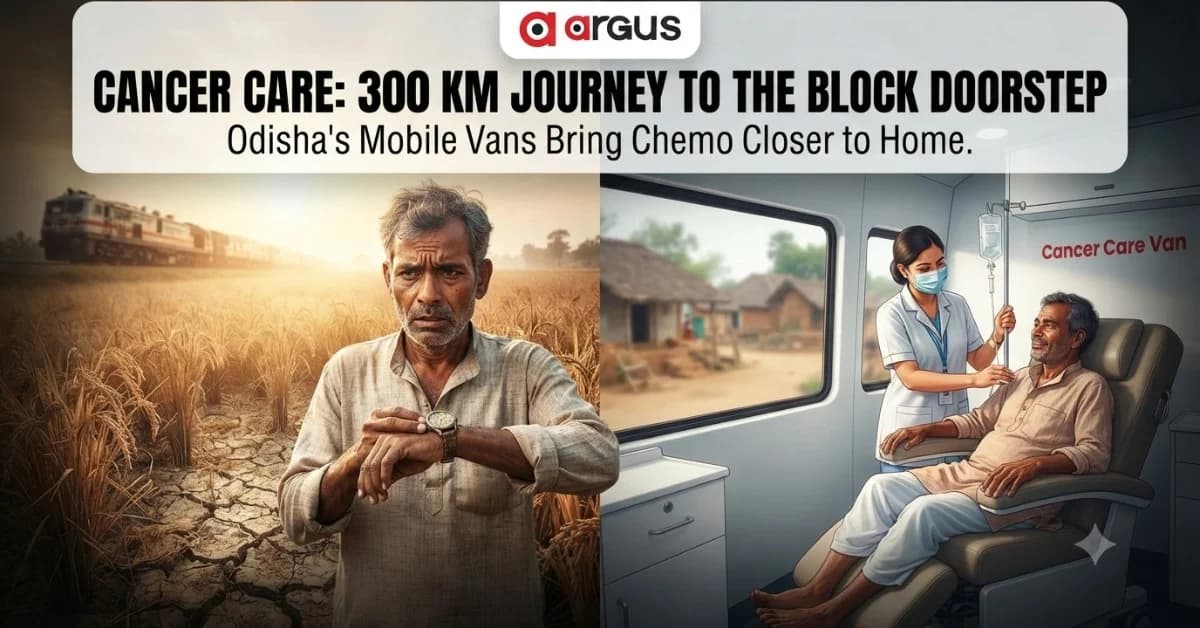
Sample this. It is midday in a village in Bargarh district. The rice fields outside are dry under the September heat.
Fifty-two-year-old Nabakishore Pradhan (name changed), a marginal paddy farmer, is not looking at the sky today.
He is looking at his watch.
It is the day of his third follow-up chemotherapy cycle for advanced gastric (stomach) cancer.

📱 Get Argus News App
✨For Nabakishore, however, the biggest change is not the chemotherapy drug being administered.
It is the distance he has to travel to receive it.
Till to date, a chemotherapy appointment meant a journey of nearly 300 kilometres to Cuttack, usually involving a crowded passenger train, a family member accompanying him, lost days of farm work and additional expenditure on food and accommodation.
For a low-income rural family, cancer treatment therefore became a double burden: the cost of the disease itself and the cost of repeatedly reaching the place where the disease could be treated.
And that distance can determine whether a patient completes treatment at all. All this result in high dropu-out rates in Chemo-threapy sessions in the State.
When treatment becomes a question of distance
Cancer care is often discussed in terms of hospitals, doctors, medicines and technology.
But for a marginal farmer, another number can matter just as much:
How far is the next chemotherapy session?
The ICMR-National Cancer Registry Programme (NCRP) estimates Odisha's projected cancer incidence at 56,514 cases in 2025.
That places Odisha among India's high-burden states, ranking 11th nationally in absolute projected cases, according to the available NCRP figures.
More importantly, cancer is not distributed evenly across the state.
Western Odisha has emerged as a particularly important cancer belt, with institutional data from VIMSAR, Burla, showing Bargarh accounting for 26.34% of the region's reported cancer prevalence, followed by Sambalpur at 24.58%.
Balangir accounts for 10.81%, Sonepur 9.68% and Jharsuguda 7.64%.
Together, these five districts account for nearly 79% of the reported cancer burden in Western Odisha in the cited institutional dataset.
The cancer profile also differs geographically.
While the coastal belt sees a high volume of cases, including oral cancers among men and breast and cervical cancers among women, Western Odisha has a particularly prominent burden of gastrointestinal and head-and-neck malignancies.
For a farmer like Nabakishore, that geography matters.
Because a cancer centre may exist in the state, but if every follow-up chemotherapy cycle requires another long-distance journey, access remains incomplete.
The hidden mathematics of cancer
The human cost becomes clearer when the patient profile is examined.
An AHRCC cohort study has earlier found that farmers constituted 34.8% of male cancer patients, making them the single largest professional group in that cohort.
Nearly 72.7% of the families belonged to the low-income category.
That creates a particularly vulnerable treatment chain.
A farmer who travels hundreds of kilometres for a four-hour chemotherapy session is not merely paying for transport.
He may lose a day's agricultural work.
A family member may lose a day's wages accompanying him.
There may be food expenses, accommodation costs and local transportation.
When those costs repeat every few weeks, treatment itself can become financially unsustainable.
That is where Odisha's emerging Cancer Care Van model attempts to change the equation.
The journey that now stops at the CHC
Wednesday the announcement made by State Health Minister Dr Mukesh Mahaling flashes a ray of hope for people like Nabakishore. The Minister has today declared that after first chemotheraphy at AHRRC, subsequent chemo sessions may be availed at the Cancer care vans at CHCs (Community Health Centres) at the block level.
So for poor farmers or low income group representative like Nabakishore Pradhan, the first journey to Cuttack does not disappear.
The initial diagnosis, staging and high-risk first chemotherapy cycle still require a specialist cancer centre or major medical facility.
But once his treatment protocol is established and he is clinically stable, the subsequent cycles can be brought much closer to home.
His treatment record is digitally linked to the healthcare network.
Instead of travelling back to Cuttack for every follow-up cycle, he can now reach his local Community Health Centre (CHC).
The difference is enormous.
What was once a 300-kilometre journey becomes a short local trip.
For some patients, it can mean walking to the designated health facility rather than boarding a train.
And inside the Cancer Care Van, the treatment is not reduced to a basic mobile medical camp.
It is designed as a mobile day-care oncology unit.
Inside the van
The vehicle is essentially a compact chemotherapy facility on wheels.
Specialised chemotherapy administration recliners allow patients to receive their infusion in a controlled environment.
A laminar airflow hood or biosafety cabinet is used for the safe preparation of toxic chemotherapy medicines, helping protect healthcare workers and the surrounding environment.
The van also incorporates critical support systems such as:
chemotherapy administration facilities;
cold-chain storage for medicines requiring controlled temperatures;
emergency equipment and crash-cart facilities;
trained oncology nursing support;
pharmacist/chemotherapy-mixing personnel;
data coordination and digital treatment records; and
tele-consultation or remote specialist supervision.
The idea is not to turn every village into a cancer hospital.
It is to take the routine, protocol-driven part of cancer treatment closer to the patient, while retaining the specialist hospital as the higher-level hub.
For Nabakishore, that means sitting in a chemotherapy chair while the nurse connects his IV drip, with his own neighbourhood outside the vehicle.
The hospital has not moved.
But the treatment has moved closer to him.
The Hub-and-Spoke cancer network
This is the fundamental structural change.
The system works through three layers.
The hub remains the tertiary cancer centre (AHRCC) or major medical college (SCB, VIMSAR, MKCG) where diagnosis, staging and the initial high-risk treatment decisions are made.
The fixed spoke is the district-level Day Care Cancer Centre, where routine chemotherapy can be administered without requiring a tertiary hospital visit.
The mobile spoke is the Cancer Care Van, which takes that decentralized capability one step further by travelling from district infrastructure to selected rural healthcare locations.
In other words, Odisha is attempting to solve two different distance problems.
The Day Care Cancer Centre reduces the distance between the patient and the major medical colleges & hospitals, as failities are opened at DHHs.
The Cancer Care Van attempts to reduce the distance between the patient and even that district hospital. (DHHS)
Odisha's cancer burden is rising
The urgency is also visible in the NCRP trajectory supplied in the inputs.
|
Year |
Projected cancer cases in Odisha |
|---|---|
|
2021 |
51,829 |
|
2022 |
52,960 |
|
2023 |
54,136 |
|
2024 |
55,335 |
|
2025 |
56,514 |
From 2021 to 2025, the projected annual caseload increased by 4,685 cases.
That rising burden makes a purely centralised cancer-care model increasingly difficult.
The answer, therefore, is not simply to build bigger hospitals.
It is also to create a system in which hospitals can concentrate on complex cases while stable patients receive appropriate follow-up care closer to home.
Why this matters beyond convenience
The Cancer Care Van is not merely a transport-saving intervention.
Its biggest potential impact is on treatment continuity.
Cancer chemotherapy is rarely a one-time procedure. Many treatment protocols require multiple cycles at defined intervals.
If every cycle involves a long journey, the logistical burden accumulates.
A patient may initially begin treatment with determination but later stop returning because the family cannot repeatedly absorb the cost.
For low-income agricultural households, the decision can become particularly painful: another hospital trip or another day of work in the field.
By bringing follow-up treatment closer, the mobile model attacks that logistical barrier.
It can potentially reduce:
travel expenditure → wage loss → accommodation burden → treatment fatigue → missed cycles → treatment dropout.
That is the real significance of the van.
A treatment system designed around the patient
The broader rollout across Odisha's 32 District Headquarters Hospitals is therefore more than an infrastructure expansion.
It represents a shift in the cancer care model.
The traditional model asks:
How does the patient reach the cancer hospital?
The decentralized model asks:
How much of the treatment can safely reach the patient?
That distinction is particularly important in a state where large rural populations remain separated from tertiary medical centres by hundreds of kilometres.
For patients requiring complex surgery, advanced diagnostics, radiation or specialist intervention, the tertiary centre will remain indispensable.
But for clinically appropriate follow-up chemotherapy, the distance can potentially be reduced dramatically.
The Bottomline: With one of the biggest barriers surrounding the treatment – distance – has been reduced.
And
for a rural family fighting a disease that demands repeated hospital
visits, that can make the difference between starting treatment and
completing it.
Also Read: Scrub Typhus Surge in Angul Sparks Calls for Urgent Preventive Actions in Neighbouring Districts| Special Report
Related Topics
Explore more stories