



EXCLUSIVE| NSO Survey on Odisha Healthcare: Cross-District Medical Travel Highlights Hidden Out-of-Pocket Expenses
Key Points
High Cross-District Movement: Odisha recorded 15,649 overnight medical trips, with 450 out of every 1,000 such journeys crossing district boundaries internally.
Rural Travel Burden: Approximately 80.3% of the state's 365-day overnight travel originates from rural areas, heavily exposing rural households to logistical and accommodation expenses.
Decentralization Challenge: Despite lower direct hospital costs, the concentration of specialized infrastructure in urban hubs forces patients to travel, shifting the financial burden to accommodation and transit.
Bhubaneswar: Odisha’s healthcare story may have a number that has largely escaped attention: medical treatment is making people travel.
And the latest overnight-trip data analysed from the National Statistical Office (NSO) points to a deeper problem than the hospital bill itself.
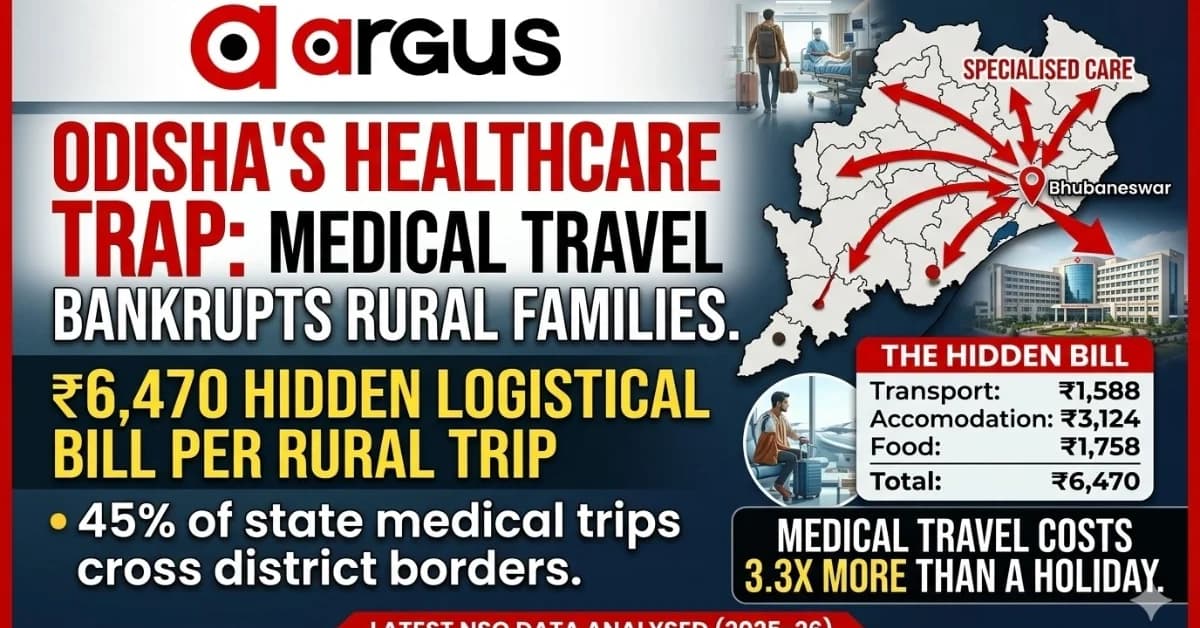
Odisha recorded 15,649 (13,661 rural + 1988 urban) overnight trips for health and medical purposes, with 450 out of every 1,000 such trips involving movement across district boundaries while remaining within the state. That means roughly 45% of these medical journeys are intrastate, cross-district movements.
For a state that has expanded public health coverage and attempted to reduce the direct financial burden of treatment, the finding raises a different question:

📱 Get Argus News App
✨If treatment is becoming more financially accessible, why are so many patients still required to leave their own districts for medical care?
The answer suggested by the expenditure data is geographical.
The burden of healthcare is increasingly shifting from the hospital counter to the road, the rented room and the family's daily expenses outside the hospital.
The 45% signal: Odisha's healthcare map is still uneven
The most striking number in the overnight-trip data is not merely the total number of medical journeys.
It is the 450-per-1,000 cross-district ratio.
|
Indicator |
|---|
Odisha
Overnight health/medical trips
15,649
Trips crossing district boundaries but remaining within Odisha
450 per 1,000
Approximate share
45%
Share of 365-day travel originating in rural areas
80.3%
The 80.3% rural-origin figure becomes important when read alongside the cross-district movement. It suggests that the people bearing a significant part of this travel burden are not simply urban patients moving between hospitals within a city; a large share of the travel ecosystem originates in rural areas.
That changes the meaning of a medical trip.
For a rural household, accessing specialised healthcare may involve transport, accommodation, food, loss of working days and the cost of keeping accompanying family members in the city.
In other words, the healthcare bill does not necessarily end when the patient reaches the hospital.
Odisha's medical-trip bill: the hidden cost is outside the hospital
The expenditure comparison in the NSO-linked analysis provides another important clue.
Average expenditure on overnight medical trips
|
State/Region |
Transport |
Accommodation |
Clinical/Medical Cost |
Total Medical Trip |
Logistical Share* |
|---|---|---|---|---|---|
|
Odisha |
₹2,096 |
₹4,684 |
₹29,936 |
₹41,649 |
16.3% |
|
Andhra Pradesh |
₹1,588 |
₹3,124 |
₹21,480 |
₹29,454 |
16.0% |
|
West Bengal |
₹2,525 |
₹1,910 |
₹23,361 |
₹32,167 |
13.8% |
|
Jharkhand |
₹3,486 |
₹2,166 |
₹4,997 |
₹16,420 |
34.4% |
|
Chhattisgarh |
₹1,886 |
₹1,740 |
₹8,284 |
₹15,561 |
23.3% |
|
All-India average |
₹1,701 |
₹3,471 |
₹23,361 |
₹32,167 |
16.1% |
*Logistical
share = transport + accommodation as a proportion of total
expenditure.
The Odisha figure deserves particular attention.
The state records an average accommodation expenditure of Rs4,684 per overnight medical trip in this comparison – the highest among the listed neighbouring states and the all-India average shown in the table.
That is a significant indicator because accommodation is not a clinical expense.
It is a consequence of having to remain away from home.
The data therefore opens a different window into Odisha's healthcare geography: the patient may receive treatment at a subsidised or comparatively affordable cost, but the family may still have to pay heavily to stay near the treatment centre.
The Odisha paradox: lower hospital cost, higher displacement burden
The analysis of out-of-pocket hospital expenditure in the NSO tables places Odisha's average hospital expense per case at Rs16,948 (released in June/July2026 see the link below), against a national average of Rs34,064.
But that relatively lower direct clinical burden sits alongside substantial travel-related expenditure.
This is where the 450-per-1,000 cross-district medical-trip figure becomes important.
A patient may not necessarily be travelling because treatment inside Odisha is unaffordable.
The patient may be travelling because the required treatment is not available close enough to home.
That is a fundamentally different healthcare problem.
The two sides of Odisha's healthcare equation
|
What has improved/exists |
What the travel data exposes |
|---|---|
|
Lower direct hospital expenditure cited in the analysis |
Large volume of overnight medical travel |
|
Public health schemes reduce some clinical costs |
Families still pay for transport and accommodation |
|
Hospital-based financial protection |
Protection may not cover the full cost of reaching and staying near the hospital |
|
Major tertiary-care institutions |
Their geographical concentration can pull patients from distant districts |
|
Expanding healthcare network |
District-level availability of advanced/specialised care remains an equity question |
The interpretation, therefore, is not that Odisha has no healthcare infrastructure.
It is that healthcare access and healthcare infrastructure are not necessarily distributed in the same geography.
₹6,470 before counting the treatment bill
The national rural medical-trip expenditure breakdown makes the hidden burden even clearer.
|
Expense |
Rural medical trip |
|---|---|
|
Transport |
₹1,588 |
|
Accommodation |
₹3,124 |
|
Food & drink |
₹1,758 |
|
Total logistical/associated spending |
₹6,470 |
|
Medical/health activities |
₹21,480 |
|
Total average trip expenditure |
₹29,454 |
The Rs6,470 figure is particularly revealing.
It is the amount represented by transport, accommodation and food in the rural medical-trip expenditure profile – before considering the actual medical/health component.
This is the hidden economics of medical migration.
A health insurance card can potentially address the hospital-side expenditure.
But the patient still has to reach the hospital.
And an accompanying family member still has to eat and sleep somewhere.
That distinction is central to understanding why a household can have substantial health coverage and yet face financial stress during a serious medical episode.
Medical travel costs 3.3 times a rural holiday
The contrast with leisure travel makes the scale easier to understand.
|
Type of rural trip |
Reference period |
Average expenditure |
|---|---|---|
|
Health & medical |
Last 365 days |
₹29,454 |
|
Holidaying/leisure/recreation |
Last 365 days |
₹8,890 |
|
Social/visiting friends & relatives |
Last 30 days |
₹2,123 |
On these figures, an average rural medical trip costs about 3.3 times a leisure trip and about 13.9 times a social visit.
But the comparison needs an important qualification.
A holiday is discretionary.
A serious medical journey generally is not.
A family can shorten a vacation, reduce discretionary spending or return home earlier.
A family confronting surgery, cancer treatment, specialised diagnostics or prolonged hospitalisation cannot simply reduce the treatment duration because accommodation has become expensive.
That makes medical travel an unusually inelastic household expense.
Why accommodation becomes the hidden healthcare expense
The expenditure components reveal another striking difference.
|
Component |
Medical |
Leisure |
Social |
|---|---|---|---|
|
Accommodation |
₹3,124 |
₹1,255 |
₹16 |
|
Food & drink |
₹1,758 |
₹1,524 |
₹315 |
|
Transport |
₹1,588 |
₹2,545 |
₹504 |
|
Medical/health activity |
₹21,480 |
₹129 |
₹42 |
Accommodation on a rural medical trip is about 2.5 times the leisure-trip figure in the data presented.
The reason is structural: medical travel can require patients and attendants to remain near hospitals for extended periods, whereas social travel often involves staying with relatives and leisure travel is generally planned around budget and duration.
The transport number tells a similar story from another direction.
Medical-trip transport expenditure is lower than leisure travel in the national rural comparison, but substantially higher than social travel.
That suggests medical travel is not necessarily about covering the greatest physical distance.
It is about travelling because treatment requires it.
Odisha's real healthcare challenge may now be decentralisation
The overnight-trip data therefore shifts the policy conversation from a simple question of how much Odisha spends on healthcare to another question:
Where is that healthcare capacity located?
The analysis identifies that specialised medical infrastructure remains concentrated around major urban centres, particularly the Bhubaneswar-Cuttack corridor, creating a pull factor for patients from outer districts.
The policy implication is straightforward:
More hospital beds are not necessarily enough.
If specialised procedures remain geographically concentrated, the patient still has to travel.
A district hospital that can diagnose a disease but cannot perform the required surgery does not eliminate medical migration.
A hospital that can stabilise a patient but cannot provide specialised cardiac, oncology or nephrology care may still leave the family with the same travel problem.
Therefore, the next phase of healthcare expansion has to be measured not only by beds, insurance cards or expenditure, but also by how far patients have to travel for different categories of treatment.
What the 450-per-1,000 figure really tells Odisha
The most important finding in the NSO overnight-trip data is therefore not simply that Odisha has medical tourists.
It is that medical necessity itself is generating substantial internal mobility.
The data chain
15,649 overnight medical trips
↓
450 out of every 1,000 cross district borders within Odisha
↓
80.3% of the 365-day travel originates from rural areas
↓
Accommodation becomes a major associated expense
↓
Transport + accommodation + food add ₹6,470 to the average rural medical journey nationally
↓
Healthcare access becomes a geographical as well as financial question
This is why the overnight-trip numbers matter.
They provide a measure of something conventional hospital expenditure statistics often fail to capture:
The distance between a patient and the healthcare they need.
Bottom Line
Odisha's healthcare challenge is no longer adequately described by the question of whether a patient can afford the hospital bill.
The NSO overnight-trip numbers point towards a second, less visible burden: whether the patient can afford to reach the hospital, remain near it and keep the accompanying family financially afloat.
With 450 out of every 1,000 medical overnight trips crossing district boundaries within Odisha, the data provides a measurable signal of healthcare mobility inside the state.
And when that is read alongside the expenditure data, a larger policy question emerges:
Should
the next healthcare expansion be judged only by how much treatment
costs inside hospitals – or also by how many kilometres a patient
has to travel to obtain it?
Also Read: NSSO Survey Unravels Odisha Tourism Paradox: Inside Why State Lags Behind Andhra Pradesh in Interstate Pilgrimage Footprint
Related Topics
Explore more stories