



EXCLUSIVE EXPLAINER| Will Modi Govt’s Medical Treatment Rate Card Display Put Fullstop on Odisha Private Hospitals “Operation Bill Spike”?
Key Points
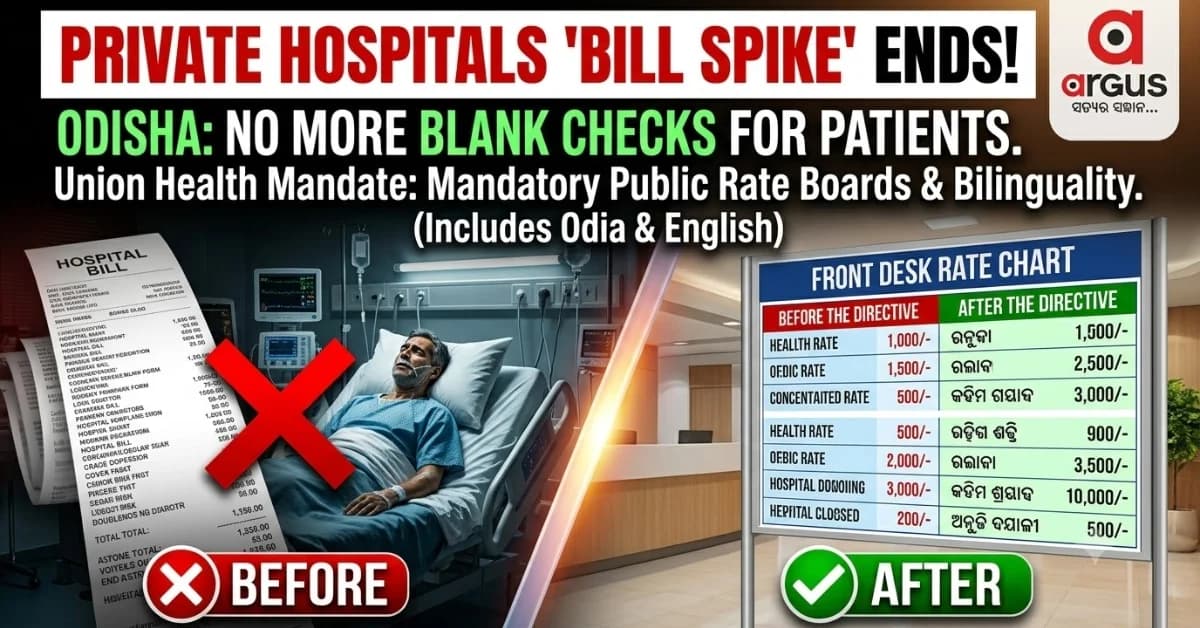
Bilingual Rate Boards: Private hospitals must display clear service and facility rates in both Odia and English at front desks.
End of Hidden Fees: Any unlisted rate or unvouched consumable fee not displayed on public boards loses legal enforceability on final invoices.
Strict Statutory Enforcement: District Collectors and CDMOs empowered to conduct surprise audits and suspend licenses for price mismatches.
Bhubaneswar: For decades, navigating a private hospital admission in Odisha has felt less like accessing essential healthcare and more like signing a blank check under duress. When a patient is wheeled into an intensive care unit (ICU) in Bhubaneswar or Cuttack, family members are rarely focused on financial line items; they are consumed by panic.
It is only at the point of discharge that the second trauma occurs: an itemized bill that stretches for pages, populated by cryptic abbreviations, unvouched consumables, and inflated diagnostic charges.
Monday Modi govt signals The End to the private hospitals ‘Operation Bill Spike’?
In a sweeping intervention, the Union Ministry of Health and Family Welfare has issued a directive to all States and Union Territories, including Odisha, demanding the mandatory, prominent, and bilingual display of service rates and facilities by all clinical establishments.

📱 Get Argus News App
✨While critics often dismiss administrative letters as bureaucratic paperwork, this directive strikes directly at the structural asymmetry of private hospital billing.
By forcing healthcare providers to anchor their prices publicly before treatment begins, this mandate alters the legal and operational dynamics of healthcare delivery across Odisha.
Modus Operandi of “Operation Bill Spike”– Understanding the "Before"
To understand why this directive is a fundamental shift, one must examine the operational landscape that existed in Odisha prior to this mandate.
Historically, private clinical establishments operated within a pricing vacuum. Under the original Odisha Clinical Establishments (Control and Regulation) Act of 1991, the state focused heavily on infrastructural licensing – such as bed counts, pollution control certificates, and fire safety clearances – while leaving financial mechanics largely unregulated.
This lack of structural transparency allowed private entities to rely on four primary tactics to systematically inflate patient bills:
1. The Pharmacy Monopoly
Hospitals routinely barred patients from sourcing external medicines or surgical consumables. Once admitted, an inpatient was captive to the hospital’s internal supply chain.
As stated recently in high-profile judicial reviews, life-saving drugs or specialized surgical equipment with low wholesale trade values were routinely billed to patients at astronomical maximum retail prices (MRPs), yielding profit margins exceeding several hundred percent for the institution. Patients had no reference rates to challenge these charges before the bills were finalized.
2. Micro-Consumable Markups
The true inflation of a medical bill rarely came from the cost of the room alone; it accumulated through the aggressive bundling of unlisted micro-consumables.
Families were charged exorbitant fees for basic items like disposable gloves, syringes, cotton swabs, and specialized needles (such as Jamshidi needles used in bone marrow procedures). Because these items were never listed on any front-desk brochure, hospitals could scale their pricing arbitrarily based on the financial profile of the patient or the overall length of stay.
3. The ICU Rolling-Charge Loophole
The intensive care unit has long been the most opaque financial zone in private medicine. Hospitals managed to inflate bills by failing to separate the basic room rent from procedural costs.
A family might be quoted an ICU bed rate of Rs5,000 per day, only to discover at discharge that they were billed an additional Rs15,000 per day for "intensive monitoring," "nursing supervision," and "ventilator handling." Furthermore, by delaying discharge protocols or withholding clinical clearance documentation, facilities could roll over these hourly charges indefinitely, forcing grieving families into financial crises before releasing a patient or a body.
4. Insurance Up-Coding
With the expansion of state-sponsored cashless insurance schemes, such as the Gopabandhu Jan Arogya Yojana (GJAY), certain private hospitals shifted their targets from out-of-pocket individuals to the state exchequer.
Hospitals engaged in "up-coding"– deliberately altering clinical records to classify a standard, low-cost medical intervention under a complex, high-paying surgical package code. Because the patient did not see the data transmitted to the state insurance portal, this institutional fraud occurred entirely in the dark.
The Paradigm Shift – What Changes Now
The central directive fundamentally alters this dynamic by establishing a statutory baseline. By invoking the Clinical Establishments (Central Government) Rules, 2012, the Union government is requiring every hospital to transform its administrative lobby into a transparent marketplace.
THE STRUCTURAL SHIFT
🔴 BEFORE THE DIRECTIVE
Hidden Pricing: Discovered only at the time of discharge.
Arbitrary Markups: On internal medical consumables & pharmacy.
Opaque ICU Fees: Delay tactics masked by "monitoring & nursing" charges.
Up-coding Fraud: Hidden within state-sponsored scheme billing.
Consumer Burden: Patient required to prove unfair overcharging.
🟢 AFTER THE DIRECTIVE
Bilingual Rate Charts: Mandatory display at front desks (Odia & English).
Anchored Pharmacy Rates: All consumables and drug prices publicly fixed.
Exposed Facility Caps: Itemized hourly/daily ICU limits shown publicly.
Synchronized Packages: Public package rates matched directly with real care.
Automatic Violation: Rate mismatch forms an automatic statutory/regulatory issue.
This structural shift introduces three major protections for patients:
- The Bilingual Mandate: In Odisha, rate charts cannot be buried in small print or presented exclusively in technical English. The directive mandates that all prices be displayed conspicuously in both Odia and English. This ensures that rural families traveling from districts like Kalahandi, Mayurbhanj, or Balasore to corporate medical hubs in Bhubaneswar can read, understand, and verify costs without requiring an administrative translator.
- The Invalidation of Hidden Fees: If a service, procedure, or facility fee is not displayed on the public rate board at the entrance of the clinical establishment, the hospital loses the legal right to include it in the final invoice. Any deviation between the publicly displayed price and the final itemized bill constitutes an immediate, open-and-shut regulatory violation.
- The Shifting Burden of Legal Proof: Previously, when an aggrieved family approached the District Consumer Disputes Redressal Commissions in Khurda or Cuttack to challenge an inflated bill, the legal burden was on the consumer to prove that a charge was "unfair" or "unreasonable." The hospital could counter by claiming the fees reflected standard internal protocols. Under the new directive, a mismatch between the public board and the final bill serves as automatic proof of a statutory violation, streamlining judicial relief for families.
Operationalizing Enforcement – The New Mandate for Ground Authorities
Because health is constitutionally designated as a State subject, the ultimate success of this initiative depends entirely on how the Government of Odisha enforces it on the ground. This requires a complete overhaul of how district-level healthcare administrators operate.
CHAIN OF COMMAND & ACTIONS
Step 1: Odisha Dept. of Health & Family Welfare
State-level policymaking and directive authority.
Step 2: District Collector (DC)
Responsible for administrative enforcement at the district level.
Step 3: Chief District Medical Officer (CDMO)
Conducts clinical and field audits on healthcare facilities.
Step 4: Mandatory Key Actions
· Bill Verification: Cross-checks actual patient bills against displayed rate charts.
· Audit Investigation: Examines "supply-induced test demand" and unnecessary testing.
· Strict Penalties: Issues immediate license suspensions for rate mismatches.
The Historical Role: Passive Registrars
Historically, the District Collector (DC), acting as the chair of the District Supervising Authority, and the Chief District Medical Officer (CDMO) functioned primarily as passive registrars. Their duties regarding private healthcare providers were largely clerical:
- Processing initial registration applications and collecting statutory fees.
- Verifying physical infrastructure during scheduled, pre-announced annual renewals.
- Intervening only when a major public crisis occurred, such as a fire or a fatal medical negligence protest that disrupted public order.
Financial auditing, billing verification, and the monitoring of consumer exploitation were viewed as outside their regulatory domain.
The New Mandate: Active Financial and Regulatory Auditors
Under the central directive, the DC and the CDMO must pivot from administrative observers to active compliance officers.
- The District Collector’s New Mandate: As the administrative head, the DC must issue clear state advisories making rate displays a non-negotiable condition for retaining a clinical establishment license. The DC has the legal authority to authorize surprise inspections, freeze the registration renewals of non-compliant hospitals via the online, and levy significant financial penalties on institutions that hide pricing data.
- The CDMO’s New Mandate: The CDMO’s office must transition into a field audit unit. Beyond checking if a hospital has the correct number of beds, medical inspectors must actively verify that pricing boards are placed in highly visible areas like reception desks, emergency bays, and billing counters.
Confronting the Next Frontier – "Supply-Induced Demand"
While the central directive provides a strong defense against arbitrary price hikes, it faces one major operational challenge: the volume loophole.
As veteran healthcare analysts note, a hospital can fully comply with the law by listing a blood test at exactly Rs500 on its public board. However, once a patient is admitted, the hospital can easily bypass the financial restrictions of that fixed price by instructing its doctors to order ten unnecessary variations of that blood test.
This tactic – known as supply-induced demand – allows providers to keep inflating the final bill even while strictly adhering to their posted rate charts.
To close this loophole and fully protect patients, Odisha must implement a two-pronged strategy that goes beyond simple price transparency:
1. Mandatory Digital Synchronization
The state should mandate that every private hospital link its internal billing software directly to the state's clinical registry portal. The prices displayed on a physical board in a lobby must match the digital prices fed into the hospital's billing systems. This ensures that no hidden "system codes" can be generated during final billing to add unauthorized operational or administrative costs.
2. Independent Medical Auditing Commissions
The Directorate of Medical Education & Training (DMET) in Odisha must establish independent medical audit boards at the district level. When a patient files a complaint regarding an inflated bill, these boards must look beyond whether the individual prices were accurate and review the clinical necessity of the treatments provided. If an audit reveals that a hospital systematically ordered unnecessary scans, excessive laboratory panels, or irrelevant diagnostics for a stable patient, the institution must be penalized for unethical trade practices.
Bottomline: The Path Forward for Odisha
The Union Health Ministry’s directive is a critical step forward, but it is not a self-executing solution.
For the people of Odisha, this mandate provides the legal tools needed to fight back against predatory medical practices. It shifts the power dynamic from corporate healthcare networks back to the patients and their families.
However, the true test of this reform will take place in the corridors of the state's private medical centers and within the administrative offices of its District Collectors and CDMOs. If the Government of Odisha treats this directive as a routine paperwork update, private facilities will quickly find workarounds.
But if the state uses this
moment to launch rigorous field audits, enforce strict digital pricing
synchronization, and protect consumer rights through the District Supervising
Authorities, it can build a more transparent, accountable, and patient-centered
healthcare system for all its citizens.
Also Read: EXCLUSIVE| NSO Survey on Odisha Healthcare: Cross-District Medical Travel Highlights Hidden Out-of-Pocket Expenses
Related Topics
Explore more stories