



Bollywood Politics / Ranveer Singh vs FWICE: Why the Don 3 Fallout Could Become Bollywood’s Biggest Power-Struggle Test in Years| Analysis
Key Points
Bhubaneswar: The controversy surrounding Ranveer Singh and the indefinitely delayed Don 3 project is no longer just another Bollywood scheduling dispute. It is rapidly turning into a larger confrontation over power structures inside the Hindi film industry, the legality of unofficial “bans,” and whether traditional pressure groups can still dictate the fate of A-list stars in the streaming and global-distribution era.
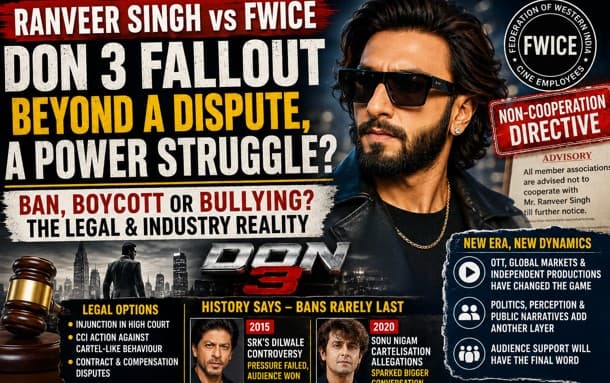
The Federation of Western India Cine Employees (FWICE) recently issued a non-cooperation directive against Ranveer Singh after producers linked to Don 3 reportedly accused the actor of stepping away from the project following prolonged delays and major financial commitments. Industry estimates suggest the film may already have incurred holding and pre-production losses of nearly ₹45 crore.
At the centre of the storm is filmmaker and FWICE advisor Ashoke Pandit, who has publicly defended the federation’s position. However, Pandit also made a crucial clarification - FWICE has not imposed a formal “ban,” but has merely advised affiliated workers and technicians not to cooperate with the actor until the dispute is resolved.
That
distinction is legally significant.
How Legal Is FWICE BAN

📱 Get Argus News App
✨Under Indian law, entertainment unions cannot officially prevent an actor from working. Legal experts frequently cite earlier Bombay High Court rulings that held film associations and trade bodies cannot interfere with an individual’s constitutional right to livelihood or stop producers from hiring artists of their choice. The Competition Commission of India (CCI) has also, in the past, examined allegations of anti-competitive conduct within entertainment associations, especially in cases involving collective boycotts or coercive industry practices.
This opens
multiple legal pathways for Ranveer Singh if the confrontation escalates
further. And this reminds one of the famous Dhurandar Dialogue.
Agar Tum Logon Ke Pataake Khatam Ho Gaye Ho Toh, Main Dhamaaka Shuru Karoon
In such a scenario, his legal team could seek an injunction before the Bombay High Court by arguing that any coordinated refusal to work with him violates Article 19(1)(g) of the Constitution, which guarantees the freedom to practice any profession. Producers associated with Ranveer’s future projects may also approach the CCI if they believe the federation’s actions are disrupting productions or causing commercial losses through collective pressure tactics.
There is another layer as well - contractual fallout. If scheduled productions are delayed because technicians or affiliated workers refuse participation, insurance disputes, breach-of-contract claims, and compensation battles could emerge between producers, insurers, and industry bodies.
This is
precisely why many trade analysts believe the current confrontation is unlikely
to evolve into a sustained industry-wide isolation campaign. Bollywood’s
history suggests that informal “bans” often weaken once commercial realities
begin colliding with institutional pressure.
Bans Work in Bollywood?
The closest parallel remains the 2015 controversy involving Shah Rukh Khan during the release of Dilwale. Following comments linked to the intolerance debate, sections of political groups and exhibition networks mounted pressure campaigns against the actor. Some theatres faced intimidation, distributors feared losses, and calls for boycotts intensified across several states.
Yet the backlash ultimately failed to isolate Shah Rukh because the economics of stardom proved stronger than organised outrage. Major studios, distributors, and exhibitors eventually prioritised box-office viability over political pressure.
A second
precedent emerged in 2020 when singer Sonu Nigam publicly alleged cartelisation
and lobbying networks within Bollywood’s music industry. Although the claims
triggered fierce resistance from influential industry circles, the controversy
ultimately expanded into a broader debate over monopolistic behaviour rather
than ending Nigam’s career.
Why Ban is Passe In Bollywood Now
That larger structural shift is central to understanding why Ranveer Singh’s case may not resemble the old-era “industry exile” model.
Bollywood today is far less centralized than it was two decades ago. The rise of OTT platforms, pan-India distribution systems, international financiers, brand partnerships, and independent production houses has fragmented the traditional studio-union power ecosystem. A-list actors are no longer dependent on a single production network or industry bloc for survival.
In many
ways, the economics of the entertainment business have changed faster than the
industry’s internal power structures.
Politics Behind Ban ?
What complicates the current controversy, however, is the political narrative that has exploded online. Ranveer Singh’s recent visit to the RSS headquarters and the Hedgewar memorial triggered intense ideological reactions across social media platforms, with rival camps quickly attempting to frame the Don 3 fallout through political lenses.
There is no evidence directly linking those visits to the FWICE action. Yet the timing fuelled speculation that the controversy had evolved beyond contractual disagreements and entered the realm of ideological perception warfare — something Bollywood increasingly finds difficult to separate from business disputes in the social-media age.
The industry now appears sharply divided.
One camp argues that stars must be held accountable for delaying high-budget projects after producers commit massive investments. The opposing camp warns that collective pressure tactics by unions or associations risk creating an atmosphere of institutional intimidation that could damage the industry’s professional credibility.
But Bollywood history continues to offer one consistent lesson: no unofficial “ban” survives for long if audiences, financiers, and distributors continue backing the star at the centre of the controversy.
And that may
ultimately decide Ranveer Singh’s future far more than any industry directive.
Also Read: Bhojpuria Bollywood / Akshay Kumar Goes Full Bhojpuri Mode With ‘Ghis Ghis’! Song Hits 8M views as Internet Erupts
Related Topics
Explore more stories