



Peddi Controversy and Long History of Female Objectification in Indian Cinema: Selective Outrage or Time for a Red Line?! Analysis
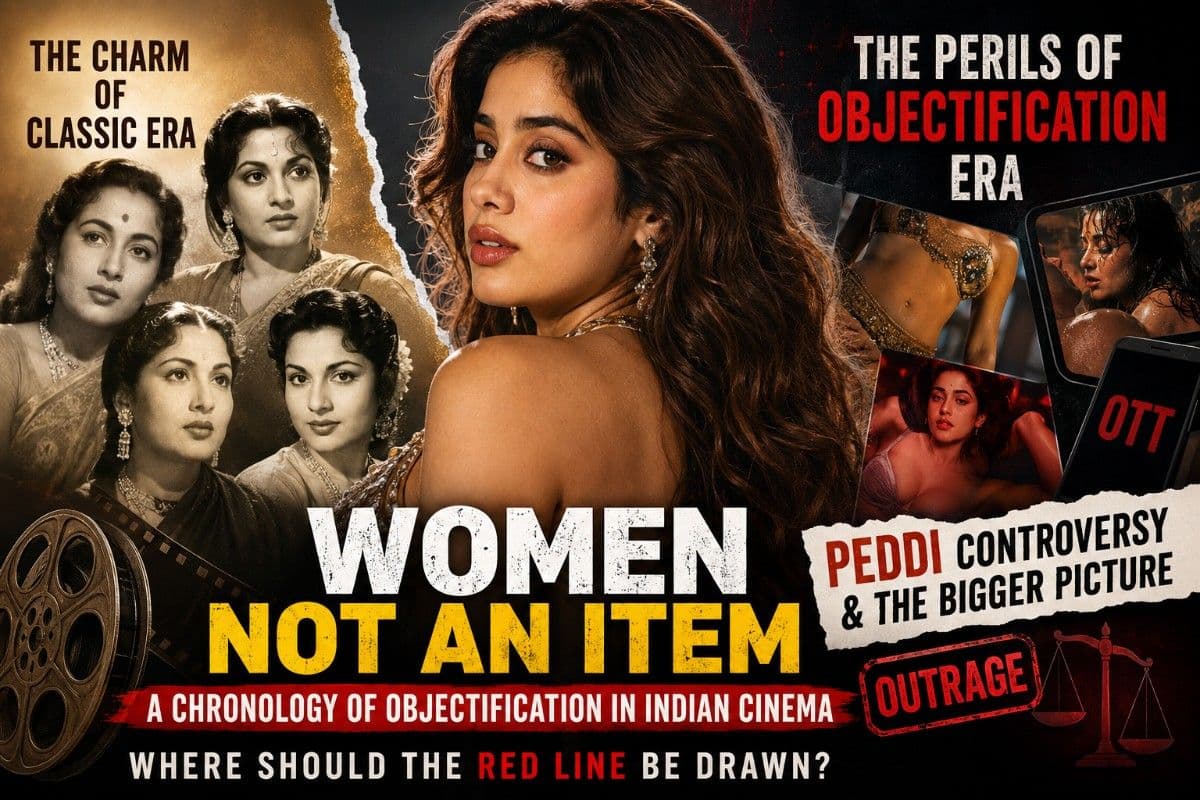
Key Points
* From Madhubala to OTT glamour culture, the story traces how women's portrayal transformed over time.
* Can one film be blamed, or is it time for a consistent industry-wide red line against objectification?
Bhubaneswar: The controversy surrounding the Peddi, starring Janhvi Kapoor and Ram Charan, has reignited a familiar debate in Indian cinema: where does glamour end and objectification begin?
Critics argue that visuals and certain cinematic tropes continue the tradition of reducing women to visual attractions rather than fully developed characters.
Defenders counter that singling out one film ignores a decades-long industry-wide practice that spans Bollywood, Tollywood, OTT platforms, music videos, advertisements and social media content.
The Peddi debate therefore raises a larger question: Is this genuinely about one film, or is it about an entertainment culture that has normalized objectification for generations?

📱 Get Argus News App
✨The Beginning: When Cinema Celebrated Grace More Than Exposure
Indian cinema's early decades, particularly from the 1940s through the 1960s, projected female stars through an entirely different lens.
Icons such as Nargis, Meena Kumari, Madhubala and Waheeda Rehman became symbols of beauty, but their appeal was built around screen presence, acting depth, emotional complexity and narrative centrality.
The camera often romanticized women but rarely reduced them solely to body-centric imagery. Songs emphasized expressions, eyes, emotions and storytelling rather than overt sensual display.
This was not an era free of patriarchy. Female characters were often confined within traditional roles. Yet there remained a distinction between portraying beauty and marketing sexuality as the primary selling point.
The Shift: Cabaret Culture and the Commercialization of Glamour
The first major shift emerged during the late 1960s and 1970s.
The rise of cabaret performances transformed the visual grammar of Indian cinema. Performers such as Helen introduced a new form of screen sensuality.
Initially, filmmakers maintained a separation. The heroine embodied virtue while the vamp represented seduction.
Over time, that distinction collapsed.
By the 1980s and early 1990s, glamour increasingly became part of mainstream heroine roles. Market competition encouraged producers to use songs, costumes and camera techniques to maximize audience attraction.
The Peak Years: The Item Number Era
Many critics identify the late 1990s through the 2010s as the peak phase of cinematic objectification.
The emergence of the "item number" transformed female bodies into standalone commercial products.
Songs often became more popular than the films themselves. Camera angles frequently focused on body parts rather than characters. Marketing campaigns revolved around glamour shots. Lyrics increasingly celebrated physical attributes in ways that would have been unimaginable in earlier decades.
Stars across industries participated because the formula worked commercially.
The phenomenon was not confined to Bollywood. Telugu, Tamil, Kannada and other regional industries developed their own versions of glamour-driven song sequences.
Objectification became institutionalized.
Ironically, many films simultaneously preached respect for women while marketing themselves through hyper-sexualized promotional content.
The OTT Explosion: A New Era or the Same Formula?
The arrival of OTT platforms was expected to change storytelling.
Instead, critics argue that many streaming productions pushed boundaries even further.
Unlike theatrical releases, OTT platforms often operated with fewer conventional restrictions. Intimacy, nudity, sexual content and voyeuristic framing became increasingly common in certain genres.
Supporters describe this as artistic freedom.
Critics call it commercialization of sexuality under the banner of realism.
The result is that today's audience encounters a far greater volume of sexualized content than previous generations ever did.
This context makes the outrage surrounding Peddi particularly complicated.
If objectification has become embedded across cinema, streaming content, music videos, advertising and social media, can one film alone be made the symbol of the problem?
Why Peddi Has Become a Flashpoint
The controversy surrounding Peddi appears to stem from a broader cultural fatigue.
Audiences are increasingly questioning why female stars continue to be introduced through glamour-centric imagery while male stars are showcased through power, heroism, action or character arcs.
The criticism is less about a single frame and more about recurring patterns.
Yet supporters of the film argue that judging an entire character based on promotional material is premature. They contend that glamour has been part of commercial cinema for decades and that outrage often appears selective depending on the industry, political climate or celebrity involved.
This argument has found resonance because similar visual treatments in many recent films and OTT productions generated little public backlash.
The Difference Between Charm and Objectification
The debate ultimately hinges on a distinction often lost in public discourse.
Cinema has always celebrated beauty.
Beauty itself is not objectification.
The classic era demonstrated that attraction could coexist with dignity, mystery and character depth.
Objectification begins when a woman's primary narrative function becomes visual consumption.
When characterization disappears and the body becomes the product, the line has been crossed.
The problem is not glamour.
The problem is reduction.
The Danger of Selective Outrage
The greatest risk in controversies like Peddi is inconsistency.
If society condemns one film while ignoring dozens of similar examples across cinema and OTT platforms, the debate becomes less about ethics and more about convenience.
Selective outrage rarely produces cultural reform.
It merely creates temporary targets.
A sustainable standard requires consistency across industries, platforms and genres.
The same benchmark should apply whether the content appears in a blockbuster film, an OTT series, a music video, a reality show or a social-media campaign.
Where Should the Red Line Be Drawn?
A practical red line may not lie in costume length, screen exposure or romantic content.
Instead, it may lie in intent and representation.
Questions worth asking include:
- Is the female character central to the story or merely decorative?
- Does the camera treat her as a person or a visual commodity?
- Would the character remain relevant if glamour elements were removed?
- Does the narrative grant agency, purpose and complexity?
If the answer to these questions is consistently negative, objectification becomes difficult to deny.
Conclusion
The Peddi controversy has exposed a larger contradiction in Indian entertainment.
For decades, commercial cinema benefited from increasingly sexualized portrayals of women. The trend expanded through television, music videos and eventually OTT platforms. Yet public outrage often emerges selectively, targeting individual films rather than the ecosystem that enabled such portrayals.
The real debate is therefore not whether Peddi alone objectifies women.
The real debate is whether Indian entertainment is finally prepared to establish a consistent standard – one that protects artistic freedom while ensuring women are portrayed as complete characters rather than commercial instruments.
Until that red line is drawn and applied uniformly, controversies will continue to erupt film by film, while the larger culture that sustains them remains largely untouched.
Related Topics
Explore more stories