



Nana Patekar’s Cinematic Odyssey: A Journey through Decades of Cinema
Key Points
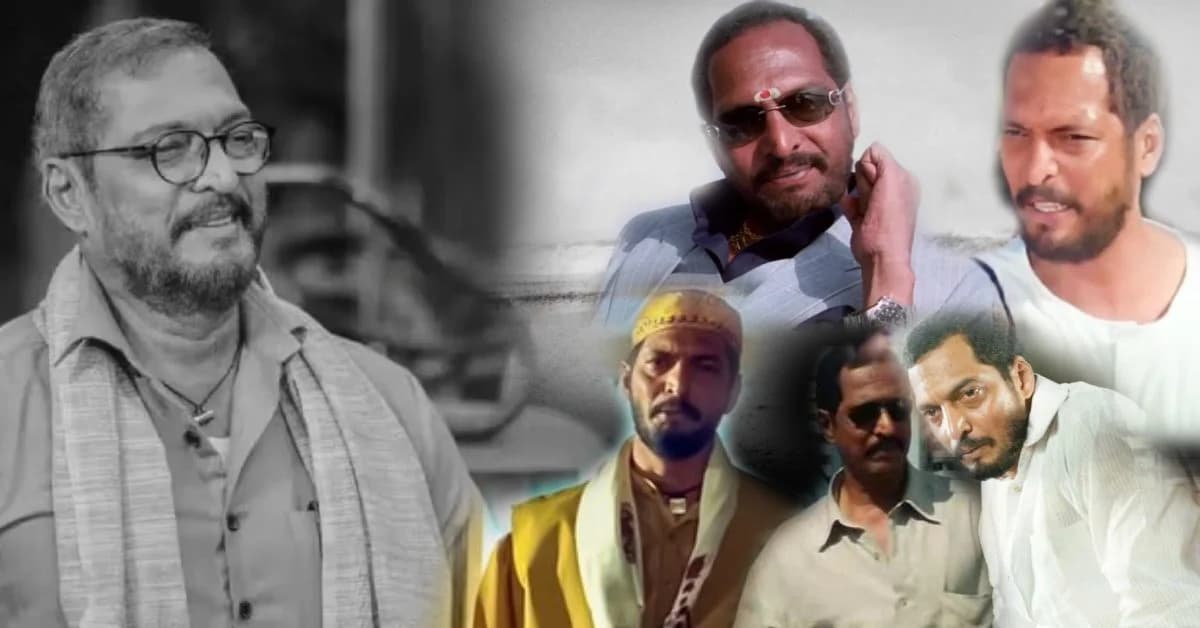
Veteran actor Nana Patekar, celebrated for his intensity, dialogue delivery, and versatility across Hindi and Marathi cinema, passed away at 75 in Goa, leaving behind a five‑decade legacy of unforgettable performances.
Mumbai, Oct 8: In a moment that has shaken the heart of Indian cinema, the passing of Vishwanath Patekar, widely known as Nana Patekar, at 75 has silenced one of the industry’s most distinctive voices.
Known for his raw intensity, commanding dialogue delivery, and ability to inhabit characters with unmatched emotional depth, Patekar’s journey from the theatre stage to the silver screen spanned nearly five decades.
His sudden demise in Goa, following a cardiac arrest, has left colleagues, admirers, and millions of fans mourning not just the loss of a legendary actor, but of a cultural icon whose artistry and social commitment transcended cinema.
Also read: Veteran Actor Nana Patekar Passes Away at 75 in Goa

📱 Get Argus News App
✨Born on January 1, 1951, in Murud‑Janjira, Maharashtra, Nana Patekar rose to prominence as an actor celebrated for his intense screen presence, distinctive voice, and raw emotional depth.
His journey into the arts began at the Sir J.J. School of Art in Mumbai, where he studied painting and became actively involved in theatre. This theatrical grounding shaped his ability to portray complex, layered characters that resonated deeply with audiences.
Patekar made his Hindi film debut with Gaman in 1978, followed by his Marathi debut in Sinhasan (1979). Early roles in films such as Bhalu, Raghu Maina, and Savitri established his versatility.
However, it was N. Chandra’s Ankush (1986) that gave his career significant momentum, portraying the struggles of ordinary people with authenticity. He continued to build his reputation with impactful performances in Pratighaat, Mohre, Andhaa Yudh, and Salaam Bombay!
A defining milestone came with Vidhu Vinod Chopra’s Parinda (1989), where his portrayal of ruthless crime boss Anna earned him the National Film Award for Best Supporting Actor.
Through the 1990s, Patekar delivered memorable performances in Agni Sakshi, Khamoshi: The Musical, Raju Ban Gaya Gentleman, Angaar, Tirangaa, Ghulam‑E‑Mustafa, Yeshwant, and Kohram.
His ability to embody intensity and vulnerability simultaneously made him one of the most respected actors of his generation.
In 2004, he delivered another career‑defining role in Ab Tak Chhappan, playing encounter specialist Sadhu Agashe with restraint and trademark intensity.
His performance in Prakash Jha’s Apaharan (2005) further cemented his reputation as an actor who could bring depth to morally complex characters. He continued to appear in films such as Taxi No. 9211, Welcome, Raajneeti, The Attacks of 26/11, and Kaala.
While largely associated with intense dramatic roles, Patekar showcased his comic brilliance as Uday Shetty in Welcome (2007). His chemistry with Anil Kapoor and impeccable timing turned the character into one of the most iconic figures in mainstream Hindi comedy, proving his versatility extended far beyond serious cinema.
Despite his success in Bollywood, Nana Patekar remained deeply connected to Marathi theatre and cinema. His Marathi filmography includes Pak Pak Pakaak, Deool, Natsamrat, Aapla Manus, and Dr. Prakash Baba Amte: The Real Hero.
His performance in Natsamrat (2016), based on V.V. Shirwadkar’s celebrated play, was hailed as one of his finest. As Ganpat Belwalkar, a retired stage actor grappling with ageing and loss, Patekar brought his theatrical roots to the forefront, earning widespread acclaim.
Beyond acting, he explored filmmaking, making his directorial debut with Prahaar: The Final Attack (1991), a film centred on the Indian Army and the life of a disciplined commando. His contributions to cinema were recognised in 2013 when he was honoured with the Padma Shri, India’s fourth‑highest civilian award.
Away from the spotlight, Nana Patekar lived a relatively private life. He married actress Neelakanti Patekar in 1978, and the couple had two sons, Durvasa and Malhar. Tragically, their elder son Durvasa passed away at the age of two‑and‑a‑half due to illness. Their younger son, Malhar, has worked behind the camera, maintaining a low profile.
Patekar was also deeply involved in social initiatives. Through the Naam Foundation, which he co‑founded, he worked to support drought‑affected farmers and their families in Maharashtra. He often visited border areas to encourage soldiers, reflecting his commitment to causes beyond cinema.
On October 8, 2026, Patekar was found unconscious at his residence in Dona Paula, Goa, and rushed to Manipal Hospital. Despite doctors’ efforts to revive him with continuous CPR for nearly 45 minutes, he was declared dead.
His passing has sent shockwaves across the film fraternity, with tributes pouring in from leaders, colleagues, and fans who remember him as an actor of unmatched intensity and integrity.
Nana Patekar’s legacy lies not only in his unforgettable performances but also in his unwavering honesty, simplicity, and social commitment. His journey from theatre to cinema, from intense drama to comedy, and from actor to humanitarian, ensures that his memory will continue to inspire generations.
(IANS)
Related Topics
Explore more stories