



Mithun Chakraborty Golden Jubilee: The Look, The Swagger and the Records That Made Him a Screen Phenomenon| Special Tribute
Key Points
Bhubaneswar: There was something almost impossible to miss about Mithun Chakraborty.
The unruly hair, the sharp eyes, the lean frame, the unmistakable swagger and that peculiar ability to look both vulnerable and intimidating in the same frame. Then came the dance – loose-limbed, energetic and distinctly his own. He did not have the polished, urbane appearance of the conventional Hindi film hero. He looked different. He moved differently. And for millions of moviegoers, that difference became the attraction.
Mithun did not merely enter the frame; he occupied it.
Fifty years after his cinematic journey began, that screen persona remains one of the most recognisable in Indian popular cinema. From the angry young man to the street dancer, from action hero to comic performer and from Bollywood star to acclaimed Bengali actor, Mithun has repeatedly reinvented himself without completely abandoning the traits that made audiences fall for him in the first place.

📱 Get Argus News App
✨50 years, but the image remains unmistakably Mithun
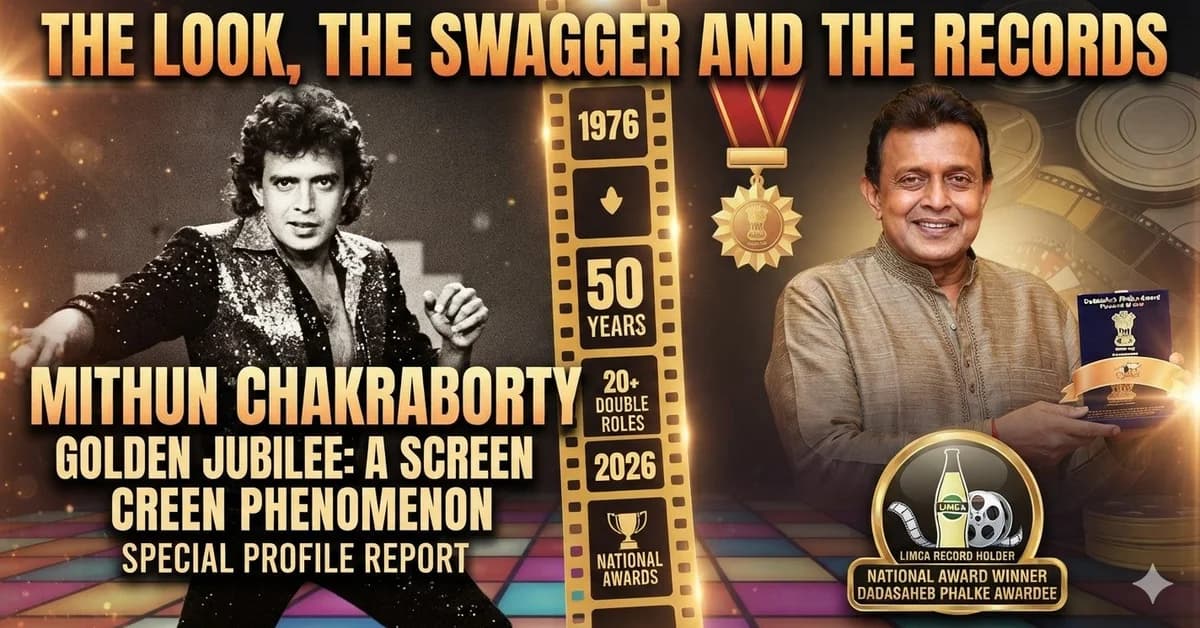
The year 2026 marks 50 years of Mithun Chakraborty's cinematic journey, dating back to 1976.
A special
golden-jubilee profile of his career highlights the scale of that journey: 17
of his films have been screened at international film festivals, while five
have won international awards. Ten Hindi films and seven Bengali films
featuring him have also been screened at international film festivals.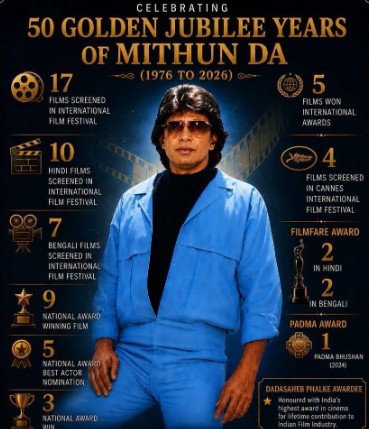
But numbers alone do not explain the Mithun phenomenon.
His appeal was built on an unusual combination – a rugged appearance, a dancer's physicality, an outsider's hunger and a style that could travel from the urban multiplex to the smallest single-screen theatre.
He could make a simple shirt-and-trouser combination look like a costume. He could turn a dance step into a signature. And he could communicate rage, romance, vulnerability and humour without losing the essential Mithun identity.
The man who turned the dance floor into a launchpad
For an entire generation, Mithun was not simply an actor who danced.
He was a dancing star.
His screen movements became a language of their own, particularly among young audiences who saw in him something less distant than the traditionally groomed Bollywood hero. His dancing had energy rather than perfection, attitude rather than ornamentation.
That quality helped turn films such as Disco Dancer into cultural landmarks.
The Mithun image eventually became so powerful that even when the industry changed, his ability to connect with mass audiences remained intact.
Then came the record-breaking double roles
One of the most extraordinary features of his career is the sheer number of multiple-role performances.
A glance at the available film records credits Mithun with 20 double roles, including 15 in Hindi films and three in Bengali films, besides two triple-role performances in Hindi cinema.
The list of
double-role films stretches across decades – from Taxi Chor (1980), Aamne
Saamne (1982), Kasam Paida Karne Wale Ki (1984), Rakta Bandhan
(1984) and Param Dharam (1987) to Bees Saal Baad (1988), Ladaai
(1989), Gunaah Ka Devta (1990), Paap Ki Duniya (1988), Pardesi
(1993), Paramatma (1994) and Jallaad (1995).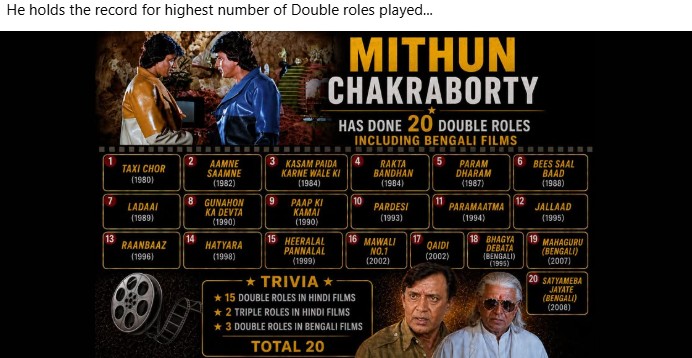
The experiment continued with films including Raambaan, Hatyara, Heeralaal Pannalal, Mawali No.1, Qaidi, Bhagya Debata, Mahaguru and the Bengali film Satyamer Jayate.
It is a remarkable record because multiple roles demand more than simply changing costumes. The actor has to create differences in body language, voice, temperament and screen presence.
Mithun repeatedly accepted that challenge.
A Limca record that reveals another side of his career
There is another unusual chapter in the Mithun story.
The Limca Book of Records credits Mithun Chakraborty and director T.L.V. Prasad with a national record for a 26-film partnership between 1995 and 2002, described as the highest number of films made by an actor-director association during that period.
Twenty-six
films.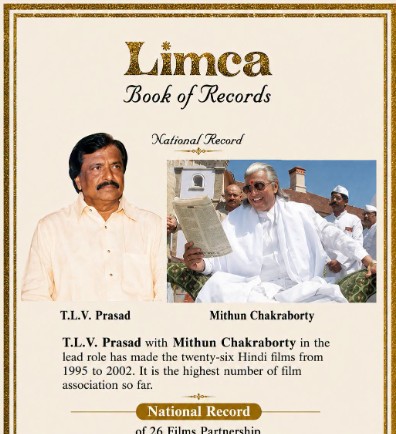
That number tells another story about Mithun – his extraordinary willingness to work across the commercial spectrum and his ability to sustain a punishing volume of film assignments.
For an industry where stars often build careers around a carefully limited number of releases, Mithun followed a radically different model.
He kept working.
From mass entertainer to critically recognised actor
Yet reducing Mithun to commercial cinema would miss half the story.
The man who became a mass icon also earned some of the highest recognition available to an Indian actor.
His career has been associated with nine National Award-winning films, while the golden-jubilee profile credits him with five National Award Best Actor nominations.
His award cabinet also includes two Filmfare Awards in Hindi cinema and two in Bengali cinema.
And then came the country's major civilian recognition.
In 2024, Mithun Chakraborty was awarded the Padma Bhushan, adding another layer to a career that had already travelled from the margins of mainstream cinema to the highest levels of national recognition.
Bengali cinema: the other half of Mithun
Before the superstar image became firmly established, Mithun's association with Bengali cinema remained an important part of his artistic identity.
The supplied career profile credits seven Bengali films with international film-festival screenings, alongside the international recognition received by his films.
That matters because Mithun has never been confined to a single cinematic geography.
Hindi cinema made him a household name across India. Bengali cinema repeatedly gave him space to explore another register of performance.
The two careers ran parallel – commercial star in one and serious performer in the other.
The international journey
The numbers from his 50-year profile also reveal how far beyond mainstream Indian entertainment his work travelled.
17 films screened at international film festivals. Five films winning international awards. Ten Hindi films and seven Bengali films receiving international festival exposure.
For an actor whose strongest connection has traditionally been with mass audiences, that international footprint is significant.
It suggests that the Mithun legacy cannot be measured only through box-office popularity or iconic dance numbers.
There is also a body of work that travelled into the festival circuit and found recognition beyond the conventional commercial framework.
From outsider to Dadasaheb Phalke Award
Perhaps the most powerful way to understand the 50-year journey is to look at where Mithun started and where it ultimately took him.
The actor who once represented the outsider's struggle eventually received the Dadasaheb Phalke Award, India's highest honour in cinema.
That recognition completes a remarkable arc.
The young man who arrived without the traditional privileges associated with the Hindi film establishment became a superstar. The dancer became an actor. The commercial hero became a National Award-winning performer. The Bengali actor became a pan-Indian icon. And the mass entertainer eventually became a recipient of the country's highest cinematic honour.
Fifty years later, the Mithun effect survives
Actors come and go. Styles change. Audiences change. The grammar of cinema changes.
But Mithun Chakraborty's appeal was never built entirely around fashion.
It was built around personality.
The hair. The eyes. The walk. The dance. The voice. The physicality. The ability to make an ordinary character look larger than life.
And above all, that unmistakable Mithun swagger.
Fifty years on, the records are impressive — 20 double roles, multiple triple-role performances, a 26-film actor-director record, international festival screenings, National Award recognition, Filmfare honours, the Padma Bhushan and finally the Dadasaheb Phalke Award.
But the most enduring record may be harder to measure.
For generations of Indian viewers, Mithun Chakraborty did not simply play the hero.
He became
a style, a movement and a screen identity of his own.
Also Read: Toxic Trailer Gets Views, But Has Yash Lost His Mass Magic? Netizens Find It Underwhelming
Related Topics
Explore more stories