



Explained: Why Odisha Added 10,372 UG Seats Despite a 74,000-Seat Admission Gap
Key Points
* Nearly 5,900 of the 10,372 newly added seats are strategically injected into top-tier State Public Universities and Government Colleges to ease extreme cutoff pressures.
* While the Arts stream handles massive geographical clustering, the Science stream presents the most intense competition, with over 1 lakh pass-outs vying for limited premium honors seats.
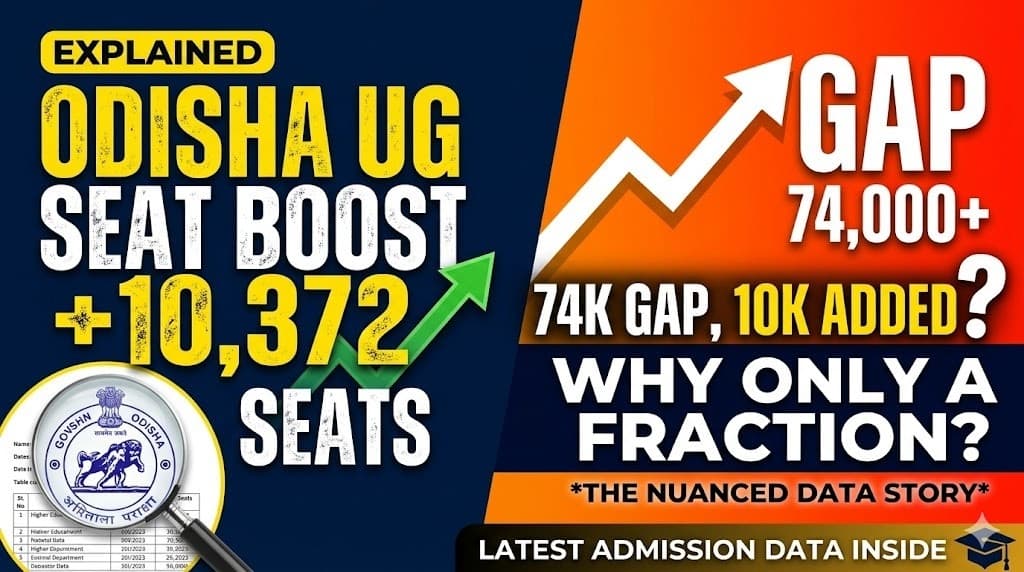
Bhubaneswar: In a significant move to align higher education capacity with record school pass-outs, the Odisha Higher Education Department has enhanced the state’s undergraduate seat matrix by 10,372 seats for the upcoming 2026–27 academic session.
According to the Higher Education Department notification issued on June 18, a total of 10,372 seats have been added, including 1,216 seats in State Public Universities, 4,684 seats in Government Colleges, and 4,472 seats in aided colleges.
The Odisha Higher Education Department’s move to raise the existing undergraduate capacity in higher educational institutions across the State was being seen as a very belated one.
And the moot question pricking everyone’s mind is will this address the pass-outs versus admission capacity of undergraduate courses when the conventional narrative is that Odisha does not have enough undergraduate seats.

📱 Get Argus News App
✨The answer to the question has been a BIG no.
Lens On Last 5 Years Admission Data
A glance at the data of last five academic years reveals that the number of students passing Higher Secondary examinations has consistently outpaced sanctioned undergraduate capacity.
|
Academic Year |
Students Passed (+2) |
Estimated UG Seats |
Gap
2022-23
2.96 lakh
2.45 lakh
-51,000
2023-24
3.12 lakh
2.50 lakh
-61,600
2024-25
3.24 lakh
2.55 lakh
-68,700
2025-26
3.32 lakh
2.58 lakh
-73,800
2026-27
3.44 lakh
2.70 lakh*
-74,031
*Includes the newly enhanced 10,372 seats.
The above table shows even after the latest expansion, Odisha continues to face a notional deficit of more than 74,000 seats.
The data, however, tells a more nuanced story. HOW?
Odisha Higher Edu Rationale
When the department knows there will be a gap of over 74000 seats, why they have gone for an increase of little over 10K seats.
It seems the rationale behind is the policymakers appear to have concluded that simply creating another 70,000 seats would not solve the admission crisis because the shortage is not evenly distributed across the system.
Thousands of seats in certain rural and pass-course programmes often remain vacant, while a handful of honours programmes in premier institutions witness cut-throat competition and sky-high cut-offs.
In other words, students are not competing for every available seat. They are competing for a specific set of seats.
The Premium Seat Crisis
The most acute pressure is concentrated in a small segment of the higher education pyramid.
Students overwhelmingly prefer:
- State Public Universities
- Major Government Colleges
- Urban and semi-urban campuses
- High-demand honours subjects
- Emerging professional and self-financing programmes
This creates what may be called a "premium seat crisis."
For example, a student scoring above 85 per cent in Science may not simply seek admission into any B.Sc. programme. The preference is often for Physics, Chemistry, Mathematics or Computer Science honours in reputed institutions.
Similarly, Arts students gravitate toward Political Science, History, Economics and Odia honours courses in established colleges.
As a result, admission cut-offs in these programmes frequently cross 90 per cent even while seats elsewhere remain unfilled.
The government's latest intervention appears designed precisely to ease these bottlenecks.
Why Most New Seats Have Gone to Universities and Government Colleges
The distribution of the new seats offers a clear clue about the policy's intent.
|
Institution Type |
Additional Seats |
|
State Public Universities |
1,216 |
|
Government Colleges |
4,684 |
|
Aided-488 Colleges |
3,416 |
|
Aided-662 Colleges |
1,056 |
|
Total |
10,372 |
Nearly 5,900 seats have been allocated to State Public Universities and Government Colleges alone.
These institutions represent the highest-demand segment within Odisha's undergraduate ecosystem.
By increasing capacity at the top tier, the government effectively creates additional room for high-scoring applicants who would otherwise be pushed out due to limited seat availability rather than lack of merit.
This could reduce the extreme cut-off pressure that has become a recurring feature of the SAMS admission process.
Science Remains the Biggest Pressure Point
The 2026 CHSE results underline why targeted expansion was necessary.
|
Stream |
Passed Students |
|
Arts |
2.16 lakh |
|
Science |
1.01 lakh |
|
Commerce |
21,600 |
While Arts contributes the largest volume of students, Science generates the most intense competition.
More than one lakh Science pass-outs are expected to compete for a comparatively limited pool of honours seats in Physics, Chemistry, Mathematics, Computer Science and related disciplines.
This demand concentration explains why Science cut-offs remain disproportionately high in leading colleges and universities.
A blanket increase in seats across all streams would have diluted resources without necessarily addressing this pressure point.
Instead, the government's decision to rationalise seats based on historical admission patterns suggests an attempt to align supply with actual student demand.
The Arts Challenge Is Different
The Arts stream presents a different type of mismatch.
Unlike Science, the issue is not an absolute shortage of seats.
Odisha already has substantial Arts capacity across the state.
The problem is geographical and institutional.
Students tend to cluster around well-known Government Colleges and urban institutions, particularly for subjects such as Political Science, History and Economics.
Consequently, urban colleges experience intense competition while many peripheral institutions struggle to fill available seats.
The additional seats in aided colleges could help absorb this pressure by allowing more students to secure honours admissions closer to their home districts, thereby reducing migration towards a handful of urban campuses.
A Strategic Shift From Quantity to Precision
What makes the 2026 seat enhancement noteworthy is that it reflects a shift in policy thinking.
Instead of pursuing a large-scale expansion of undergraduate capacity, the government appears to be embracing a strategy of micro-rationalisation.
The objective is not to eliminate the state's overall seat deficit overnight.
Rather, it is to identify where admission stress is actually occurring and add capacity precisely at those pressure points.
The approach recognises that Odisha's higher education challenge is increasingly one of distribution, subject preference and institutional hierarchy, rather than merely a shortage of seats.
The Bottom Line
The addition of 10,372 undergraduate seats will not erase Odisha's overall supply-demand gap, which still exceeds 74,000 seats based on current pass-out numbers.
However, the move was never intended to be a blanket expansion.
Instead, it is a targeted intervention aimed at easing the state's most severe admission bottlenecks – particularly in premier universities, Government Colleges and high-demand honours programmes.
In that sense, the policy may be viewed as a subtle but significant attempt to correct a long-standing imbalance in Odisha's higher education system: not the lack of seats, but the lack of seats where students most want them.
As the
2026-27 admission season unfolds, the real measure of success will not be
whether every student gets a seat, but whether more students are able to secure
the seat they actually aspire to.
Also Read: Plus 2 Results / CHSE 2026 Results: Why Science Records Higher Pass Percentage Than Arts Despite Tougher Curriculum | Exclusive
Related Topics
Explore more stories