



Special Report| Paper Leak Crackdown, Upcoming Local Poll Politics: Odisha BJP Govt Pushes Common Recruitment Exam, Unified Education Board
Key Points
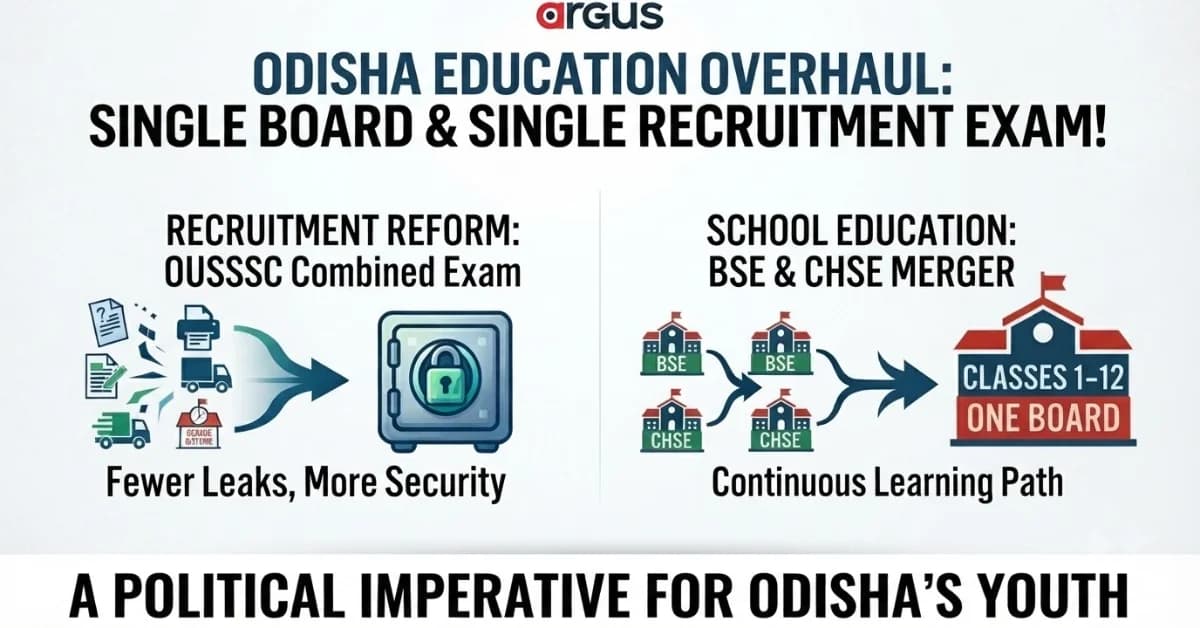
The Odisha Cabinet approved amending OUSSSC rules to conduct a single Combined Recruitment Examination for multiple uniformed services to shrink security vulnerabilities.
The state is moving toward legislation to merge the Board of Secondary Education (BSE) and Council of Higher Secondary Education (CHSE) into a unified board for Classes 1 to 12.
These structural administrative overhauls aim to centralize exam management, align with NEP 2020, and rebuild trust among students, job aspirants, and young voters.
Bhubaneswar: As Odisha moves towards an upcoming rural and urban civic polls, the State government is simultaneously attempting two institutional overhauls that could have a direct bearing on a large and politically important constituency – students, job aspirants and young voters.
At the heart of the exercise is a simple but politically potent issue: how to prevent examination papers from reaching the wrong hands.
The Odisha Cabinet's approval to amend the rules of the Odisha Uniformed Services Staff Selection Commission (OUSSSC) to facilitate a single Combined Recruitment Examination (CRE) for multiple uniformed services is therefore more than an administrative restructuring.
It seeks to address one of the most damaging vulnerabilities in government recruitment -the fragmentation of examinations, question-paper handling and recruitment logistics that can create multiple points for organised malpractice and paper leaks.

📱 Get Argus News App
✨At the same time, the government's move towards legislation to merge the Board of Secondary Education (BSE) and Council of Higher Secondary Education (CHSE) into a single school board represents a parallel restructuring of the academic examination system.
Taken together, the two reforms point towards a broader government objective: centralise examination management, standardise processes and reduce the institutional gaps through which leakages and administrative duplication can occur.
One recruitment exam, fewer targets for paper-leak networks
For competitive-exam aspirants, the most immediate significance lies in the OUSSSC reform.
Under a fragmented recruitment system, different uniformed departments or recruitment bodies can conduct examinations independently. Each examination potentially requires separate question-paper preparation, printing, storage, transportation, distribution and examination-centre management.
That creates multiple points of vulnerability.
The proposed Combined Recruitment Examination changes that architecture by bringing recruitment for different uniformed services under one examination framework.
The objective is not merely to make recruitment convenient.
It potentially shrinks the security attack surface.
Instead of protecting several independent examination systems operating at different times, the State can concentrate security protocols, surveillance, secure logistics and digital auditing around a common examination architecture.
For candidates, there is another immediate benefit.
A common examination can reduce the burden of repeatedly paying application fees, travelling to different examination centres and preparing separately for multiple recruitment tests.
But its larger test will be credibility.
A common examination system can strengthen confidence only if the entire chain – from question-bank creation to final evaluation – is protected against manipulation.
Why digital testing matters
The shift away from conventional paper-based examinations could become the second major pillar of the anti-leak strategy.
Physical question papers require printing, packaging, storage and transportation. Every additional handoff creates another potential vulnerability.
A stronger Computer-Based Test (CBT) ecosystem can reduce dependence on this physical chain.
With appropriate encryption, controlled question-bank access and secure digital transmission, examination questions can be made available to authorised centres much closer to the examination time.
This does not make a system automatically leak-proof.
Rather, it changes the nature of the risk.
Instead of relying predominantly on physical security, the State can create a system in which access is digitally logged and irregular activity can potentially be traced.
That becomes particularly important in the era of organised paper-leak networks, where the credibility of an examination can collapse even before results are published.
For Odisha's competitive-exam ecosystem, therefore, the real measure of the OUSSSC reform will not be how many examinations are combined, but whether the new architecture makes leakage harder and detection faster.
From Class 10–12 divide to one academic board
The second reform is aimed at a different examination pipeline.
For decades, Odisha's school education system has had separate institutions overseeing secondary and higher-secondary examinations.
The proposed merger of BSE and CHSE seeks to create a single board for Classes 1 to 12.
Politically, this is significant because it affects a much larger population than government recruitment alone.
Academically, the government's stated direction is closely linked to the National Education Policy (NEP) 2020, which replaces the traditional 10+2 conceptual framework with the 5+3+3+4 pedagogical structure.
Under NEP, the secondary stage extends across Classes 9 to 12.
A division between separate boards after Class 10 does not fit neatly into that integrated framework.
A unified board could therefore allow the State to administer the secondary stage as a more continuous academic cycle.
What changes for students?
|
Reform |
Existing structure |
Proposed direction |
Likely significance |
|---|---|---|---|
|
School board |
BSE and CHSE operate separately |
One unified board |
One administrative framework for Classes 1–12 |
|
Secondary education |
Class 10 and +2 separated institutionally |
Classes 9–12 treated as an integrated secondary stage |
Greater curricular continuity |
|
Assessment |
Separate board structures |
Common examination administration |
Standardisation |
|
NEP implementation |
Legacy 10+2 architecture |
5+3+3+4 framework |
Better alignment with NEP 2020 |
|
Competitive preparation |
Separate academic stages |
Greater continuity in assessment |
Potentially stronger competency-based preparation |
The merger could also facilitate a gradual movement away from rigid divisions between Science, Commerce and Arts.
That is central to the NEP vision of allowing students greater flexibility in choosing subjects and developing multidisciplinary learning.
Why the two reforms matter together
The recruitment-exam reform and education-board merger are not identical exercises.
One deals primarily with government recruitment; the other with school education and examinations.
But both are built around the same administrative principle: reduce fragmentation.
For competitive-exam aspirants, that could mean fewer recruitment examinations and a more standardised examination ecosystem.
For school students, it could mean one institutional framework from school education through the higher-secondary stage.
For the government, the political dividend could be equally important.
In the run-up to rural and urban civic politics, reforms affecting jobs, examinations and education touch constituencies well beyond government employees. They reach students, parents, unemployed youth and first-time voters – groups for whom examination credibility and employment opportunities can become politically consequential issues.
The politics, therefore, is not simply about merging boards or conducting one recruitment examination.
It is about whether the government can convince a generation of aspirants that the system is fair, predictable and harder to manipulate.
The real test: implementation
The proposed architecture will ultimately be judged by execution.
A single recruitment examination can reduce duplication, but a single failure can potentially affect a much larger pool of candidates.
Likewise, a unified education board can remove administrative overlap, but it will have to manage the enormous challenge of synchronising curriculum, examinations, evaluation, personnel and institutional responsibilities.
The State will therefore have to ensure that centralisation does not merely centralise failure.
For Odisha's students and job aspirants, the expectation is straightforward: fewer examinations should not mean greater risk concentrated in one examination; one board should not merely mean one office replacing two.
The success of these reforms will depend on whether institutional consolidation translates into greater examination security, transparent recruitment and a more coherent academic system.
And
in an environment where every paper-leak allegation can undermine
thousands of candidates' trust, that credibility may prove to be the
most important outcome of all.
Also Read: State Cabinet Meet: ODOP Gets Administrative Backbone as Odisha Restructures 31 DICs, A Push to Make Districts Export Hubs! | Special Report
Related Topics
Explore more stories