



State Cabinet Meet: ODOP Gets Administrative Backbone as Odisha Restructures 31 DICs, A Push to Make Districts Export Hubs! | Special Report
Key Points
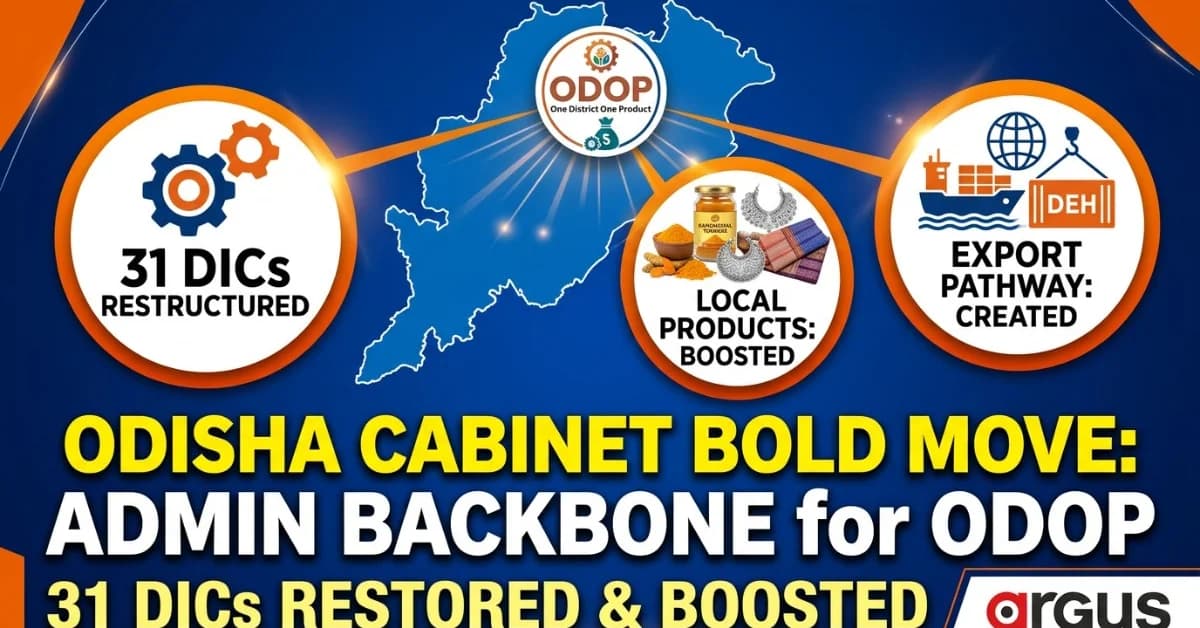
Odisha Cabinet restructures the ministerial cadre across 31 District Industries Centres to fortify district-level industrialisation.
The administrative reform transitions the One District One Product initiative from product identification to practical execution and export readiness.
Standardised staffing structures streamline financial scheme delivery, reducing administrative friction for rural artisans and MSMEs.
Bhubaneswar: The Odisha Cabinet decision on Monday about restructuring the ministerial cadre across 31 District Industries Centres (DICs) could emerge as a significant administrative step in consolidating the State’s One District One Product (ODOP) framework, by strengthening the machinery required to execute an initiative that is already operational.
The MSME Department’s restructuring of DIC staff effectively addresses the administrative layer beneath district-level industrialisation. With clearer staffing structures, defined responsibilities and dedicated ministerial support, the reform can give ODOP clusters greater institutional continuity and improve the government’s ability to take local products from identification to production, branding, finance and markets.
The strategic shift is important: ODOP provides the district-level economic strategy; the restructured DICs can provide the administrative engine to execute it.
From identifying products to executing the ODOP strategy
Odisha has already identified district-specific products under its ODOP framework. Products such as Cuttack’s silver filigree, Kandhamal turmeric and Sambalpuri-Bomkei handlooms are not awaiting the launch of ODOP.

📱 Get Argus News App
✨The challenge now is execution.
Once a product is identified, a district administration needs to handle applications, scheme benefits, documentation, clearances, financial assistance, infrastructure requirements and coordination with multiple agencies.
This is where the DIC restructuring assumes significance.
The introduction and rationalisation of positions such as Junior Assistants, Senior Assistants and Section Officers can create a more clearly defined administrative chain inside the district industrial offices. Instead of ODOP remaining primarily a product-identification exercise, the restructured machinery can help convert individual district specialities into functioning economic clusters.
The missing link: Districts as Export Hubs
The larger opportunity lies in linking ODOP with the Districts as Export Hubs (DEH) approach.
The national strategy seeks to identify products and services with export potential at the district level and build the ecosystem needed to take them to wider markets.
But exporting a local product requires far more than identifying it.
Quality certification, documentation, packaging, market intelligence, institutional coordination, financial support and logistics all require administrative capacity.
A stronger DIC structure can therefore become the district-level bridge between an artisan or micro-enterprise and the larger export ecosystem.
For Odisha, this could be particularly significant for products with an established cultural or agricultural identity but limited access to organised markets.
Faster money, faster enterprise
The restructuring could also have a direct bearing on the delivery of financial assistance.
Many ODOP-linked micro-enterprises depend on schemes such as PM-FME, which operates around an ODOP-oriented cluster approach, besides state-level credit and interest-support mechanisms.
Delays in processing applications, documentation and reimbursements can effectively neutralise the benefit of such schemes for small entrepreneurs.
A dedicated and standardised ministerial structure at DIC level can reduce this administrative friction, allowing district offices to process applications and coordinate financial assistance more efficiently.
For a small food processor, artisan or rural entrepreneur, that administrative efficiency can determine whether an expansion plan actually gets off the ground.
More than a staffing exercise
The restructuring also attempts to address a less visible problem: institutional continuity.
District industrial offices need personnel who understand MSME regulations, industrial schemes, applications, financial assistance and the specific economic profile of their districts.
A defined ministerial cadre creates clearer career progression and departmental ownership while reducing dependence on shared or fragmented administrative arrangements.
That matters for ODOP because district-level economic development is not a one-year exercise. Building a successful product cluster requires institutional memory – knowing which entrepreneurs need support, where bottlenecks exist and which products have genuine market potential.
Odisha’s ODOP test now moves to execution
The restructuring strengthens the institutional infrastructure underneath the scheme.
The real test will now be whether the restructured DICs can translate this administrative capacity into more enterprises, faster access to credit, better product quality, stronger branding, wider markets and ultimately greater exports from Odisha’s districts.
In that sense, the government is not merely restructuring posts.
It is potentially rebuilding the district-level execution machinery for Odisha’s ODOP economy – moving the initiative from identifying what each district can produce to determining how effectively that product can be produced, financed, marketed and sold to the world.
Also Read: After Pension Fallout, Odisha Govt Brings in SSEPD Full-Time Secretary? | Special Story
Related Topics
Explore more stories