



PM’s NTA Reform Panel Explained: Nilekani May Lead the Overhaul; Tapan Deka’s Entry Signals War on India’s Paper Leak Mafia| Exclusive
Key Points
Bhubaneswar: Prime Minister Narendra Modi on Sunday announced through a video message the constitution of a six-member high-powered task force headed by Infosys co-founder Nandan Nilekani to recommend structural reforms for the National Testing Agency (NTA) and make India's examination system secure, transparent and future-ready.
The panel also includes former Intelligence Bureau Director Tapan Deka, former ISRO Chairman S. Somnath, IIT Madras Director Prof. V. Kamakoti, former Union Education Secretary Anita Karwal and senior bureaucrat Amrit Lal Meena.
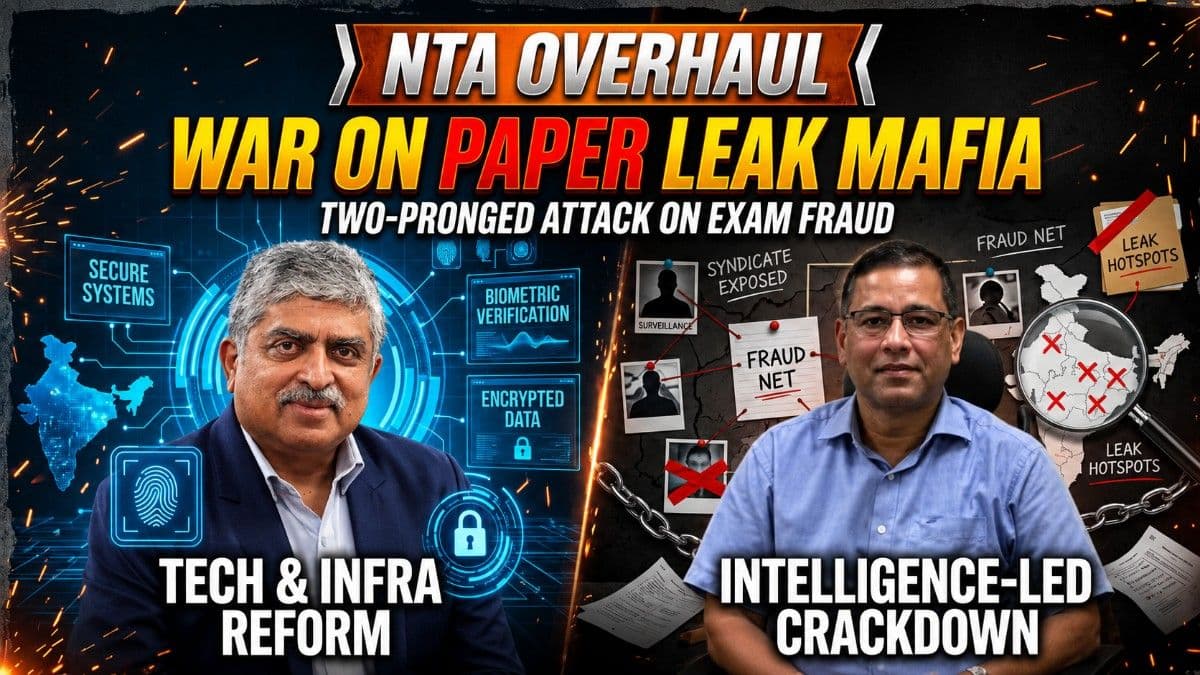
While Nilekani's appointment has grabbed the headlines, the inclusion of India's former top intelligence officer could prove to be the most consequential decision, signalling that the Centre now views paper leaks not merely as examination malpractice but as an organised criminal enterprise requiring an intelligence-led response.
A Carefully Crafted 'Crisis Cabinet' for India's Exam System
The composition of the panel reflects a deliberate attempt to address every vulnerability that has plagued India's public examination ecosystem.
Nandan Nilekani, the architect of Aadhaar and India's Digital Public Infrastructure, has been chosen to design a technology-first architecture capable of handling millions of candidates with secure identity verification, encrypted data management and large-scale digital examination infrastructure. His experience in building population-scale digital platforms makes him the natural choice to redesign the NTA.
Tapan Deka, former Director of the Intelligence Bureau, brings an entirely different dimension. One of India's most experienced intelligence professionals with expertise in counter-terrorism, cyber security and organised criminal networks, Deka has been tasked with plugging the security gaps that have repeatedly allowed examination papers to be stolen, trafficked and sold by interstate syndicates.
S. Somnath, former Chairman of ISRO, represents mission-critical systems engineering. Having overseen some of India's most complex space missions where even the smallest error can prove catastrophic, Somnath is expected to introduce zero-failure operational protocols into examination management.
Prof. V. Kamakoti, Director of IIT Madras, is among India's leading computer scientists. His expertise in secure computing, cryptography and hardware architecture is expected to shape the technical backbone of encrypted computer-based examinations.
Anita Karwal, former CBSE Chairperson and former Union Education Secretary, offers unmatched administrative experience in conducting examinations involving millions of students. She understands the operational realities of school education and examination logistics.
Amrit Lal Meena, a senior administrator with extensive governance experience, is expected to strengthen the physical logistics chain, ensuring secure transportation, storage and tracking of examination material.
The Bigger Story: Why Tapan Deka's Presence Changes Everything
Nilekani may be the face of the reforms, but Tapan Deka is arguably the panel's most strategically significant inclusion.
Until now, paper leaks have largely been treated as isolated cases of cheating, local corruption or administrative failure. Deka's induction fundamentally changes that approach.
His appointment indicates that the government now sees examination leaks as organised criminal operations that resemble sophisticated intelligence and cyber-security threats rather than ordinary education offences.
According to the task force's strategic framework, Deka's role will be to design intelligence protocols, dismantle organised leak syndicates, track dark-web data trafficking, strengthen cyber defences and build an integrated anti-fraud intelligence network around India's examination ecosystem.

📱 Get Argus News App
✨This marks a shift from catching individual offenders after a leak to preventing criminal networks from operating in the first place.
From Local Cheating to National Security
The repeated paper leak scandals – from recruitment examinations to NEET – have demonstrated that these crimes are no longer confined to a single examination centre or one corrupt official.
Over the years, investigators have uncovered interstate networks involving middlemen, technology experts, coaching operators, insiders and financial intermediaries. Such syndicates exploit vulnerabilities across question paper transportation, digital servers, printing units and local examination centres.
The inclusion of India's former intelligence chief therefore sends a strong institutional message: organised exam fraud will increasingly be tackled using intelligence gathering, cyber surveillance, financial tracking and inter-state coordination rather than relying solely on conventional criminal investigations.
It effectively elevates paper leaks from an education administration issue to a matter affecting national governance and public trust.
What the Nilekani-Deka Combination Could Deliver
The partnership between Nilekani's digital infrastructure expertise and Deka's intelligence background could fundamentally transform how examinations are conducted.
The emerging framework points towards:
- End-to-end encrypted digital delivery of question papers instead of prolonged physical storage.
- Just-in-time decryption where question papers become readable only at the scheduled examination time.
- AI-powered biometric verification to eliminate impersonation.
- Hardware-level security protocols preventing remote access or screen-sharing during computer-based examinations.
- Continuous AI monitoring of candidate behaviour to detect suspicious activity.
- Immutable digital audit trails to detect post-examination manipulation.
- Intelligence-led monitoring of organised leak syndicates before examinations are conducted.
Together, these measures aim to eliminate both technological vulnerabilities and human collusion.
A Fundamental Shift in NTA's Philosophy
The proposed reforms extend far beyond introducing better software or stricter invigilation.
If implemented, the recommendations would transform the NTA from an examination-conducting agency into a technology-driven, intelligence-backed national testing institution built around the principles of zero trust, continuous surveillance, encrypted operations and predictive risk management.
The emphasis would shift from reacting to paper leaks after they occur to designing an ecosystem where leaks become structurally difficult, digitally traceable and operationally unattractive.
The Bottom Line
The immediate headline is easy to identify: Nandan Nilekani has been entrusted with rebuilding India's examination architecture.
The more consequential story, however, lies in Tapan Deka's inclusion.
By placing the country's former intelligence chief at the heart of NTA reforms, the government has effectively acknowledged that India's examination crisis is no longer just an academic challenge. It is a battle against organised crime networks that have repeatedly undermined public trust in competitive examinations.
If Nilekani
is expected to build the digital fortress, Tapan Deka's mandate is to hunt down
those who have learnt to breach it. Together, they represent a twin-track
strategy – technology to prevent leaks and intelligence to dismantle the
syndicates behind them.
Also Read: Resignation: Dharmendra Pradhan’s Masterstroke Upholds ‘Odia Asmita’, Blunting Opposition BJD, Congress Weapons| Political Analysis
Related Topics
Explore more stories