



India Skill Report 2026: Six Years On, Odisha Still Missing From India’s Employability Map Despite Skill Hype| Exclusive
Key Points
Bhubaneswar: Six years after Odisha’s skills ecosystem first came under the scanner, the State appears to be caught in the same employability trap.
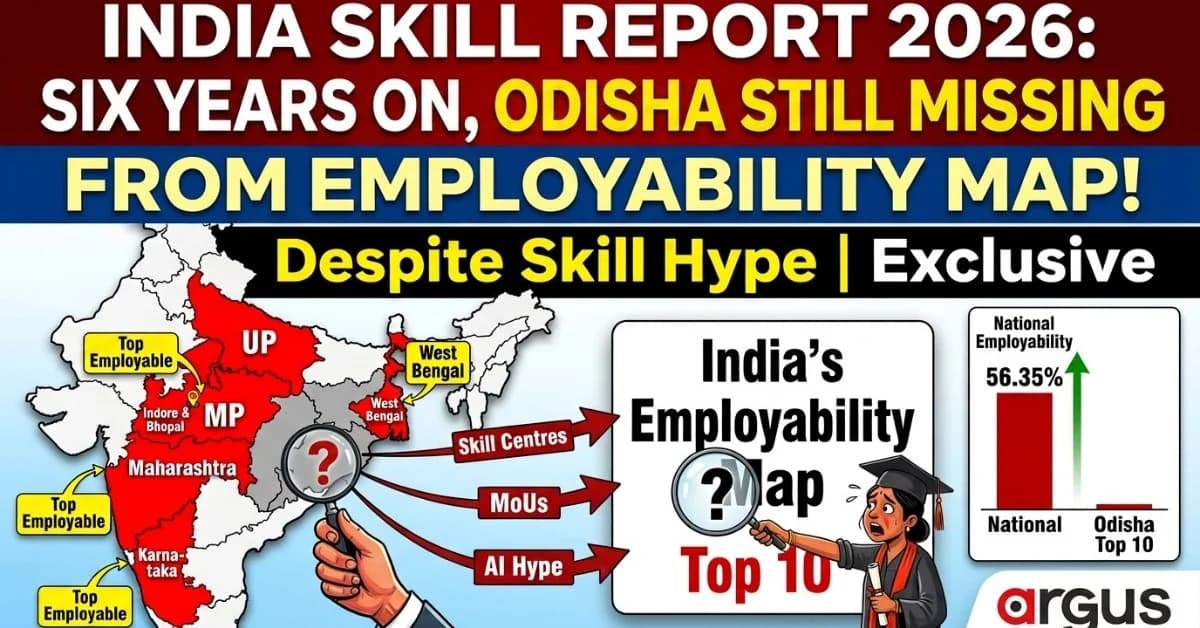
The latest India Skills Report 2026 offers a particularly uncomfortable reality check. As India’s overall employability climbed to 56.35%, Odisha once again failed to figure among the country’s top 10 most employable states.
And this is not an isolated miss.
It is a pattern that has persisted across three editions of the India Skills Report – 2020, 2021 and now 2026.

📱 Get Argus News App
✨In 2020, Odisha was outside the top 10 states for employability, while Bhubaneswar too failed to make the top 10 cities. The question then was whether the State’s much-publicised “Skilled-in-Odisha” narrative was translating into actual workforce readiness.
The 2021 report made the picture more disturbing: not even 31% of students assessed in Odisha were found to possess employable talent.
Six years later, the latest report suggests that the fundamental problem has still not been cracked.
Comparative Analysis: 2020 vs. 2021 vs. 2026
|
Report Metric |
ISR 2020 (Your First Report) |
ISR 2021 (Your Second Report)
ISR 2026 (Current Report)
Overall Employability Status
Failed to reach top 10 states.
Plummeted drastically; not even 31% passed.
Remains out of the top 10; beaten out by states like MP and Punjab.
Bhubaneswar's Rank
Missing from top 10 cities despite leading Smart City tags.
Outpaced by neighboring tier-2/3 cities regionally.
Left behind as cities like Indore, Coimbatore, and Surat became primary hiring hubs.
Core Skill Bottlenecks Identified
Business Communication, Numerical, and Critical Thinking.
Demand-supply asset gaps across standard engineering streams.
AI-augmentation literacy, cloud infrastructure fluency, and soft-skill execution.
Primary Policy Narrative
"Skilled-in-Odisha" branding push.
Aggressive signing of institutional MoUs.
"World Skill Centre" and high-level AI framework hype.
The jinx that refuses to break
The national picture has changed dramatically since the first reports.
India’s employability rate, according to the 2026 report, has risen to 56.35%, from 54.81% in 2025. The assessment covered more than 1 lakh candidates and reflects a labour market increasingly shaped by AI, digital skills, gig work, freelancing and remote employment.
But Odisha is conspicuous by its absence from the top 10.
The 2026 employability map is led by Uttar Pradesh, Maharashtra and Karnataka, followed by Kerala, Punjab, Madhya Pradesh, West Bengal, Rajasthan, Arunachal Pradesh and Jammu & Kashmir.
Odisha does not figure on that map.
That becomes more revealing when the map is read alongside the report’s other indicator – where people actually want to work.
Odisha is missing from the job-preference map too
The report’s preferred-workplace data adds another layer to the story.
Among male users, Madhya Pradesh features in the top 10 preferred states to work. Among female users, Andhra Pradesh makes the list.
Maharashtra, Karnataka, Punjab, Telangana, Tamil Nadu, Uttar Pradesh and other states also appear across the two preference lists.
Odisha appears in neither.
This is not merely a question of employability scores. It raises a bigger economic question: how attractive is Odisha’s job ecosystem to the very workforce it is trying to skill?
A State can build skill centres. It can sign MoUs. It can announce AI initiatives. It can establish technology parks.
But if its trained workforce does not see the State as a preferred destination for employment, the skills pipeline remains incomplete.
MP's rise is the uncomfortable comparison
The most striking comparison for Odisha is perhaps Madhya Pradesh.
MP is now in the 2026 top 10 employability list, at No. 6, while also figuring among the preferred Job destinations for male users.
The contrast is significant because neither state has the traditional industrial profile of Karnataka or Maharashtra.
An analysis shows why MP outpaced Odisha. The key factors are listed below:
1. The Growth of Mini-Metros: Indore and Bhopal as Tech Hubs
The core difference lies in the nature of the cities. MP developed Indore and Bhopal into highly competitive mini-metros.
- The IT Squeeze: Indore is home to massive corporate tech delivery infrastructure, hosting operations for global firms like Infosys, TCS, Accenture, and Cognizant. It boasts more than 15 functional IT parks and over 1,200 tech startups.
- White-Collar vs. Heavy Plants: While Bhubaneswar is a rising IT destination, Odisha's broader corporate infrastructure lacks a secondary tier-2 hub that balances out the capital. MP's twin-engine structure (Indore and Bhopal) generates a significantly higher volume of everyday digital, consulting, and corporate jobs. This creates immediate local demand and a culture of corporate readiness.
2. The First-Mover Advantage in Next-Gen Tech Policies
The report emphasizes that the 2026 job market heavily favours states that train students in AI infrastructure, fintech, and deep tech. MP moved fast on policy implementation:
- MP was among the first states to implement a dedicated Global Capability Centre (GCC) Policy and a structured Semiconductor and Drone Promotion Policy.
- This proactive strategy led to direct institutional partnerships, such as memorandums of understanding with Google Play India to modernize state training ecosystems. This approach directly prepares students to clear national assessment cut-offs.
3. The Institutional Volume Advantage
The India Skills Report 2026 indicates that the highest-scoring demographics are management (MBA) and tech engineering grads.
- MP houses a massive volume of over 300 technical training institutes, pumping out more than 50,000 tech graduates annually.
- Crucially, it hosts an unmatched concentration of apex national branding institutions within a single state: IIT Indore, IIM Indore, IIITM Gwalior, and NIT Bhopal. This dense concentration of premier institutes creates a competitive training matrix that naturally pushes average state test scores higher than regions relying primarily on a few centralized facilities.
4. Direct Corporate Exposure over Exam Alignment
A noted structural bottleneck among Odisha graduates is an expectation mismatch, where many top-tier students focus heavily on writing government exams year after year.
- In contrast, the vibrant startup and software product industry footprint in cities like Indore exposes MP students to corporate workflows, internships, and dynamic portfolio-building from their very first year in college.
- When these students take a corporate-focused exam like the Global Employability Test, they clear the soft skill, critical thinking, and technical baseline cut-offs at a higher rate.
While Odisha commands superior numbers in resource wealth, mining, and fiscal balance sheets, MP successfully adapted its education to match the immediate demands of the services-driven market. By focusing on cloud spaces, tech parks, and corporate partnerships, MP ensured its youth scored higher in immediate industry readiness.
Odisha has been trying to build that loop largely around Bhubaneswar.
The problem is that one capital city cannot by itself transform the employability profile of an entire State.
West Bengal too has moved into the club
The eastern comparison is equally revealing.
West Bengal figures among the 10 states with the highest employability in 2026.
That matters for Odisha because the State cannot simply attribute its position to geography or the absence of a large northern or western Indian corporate market.
A neighbouring eastern state has made the national employability list.
Odisha has not.
This makes the question less about geography and more about the depth of the education-to-employment pipeline.
Here is the detailed comparison, How Odisha trumped by West Bengal:
|
Metric |
West Bengal |
Odisha |
|
Employability Focus |
Services, BFSI, Digital/Gig, and Soft Skills |
Heavy Industry, Mining, and Core Engineering |
|
Urban Exposure Pool |
~32% Urbanization (High corporate exposure) |
~17% Urbanization (Slower soft-skill scaling) |
|
Primary Economic Output |
Consumer-driven, tech-enabled services |
Capital-intensive raw material processing |
|
Core Skill Pain Point |
Shortage of core tech-manufacturing plants |
Mismatch between degree and job-readiness |
Andhra Pradesh sends another signal
The preferred-workplace data provides another warning.
Andhra Pradesh appears among the top 10 preferred states to work for female users.
That does not mean Andhra is necessarily ahead of Odisha on every employability parameter. But it does indicate that its employment ecosystem is generating enough visibility and attractiveness to place it among preferred destinations.
For Odisha, the absence from both gender-wise workplace preference lists should therefore be read as a job-market signal, not merely a ranking failure.
From “Skilled-in-Odisha” to employable-in-Odisha
This is where the six-year timeline becomes important.
The 2020 report exposed the disconnect between Odisha's ambitious skills branding and its actual employability position. Bhubaneswar's absence from the top city rankings made the contradiction sharper.
The 2021 report then showed that the problem was not confined to rankings: less than 31% of assessed students were employable.
The State subsequently expanded its skilling architecture and invested in high-profile facilities such as the World Skill Centre, while the policy narrative increasingly moved towards AI, advanced technology and industry-linked training.
Yet the 2026 map shows Odisha still outside the top employability league.
The issue, therefore, may not be the absence of flagship institutions.
It may be the scale of their impact.
World Skill Centre cannot solve a mass problem alone
The World Skill Centre can provide high-quality training to a selected pool of students.
But Odisha's employability problem is much larger.
Thousands of students graduate every year from ordinary engineering colleges, degree colleges, ITIs and other institutions spread across districts.
If advanced training remains concentrated in a few showcase institutions while the average student continues to struggle with communication, critical thinking, digital fluency and workplace exposure, the State's headline skill infrastructure will not necessarily translate into a higher statewide employability score.
This is the difference between creating a world-class facility and creating a world-class workforce.
The real problem: training is not the same as employability
The 2026 report is being released into a labour market radically different from the one that existed when Odisha's skills problem was first highlighted.
AI is now changing job descriptions. Cloud computing, data analytics, cybersecurity and digital platforms are becoming mainstream requirements. The report itself identifies AI and digital capability as major forces behind the changing employment landscape.
That makes the persistence of Odisha's problem even more consequential.
A student who merely completes a course is not necessarily job-ready.
Employability requires the ability to communicate, think critically, adapt, solve problems, work in teams and use technology in a real workplace.
The State's challenge is therefore to move from certificate-based skilling to outcome-based employability.
Odisha has the assets. The missing piece is conversion.
The irony is that Odisha is hardly a resource-starved State.
It has a large industrial base, mineral wealth, improving infrastructure, a growing IT ecosystem and a government that has repeatedly placed skill development at the centre of its economic narrative.
But the latest employability map suggests that these assets have not yet produced a proportionate human-capital advantage.
That is the real story behind Odisha's 2026 exclusion.
The State is not being defeated by lack of ambition.
It is being challenged by the gap between announcement and absorption, training and placement, infrastructure and exposure, and education and employability.
And the comparisons are getting harder to ignore.
Madhya Pradesh is on the employability map. West Bengal is on it. Andhra Pradesh is on the preferred-workplace map. Odisha is on neither.
That is why the latest India Skills Report should not be treated as another ranking to be debated for a day.
For Odisha, it is a six-year-old question returning with greater urgency:
After all the skill centres, MoUs, policy announcements and AI-era promises, why is the average Odia graduate still not making the national employability map?
The answer
may lie not in building another flagship centre, but in fixing what happens in
the thousands of ordinary classrooms where Odisha's next workforce is actually
being produced.
Also Read: PLFS April-June 2026: Odisha Has More People in Workforce Than India, But Youth Jobs Remain the Big Concern | Exclusive
Related Topics
Explore more stories