



EXPLAINER| Paradip Mega Port Status: How Odisha’s New Maritime Hub is Creating 15 Lakh Non-Port Jobs
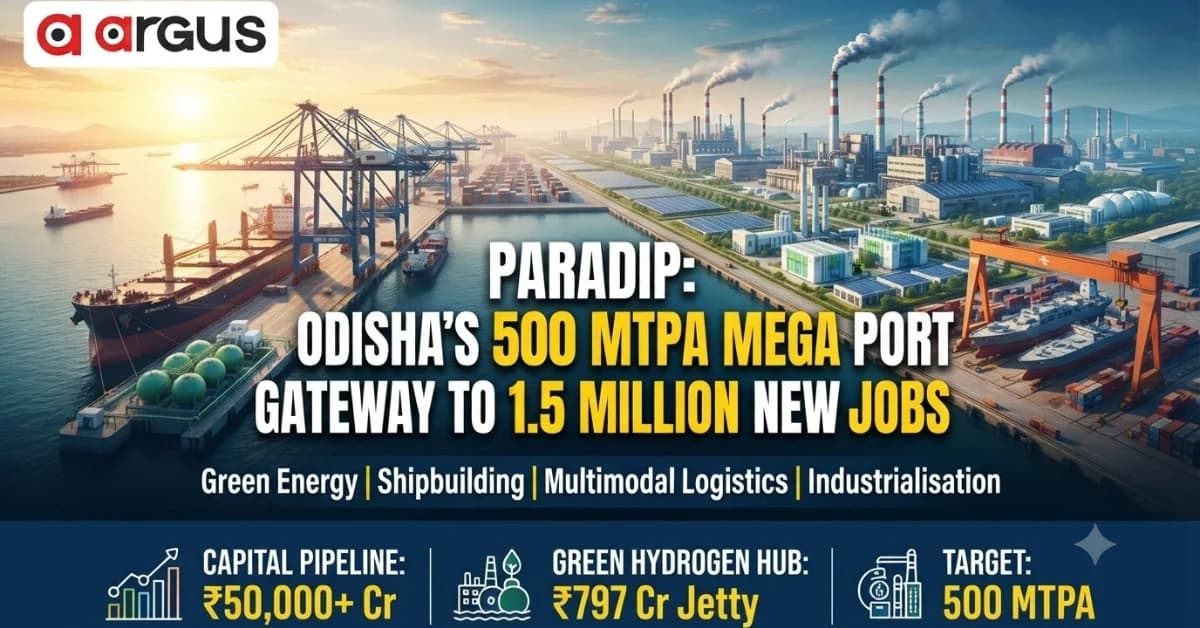
Key Points
Bhubaneswar: A port does not create an economy merely by moving cargo. The bigger economic story begins when cargo attracts factories, factories create supply chains, and supply chains create jobs.
That is the business opportunity opening up for Odisha with Paradip’s elevation into India’s new Mega Port framework – a transition that could potentially take the employment story of the state far beyond traditional port and logistics jobs.
Paradip already has the scale to justify that ambition. The port handled a record 156.45 million metric tonnes (MMT) of cargo in FY 2025-26, its highest-ever throughput, while its rated capacity stood at about 289 MTPA. The port is now pursuing a long-term expansion towards 500 MTPA by 2047.
The significance of the September 2026 Mega Port designation, therefore, lies less in the new label and more in what it can trigger around the port.

📱 Get Argus News App
✨From Port Employment to Port-Led Employment
Paradip's traditional employment base has largely been linked to cargo handling, transport, stevedoring, shipping agencies, maintenance and allied services.
The next phase could be structurally different.
As cargo-handling capacity rises, the demand for warehousing, multimodal logistics, vessel services, freight forwarding, equipment maintenance, marine engineering, customs-related services, packaging and distribution can expand alongside it.
And then comes the larger multiplier: industries that locate themselves close to the port because the port reduces their logistics cost.
This is where the Mega Port transition becomes relevant to Odisha's employment story.
The Paradip Port Authority has already outlined a wider port-led industrialisation strategy covering green hydrogen, shipbuilding and repair, logistics and industrial development. It has also allocated land to industries in the past, with earlier allocations expected to attract thousands of crores of investment and additional cargo traffic.
The employment potential, therefore, cannot be measured merely by counting new posts inside the Port Authority.
The bigger number could emerge outside the port.
500 MTPA: The Employment Multiplier
Paradip's long-term capacity target of 500 MTPA changes the scale of the business proposition.
The port is already moving towards complete mechanisation by 2030. That means future employment is unlikely to come simply from multiplying manual cargo-handling jobs with cargo volumes.
Instead, the composition of employment is likely to change.
More cargo and larger vessels can create demand for:
logistics and multimodal transportation;
warehousing and distribution;
marine engineering and vessel maintenance;
port equipment and automation services;
freight forwarding and customs services;
industrial packaging and cargo processing;
ship repair and shipbuilding;
green-energy production and handling;
downstream steel, chemicals and petrochemicals;
technology, data and smart-port services.
Paradip Port itself says it is moving towards 100% mechanisation by 2030, while its Western Dock project is being developed to accommodate larger Capesize vessels.
That produces an important economic paradox:
A more automated port may create fewer conventional port jobs per tonne—but a much larger industrial ecosystem around the port can create more jobs across the value chain.
The ₹50,000-Crore Green-Energy Opportunity
The other major employment multiplier could come from the energy transition.
Paradip has been recognised as a Green Hydrogen Hub, while the port is developing dedicated infrastructure for green hydrogen and ammonia. In February 2026, the Centre approved a ₹797.17-crore dedicated jetty and allied facilities for handling green hydrogen, ammonia and other liquid cargo, with a proposed capacity of 4 million tonnes per annum.
The port has also reported MoUs associated with green hydrogen and related projects running into very large investment numbers. Its own roadmap envisages Paradip becoming an important node in the global green-fuel supply chain.
For Odisha, the business significance is clear: green hydrogen is not merely a port cargo opportunity.
It can create an ecosystem involving:
renewable power → hydrogen production → ammonia/e-fuels → storage → specialised transportation → export → manufacturing.
Every link requires skills, services, infrastructure and ancillary businesses.
That potentially moves employment from the traditional dock-worker model to a high-skill maritime-industrial model.
Then Comes Shipbuilding
The employment story becomes even wider if Paradip's maritime ecosystem connects with the proposed shipbuilding and ship-repair cluster.
The Port Authority has outlined plans for a 1.5-million-gross-tonne shipbuilding and ship-repair facility near Paradip, while the broader Odisha maritime strategy also includes the proposed Bahuda Port in Ganjam.
Shipbuilding is employment-intensive in a different way from bulk cargo handling.
It needs welders, fabricators, marine engineers, electricians, designers, machinists, logistics workers, safety professionals and a large network of ancillary suppliers.
This creates a possible chain:
Mega Port → more cargo → more logistics → more industry → more shipbuilding → more ancillary manufacturing → more jobs.
That is the real business case behind Paradip's transformation.
The Missing Link: Skills
But investment does not automatically translate into Odisha jobs.
That is perhaps the most important qualification in the employment projection.
If the new ecosystem demands specialised marine engineering, automation, hydrogen handling, advanced logistics and shipbuilding skills, the availability of trained manpower will determine how much of the employment opportunity stays within Odisha.
Paradip Port has already been running skill-development initiatives. The Port Authority said its programmes through CEMS and CIPET generated employment opportunities for Odisha's youth, with almost 100% placement during the previous financial year.
The next challenge is therefore to scale that model.
The question is no longer merely how many jobs Paradip will create. It is how many Odisha youth will possess the skills required to capture those jobs.
Why the Mega Port Tag Matters to Odisha
The Indian Ports Act, 2025 itself does not hard-code a permanent numerical definition of a Mega Port. Section 73 empowers the Centre, in consultation with states, to notify the criteria and classify ports that satisfy those criteria as Mega Ports.
That distinction matters.
Paradip's new status should therefore be read as part of a larger policy and infrastructure transition rather than as a standalone employment announcement.
Its record cargo performance – 156.45 MMT in FY 2025-26 – has already established its scale. Its planned capacity expansion, deeper-draft infrastructure, mechanisation, green-energy projects and maritime industrial plans provide the potential next layer.
For Odisha's economy, the ultimate prize is not simply more tonnes passing through Paradip.
It is more economic value staying around Paradip.
Macroeconomic Boost, Investments & Job Creation
1. CAPITAL INVESTMENT
Before
Mega Port
Routine
infrastructure upgrades: ₹1,000–₹2,000
crore annually
Post-Mega
Port
₹50,000+
crore
pipeline across PPP projects, green hydrogen and Western Dock
development.
Economic
Impact
₹50,000+
crore potential capital pipeline for Odisha
2. GREEN ENERGY
Before
Mega Port
No
commercial-scale green-fuel infrastructure.
Post-Mega
Port
₹2,000+
crore initial investment
for a specialised Green Hydrogen & Ammonia Hub.
Economic
Impact
Paradip
emerges as a potential green-fuel hub for global shipping
3. JOB CREATION
Before
Mega Port
Around
50,000
sustained local port and logistics jobs.
Post-Mega
Port
An
Analysis projects substantial new employment across manufacturing,
logistics and marine services.
Economic
Impact
Potential
large-scale employment expansion around the Paradip ecosystem An
Anslysis shows an estimated 1,500,000+
new jobs
may get created across manufacturing, logistics, and marine services.
4. ODISHA'S GSDP
Before
Mega Port
Economy
driven significantly by raw
mineral exports,
with moderate value addition.
Post-Mega
Port
Potential
downstream expansion in steel,
chemicals and petrochemicals.
Economic
Impact
Paradip
could help shift Odisha from raw-material movement towards
higher-value manufacturing
5. KENDRAPARA MARITIME CLUSTER
Before
Mega Port
Shipbuilding
ecosystem remained fragmented and dependent on further institutional
support.
Post-Mega
Port
Potential
integration with the proposed ₹24,700-crore
shipbuilding cluster.
Economic
Impact
From
cargo handling to shipbuilding: an integrated maritime ecosystem
could emerge
At a Glance
₹50,000+
crore
Potential
investment pipeline
₹2,000+
crore
Initial
green hydrogen & ammonia investment cited in the inputs
500
MTPA
Long-term
Paradip cargo-capacity ambition
Shipbuilding
+ Green Energy + Logistics
Three
major potential employment multipliers beyond traditional port jobs
The Bottom Line
For decades, Paradip's economic identity was largely that of a gateway: minerals, coal, crude and other bulk commodities entered or left through the port.
The Mega Port phase offers a different proposition.
Can Paradip become the gateway not just for Odisha's cargo, but for Odisha's jobs?
That will depend on whether the state can convert port capacity into manufacturing, logistics, shipbuilding, green energy and downstream value addition.
If that transition happens, the biggest employment gain may not appear on the Paradip Port payroll at all.
It could appear in thousands of companies, contractors, factories, logistics firms, shipyards and service businesses that grow around the port.
Paradip's
next economic milestone, therefore, may not be another record in
million tonnes. It may be the number of Odisha livelihoods created
for every million tonnes that passes through the Mega Port.
Also Read: EXCLUSIVE| MMDR Theater in Odisha Assembly: BJD's Cash Race and Congress U-Turn Not Only Betrays Rajiv-Manmohan Legacy but Leave the Common Voter Biggest Loser
Related Topics
Explore more stories