



EXCLUSIVE| Odisha Student Union Polls: D-day on Oct 15, Why State HQ Khordha Vs Kalahandi Hint Big
Key Points
Historical Return: Odisha holds student union elections across 347 colleges and 13 universities after an eight-year hiatus, featuring 6,891 candidates.
Widespread Disruptions: Violent clashes, bomb attacks, voter bribery scandals, and candidate abductions forced 19 colleges to call off polls and declare sine die shutdowns.
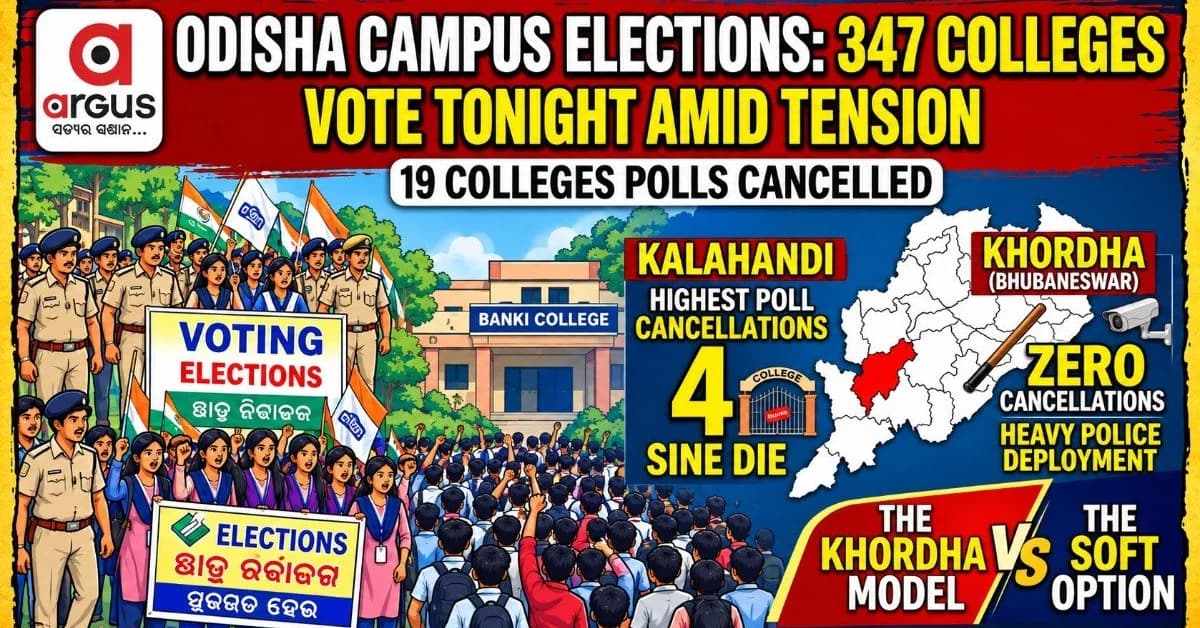
Regional Security Divide: Capital district Khordha registered zero poll cancellations due to heavy police deployment, while peripheral districts like Kalahandi saw high suspension rates.
Bhubaneswar: Campuses across Odisha are under tight security tonight as 347 colleges and 13 universities prepare for tomorrow’s highly anticipated student union elections. Returning after a long eight-year gap, this massive democratic exercise features 6,891 candidates vying for leadership roles.
The critical pre-election "Why I Am Standing as a Candidate" meetings concluded this evening. Contesting candidates pitched their final manifestos to voters inside heavily guarded auditoriums.
At Sailabala Women's Autonomous College in Cuttack, high-pitched campaigns culminated in rallies. Aspiring student leaders laid out dedicated welfare agendas for female students.
However, beneath the vibrant display of flags, banners, and student rallies lies deep institutional friction. What was promised as a revival of campus democracy has instead triggered widespread security challenges.

📱 Get Argus News App
✨A series of violent clashes, candidate abductions, and voter bribery scandals have significantly disrupted the peaceful conduct of the polls. These disruptions have forced multiple college administrations to call off their elections entirely.
Shadow of Intimidation and Bribery Disrupted the Democratic Process
The run-up to tomorrow’s election has been marred by intense political friction. Reports show, across multiple districts, student groups resorted to disruptive tactics to influence voters or stall the election entirely.
The Bribery Scandal
In a major development on Oct 13/14, local police intercepted two tourist buses carrying over 100 students from Chitrada College, Mayurbhanj. The buses were heading toward the coastal town of Puri.
Initial investigations revealed that a Congress party functionary allegedly organized and funded the entire trip as an illicit inducement to sway student voters right before polling day.
When intercepted at Dantiamuhan village by Morada and Betnoti police, authorities discovered that the students lacked written parental consent for the overnight trip. The buses were ordered to turn back, exposing voter bribery tactics.
The Campaign Trail Excesses
Inducement strategies were similarly observed in the Bhograi Block of Balasore district. Reports suggest how candidates have engaged in intense nocturnal door-to-door campaigning. Political factions reportedly distributed lavish free meals at student messes and private residences to secure votes.
Direct Violence and Intimidation
Where bribery failed, direct intimidation took over. At Banki Autonomous College in Cuttack, miscreants hurled explosives inside the campus premises. This triggered protests by ABVP student leaders, who staged a sit-in outside the Banki Police Station, demanding the immediate arrest of the culprits.
Similarly, at National College in Nuapada, a mass protest led by Congress workers escalated into a violent clash with law enforcement. Police detained a Zilla Parishad member following a tense road blockade.
The most severe security breach occurred at Panchayat Samiti College (Odapada) in Dhenkanal district, where the alleged abduction of the ABVP presidential candidate forced a total campus lockdown, compelling authorities to scrap the polls.
The Electoral Math: A Statistical Analysis
Out of the 359 total higher education institutions scheduled to go to the polls, administrative statistics compiled on October 14 reveal that 19 colleges completely failed to hold elections. Campus unrest, safety threats to faculty, and nomination disputes forced college authorities to declare sine die shutdowns.
State-Wide Summary
· Total Scheduled Campuses: 359 (347 Colleges, 12 Universities)
· Total Cancelled/Suspended College Polls: 19 Colleges
· Active Campuses Facing Unrest (Polls Ongoing):** 3 Institutions
· Campuses Flagged for Serious Bribery/Code Violations: 3 Regions
The data highlights a distinct geographical divide in how security threats were handled. While some districts chose to close campuses entirely, others maintained election schedules by deploying heavy police forces.
The Power Center vs. The Hinterland: State HQ Khordha vs. Kalahandi
A comparative analysis of Khordha district (encompassing the state capital, Bhubaneswar) and Kalahandi district reveals contrasting administrative approaches to handling campus unrest.
1. Kalahandi District (Highest Suspension Rate)
Kalahandi recorded the highest rate of election suspensions in the state, with 4 colleges collapsing into sine die status. At institutions like Kesinga College, procedural disputes over the alleged arbitrary rejection and subsequent administrative restoration of nomination papers led to gridlock.
Fearing campus violence and unable to reconcile rival student factions, college administrations opted to suspend the democratic process entirely. This structural pattern was mirrored in other rural and semi-urban pockets of the state, where localized colleges lacked the security infrastructure to handle political friction.
2. Khordha District (The Capital Footprint)
In stark contrast, Khordha district managed to preserve its election footprint without a single college poll suspension, despite holding the largest student and college density in the state. Khordha features a large concentration of high-stakes institutions, including Capital College, where the ABVP has already established an edge by winning 20 out of 29 seats unopposed.
Even when severe inter-group conflicts and pre-poll violence threatened Utkal University (Vani Vihar) in Bhubaneswar, the administration refused to suspend the process. Rather than opting for poll suspension, the state machinery deployed heavy police platoons, set up extensive CCTV monitoring, and strictly enforced the Lyngdoh Committee guidelines to keep the election on track.
State-Wise Campus Election Status at a Glance
|
District Name |
Total Colleges Scheduled for Polls |
Cancelled / Suspended College Polls |
Specific Campuses Cancelled & Primary Reasons |
|
Kalahandi |
14 |
4 |
Kesinga College & 3 others: Nomination rejections and legal disputes. |
|
Jajpur |
26 |
2 |
Vyasanagar Autonomous & Upendranath Sarada College: Inter-group conflicts. |
|
Bhadrak |
11 |
2 |
Bhadrak Women's College & Naami Mahavidyalaya: Disciplinary breakdown. |
|
Nabarangpur |
7 |
2 |
Govt. Model Degree College & Umerkote College: Lack of eligible candidates. |
|
Kendrapada |
18 |
2 |
Laxmibarah Degree & U.K. Mahavir College: Active law-and-order threats. |
|
Nayagarh |
11 |
2 |
Prajamandal Women's & Model Degree (Lathipada): Preemptive suspension. |
|
Cuttack |
22 |
1 |
Banki Autonomous College: Cancelled post-campus bombing incident. |
|
Dhenkanal |
10 |
1 |
Panchayat Samiti College (Odapada): Abduction of ABVP Presidential candidate. |
|
Balasore |
24 |
1 |
Jambeswar Degree College (Soro): Death threats issued to the Principal. |
|
Puri |
17 |
1 |
Gop College: Student rioting following nomination rejections. |
|
Nuapada |
8 |
1 |
Khariar Autonomous College: Intense inter-group campus friction. |
|
Khordha |
45 |
0 |
No cancellations; handled high-profile tension via police deployment. |
|
Other 18 Districts |
138 |
0 |
Polling scheduled to proceed smoothly. |
|
TOTAL |
347 Colleges |
19 Colleges |
5.5% of state college footprint suspended. |
Why Khordha Stood Firm While Others Took the "Soft Option"
The fact that Khordha district, with the highest college footprint in the state, recorded zero college suspensions reveals a clear disparity in administrative capacity and risk management between the state capital and outlying districts.
Khordha District
- Density: High Density (45)
- Suspensions: 0 Suspensions
- Action Strategy:
1. Heavy Police Deployment
2. CCTV Surveillance
3. Active Conflict Resolution
Outlying Districts
- Density: Lower Density
- Suspensions: 19 Suspensions
- Action Strategy:
1. "Soft Option" (Sine Die)
2. Complete Poll Cancellation
3. Hostel Evacuations
1. Strategic Police Proximity and Force Mobilization
The primary reason Khordha avoided suspensions was the immediate availability of state security infrastructure. When clashes occurred at Utkal University, the Commissionerate Police deployed multiple platoons of armed forces within minutes. In rural districts like Kalahandi, Nabarangpur, or Nuapada, local police stations lacked the quick-response personnel necessary to secure multiple campuses simultaneously, making sine die the safest operational alternative for administrators.
2. Institutional Risk Aversion and the "Soft Option"
For college principals in peripheral districts, declaring a campus sine die and canceling elections has become a preferred "soft option" to avoid personal liability and property damage. In contrast to Khordha, where senior bureaucrats can directly oversee campus security, rural principals often face localized political pressure without sufficient administrative backing. When presented with threats – such as the death threats sent to the principal of Jambeswar Degree College in Balasore – rural institutional heads often opt to cancel the polls rather than risk escalation.
3. Administrative Focus on the State Capital
Because Bhubaneswar serves as the state’s political nerve center, any election cancellation or campus shutdown in Khordha generates immediate media coverage and political debate. The state administration used significant resources to ensure that capital institutions like Capital College and RD Women's University remained operational. This level of administrative focus and security backing was less available to smaller institutions like Japkud Women’s Degree College or Naami Mahavidyalaya, leading to their eventual closure.
As the state heads into
tomorrow's decisive voting window, the remaining campuses stand ready under
heavy guard, while the 19 silenced institutions serve as a stark reminder of
the challenges facing campus democracy after an eight-year hiatus.
Also Read: EXCLUSIVE| Odisha Student Union Polls 2026 Trend: Why the 8-Year Ban Failed to Stop Campus Violence at Habitual Hotspots
Related Topics
Explore more stories