




WhatsApp’s @Username Feature Faces Indian Legal Heat: Could Privacy Upgrade Become a New Weapon for Scammers? | Special Analysis
Key Points
* The feature may conflict with Section 79 of the IT Act and IT Rules, potentially putting Meta's Safe Harbour protection under legal scrutiny.
* Cyber investigators fear usernames could delay fraud investigations, money-trail tracking and national security probes across India.
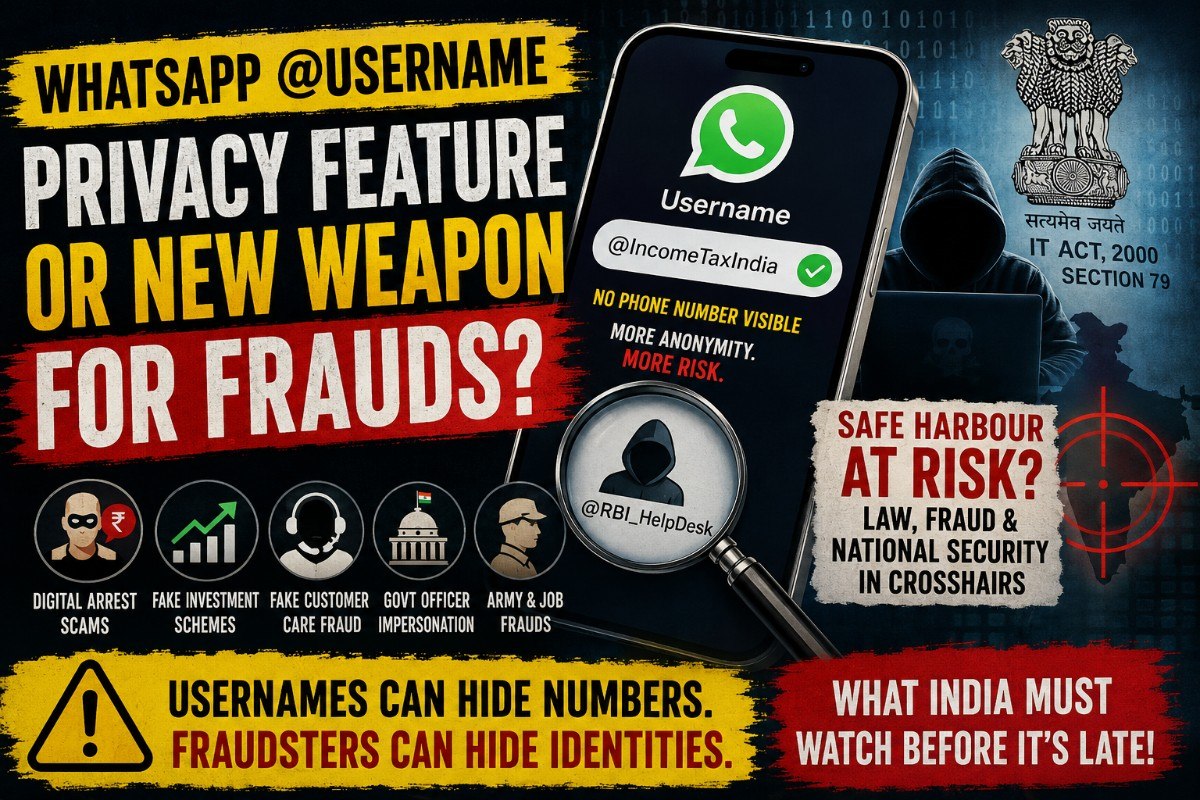
Bhubaneswar: WhatsApp's upcoming @username feature, designed to enhance user privacy by allowing people to chat without revealing their mobile numbers, is emerging as one of the biggest legal and cybersecurity flashpoints between Meta and the Government of India.
What appears to be a simple privacy enhancement could fundamentally alter how India's cyber police investigate financial frauds, impersonation rackets, cyber extortion and even national security cases.
For the common user, the feature promises privacy.
For cyber investigators, it could create another layer of anonymity that criminals may exploit.
The debate is no longer about technology alone – it is increasingly about whether a platform can strengthen user privacy at the cost of weakening India's existing cyber investigation ecosystem.
Why India is worried: The country's fraud epidemic is already exploding
India is witnessing an unprecedented rise in cyber-enabled financial crimes.
According to the Indian Cyber Crime Coordination Centre (I4C), citizens lose thousands of crores annually through online scams. WhatsApp remains one of the primary communication channels used by fraudsters before victims are tricked into transferring money.
Some of the most common frauds include:
1. Digital Arrest Scam
Perhaps India's fastest-growing cyber fraud.
Fraudsters impersonate officials from:
- CBI
- ED
- Income Tax Department
- RBI
- Police
- Supreme Court
Victims receive WhatsApp video calls showing fake police stations, forged arrest warrants and fake government logos.
People are psychologically pressured into transferring lakhs of rupees to "verify accounts" or "avoid arrest."
Several senior citizens, doctors, businessmen and professionals across Maharashtra, Karnataka, Odisha, Telangana and Delhi have lost crores through such scams.
2. Fake Investment Groups
Scammers create WhatsApp groups claiming association with:
- SEBI-registered advisors
- International investment firms
- Stock market experts
Victims are shown fake profits before being persuaded to invest increasingly larger sums.
Many lose their life savings.
3. Fake Customer Care Fraud
Victims searching online for customer care numbers of banks, airlines or e-commerce companies often receive WhatsApp messages from fraudsters posing as executives.
Using screen-sharing apps and phishing links, they empty bank accounts within minutes.
4. Government Officer Impersonation
IAS officers, IPS officers, District Collectors and even Chief Ministers have repeatedly had their photographs stolen and used on WhatsApp profiles.
Fraudsters then contact bureaucrats, businessmen and public representatives seeking emergency fund transfers.
5. Army Recruitment & Job Frauds
Fake Army officers and defence recruitment agents have used WhatsApp extensively to collect registration fees from unemployed youth.
6. Matrimonial & Honey Trap Scams
Fraudsters establish relationships over WhatsApp before demanding money or blackmailing victims using morphed photographs.
So where does the username feature change everything?
Currently, every WhatsApp account is linked to a visible mobile number.
Although criminals can still obtain fake SIM cards or foreign virtual numbers, investigators immediately obtain an important starting point:
- telecom operator
- SIM registration details
- tower location
- IMEI information
- KYC documents
This allows cyber police to move quickly.
The proposed username feature changes that first layer.
Instead of seeing:
+91-98XXXXXXXX
users may simply see:
@IncomeTaxIndia
or
@RBI_HelpDesk
or
@PoliceSupport
The actual phone number remains hidden.
For genuine users, this protects privacy.
For fraudsters, critics argue, it creates another disguise.
A common man's example
Imagine receiving a WhatsApp message from:
@PMO_India
The profile picture carries the national emblem.
The display name says:
Prime Minister's Office
No phone number is visible.
Many users may never question whether the account originates from an Indian SIM, an overseas virtual number or a disposable internet-based registration.

📱 Get Argus News App
✨Earlier, a suspicious international number itself often served as a warning.
Now that visual clue disappears.
The new risk: Lookalike usernames
Cyber criminals have mastered "lookalike" identities.
Instead of:
@SBIOfficial
they may create
@SBI_Official
@SBlOfficial (using lowercase "l")
@SBI-lndia
@IncomeTaxHelp
@CBI.Support
@GovtSupport91
To an ordinary citizen, these appear authentic.
The possibility of impersonation increases dramatically.
Why this becomes a legal issue in India
This is where Section 79 of the Information Technology Act, 2000 enters the picture.
Section 79 grants internet intermediaries – including WhatsApp – what is popularly known as Safe Harbour.
Simply put:
If users commit crimes using the platform, WhatsApp ordinarily cannot be held legally responsible.
But this protection comes with conditions.
The intermediary must:
- exercise due diligence;
- comply with Government-prescribed IT Rules;
- assist law enforcement promptly.
If these obligations are violated, Safe Harbour protection can be lost.
The Government's concern
The Ministry of Electronics and Information Technology (MeitY) may argue that introducing usernames creates an architecture that makes impersonation easier and investigations slower.
If that architecture weakens enforcement against cyber fraud, the Government could contend that WhatsApp is no longer fulfilling its statutory due diligence obligations.
That would expose Meta to a far more serious legal position.
Where the IT Rules may clash with usernames
1. Anti-Impersonation Obligations
The IT (Intermediary Guidelines and Digital Media Ethics Code) Rules, 2021 require platforms to discourage content that deceives users regarding the origin of communication or impersonates another person.
Government officials believe usernames could become structural tools for impersonation rather than isolated misuse.
Unlike fake display names – which already exist – the addition of customizable usernames could make fraudulent identities appear significantly more authentic.
2. Traceability Challenge
India's traceability rule has long been opposed by WhatsApp.
The Government argues that in serious offences – terrorism, national security threats, child abuse or major public disorder – it should be possible to identify the originator of messages through lawful procedures.
WhatsApp has maintained that weakening end-to-end encryption would undermine user privacy.
Usernames introduce another layer.
Investigators fear that even before encryption becomes relevant, identifying the account holder may now require additional requests to Meta instead of relying on immediate telecom records linked to visible phone numbers.
3. Delayed Financial Crime Investigation
This may become the biggest operational concern.
Today, if a fraud complaint reaches cyber police quickly, investigators can immediately:
- identify telecom operator
- seek SIM details
- obtain tower dumps
- track IMEI
- freeze connected bank accounts
Time is critical. Money is often layered through mule accounts within hours.
If usernames hide the primary identifier, investigators may first need to seek account information directly from Meta through formal legal requests.
Officials worry that even small delays could allow stolen money to disappear.
Why national security agencies are also watching
The concern extends beyond financial fraud.
Anonymous or semi-anonymous communication channels have historically been exploited by:
- organised crime syndicates
- terror modules
- espionage networks
- separatist organisations
- foreign intelligence operations
Investigators argue that any feature introducing an additional anonymity layer must simultaneously provide equally strong mechanisms for rapid lawful identification under judicial oversight.
WhatsApp's perspective
From Meta's standpoint, usernames are designed to enhance user privacy – not criminal anonymity.
The company is expected to argue that:
- phone numbers remain linked internally to accounts;
- usernames reduce unwanted exposure of personal numbers;
- multiple safeguards against impersonation can be built into the system;
- law enforcement requests will continue to be processed under applicable law.
Privacy advocates also note that millions of users – especially women, journalists, activists and professionals – prefer not to share personal mobile numbers with strangers merely to initiate a conversation.
For them, usernames can significantly reduce harassment, spam and unsolicited contact.
The real balancing act
The debate therefore is not privacy versus surveillance.
It is about balancing:
- privacy,
- cybersecurity,
- financial protection,
- lawful investigation,
- digital innovation.
India has one of the world's largest WhatsApp user bases and simultaneously one of the fastest-growing cyber fraud ecosystems.
A feature that works seamlessly in smaller jurisdictions may have very different consequences in a country where millions of first-time internet users rely on WhatsApp as their primary digital communication platform.
What could happen next?
Technology experts believe consultations between Meta and the Ministry of Electronics and Information Technology will likely focus on safeguards such as:
- verified badges for government departments and regulated institutions;
- stronger detection of lookalike usernames;
- faster emergency data-sharing mechanisms for cybercrime investigations;
- rapid account suspension protocols for impersonation complaints;
- enhanced cooperation with Indian law enforcement in high-priority financial fraud cases.
If regulators conclude that the feature materially weakens compliance with India's due diligence framework under the IT Act and the IT Rules, they could seek modifications, delay the rollout, or in an extreme scenario, direct restrictions on the feature until adequate safeguards are in place.
Bottom Line
WhatsApp's
username feature is not merely a product update – it represents a significant
policy test for India's digital governance framework. While it promises greater
privacy for ordinary users, it also raises legitimate questions about
impersonation, cyber fraud, investigation timelines and platform accountability.
The ultimate challenge for both Meta and Indian regulators will be to ensure
that stronger privacy does not inadvertently become a stronger shield for
cybercriminals.
Also Read: Amit Shah Orders Mandatory ED Crackdown on Drug Cartels to Crush their Finances; New Doctrine Revealed| Big Breaking
Related Topics
Explore more stories