



Special Report| Odisha’s 72-Year-Old Acid Attacker: An Unprecedented Crime Profile That Challenges India’s Understanding of Acid Violence
Key Points
Unprecedented Age Profile: A 72-year-old man's alleged involvement in the Kharvela Nagar acid attack breaks the conventional demographic norm of younger perpetrators.
A Shift in Motive Dynamics: The case marks what appears to be India's first recorded instance of an elderly individual targeting someone over unrequited love or romantic rejection.
Historical Context: Contrasts the new incident against past landmark Odisha cases like the 2009 Pramodini Roul attack and broader NCRB data trends.
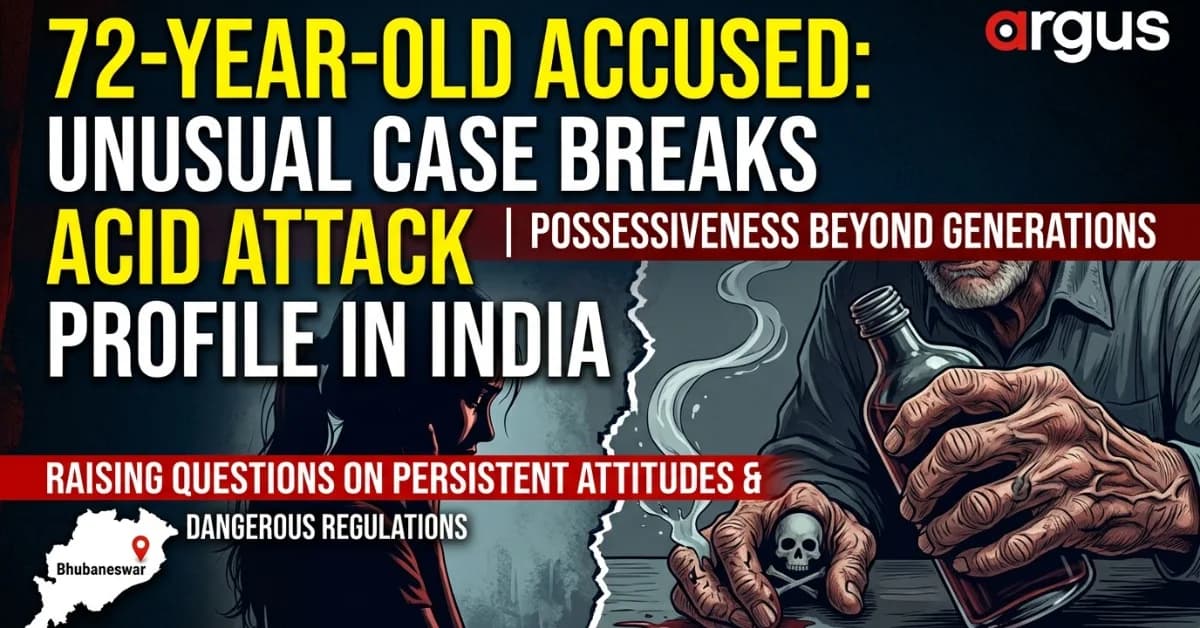
Bhubaneswar: Acid attacks in India have predominantly been associated with young men driven by rejection, failed relationships, stalking or personal vendettas. But the alleged involvement of a 72-year-old man in the recent Kharvela Nagar acid attack case in State Capital has brought an unusual dimension to the country’s history of acid violence, raising questions about the age profile of perpetrators, the persistence of possessive attitudes and the effectiveness of regulations governing the sale of corrosive substances.
The case involving Basanta Ashwini Choudhury stands out against the historical profile of acid attack perpetrators documented in Odisha. While previous cases in the state have largely involved men in their 20s and 30s, the Bhubaneswar incident involves an accused in his seventies, making it an exceptional case in the available historical record of acid violence in Odisha.
The case also raises a larger question: can acid violence, often viewed through the lens of youth-driven romantic rejection, emerge from the same pattern of alleged possessiveness and retaliation even among perpetrators in their seventies?
A 72-year-old accused breaks the conventional crime profile
The age of the accused is the most striking feature of the Kharvela Nagar case. An analysis of the available records from 1995 to 2026 indicates that elderly men in their seventies have been exceptionally uncommon among perpetrators of acid attacks linked to romantic rejection in Odisha.

📱 Get Argus News App
✨Historically, acid violence in the state has largely involved young and middle-aged men.
The 2009 attack on Pramodini Roul, the 2018 attack on Debanti Bibhar and other cases involving rejected romantic advances illustrate a recurring pattern in which perpetrators allegedly resorted to extreme violence after women refused their proposals or advances.
The Bhubaneswar case presents a markedly different demographic profile.
At 72, Choudhury is far removed from the age group traditionally associated with such crimes. The incident therefore challenges the assumption that acid violence driven by possessiveness, rejection or retaliation is predominantly a crime of younger men.
However, age alone does not establish a new category of criminal behaviour. The circumstances, alleged motive and evidence in the individual case remain central to understanding the crime.
India's first case involving an elderly acid attack accused?
The Kharvela Nagar incident could represent an unprecedented case in a specific category of acid violence: an alleged acid attack by a man in his seventies linked to unrequited love or romantic rejection.
The available historical inputs identify no earlier case in Odisha since 1995 involving a man aged around 70 or above carrying out an acid attack on a young woman for this alleged motive.
However, nationally seen, this seems also to be India's first case involving an elderly acid attacker attacking with the motive of unrequited love. But Basanta is not the first 70+ man who has used acid as weapon of crime.
Sample the Following:
In March 2026, a 75-year-old man allegedly threw an acid-like corrosive liquid at his 61-year-old estranged wife inside a family court in Surat, Gujarat, during a maintenance dispute.
In Delhi, a 70-year-old man was reported to have thrown a corrosive substance at two women and six children in 2017 following a neighbourhood dispute.
There was a 2013 case in Lucknow in which a 50-year-old man (mark the age) allegedly attempted to attack a 24-year-old woman with acid after she rejected his marriage proposals.
These incidents establish that, though, elderly perpetrators have used acid as crime weapon, none in the 70+ used it for rejection of romantic advancements.
From Pramodini Roul to Kharvela Nagar: A disturbing continuity
Odisha's history of acid violence offers several cases that help explain the recurring connection between rejection and extreme retaliation.
In 2009, 17-year-old Pramodini Roul, popularly known as Rani, was attacked with acid after rejecting a marriage proposal from Santosh Bedanta, a 35-year-old paramilitary jawan. The attack left her with extensive burns, blindness and severe physical disabilities. After years of struggle, the case was reopened, eventually leading to the conviction of Bedanta and an associate, who were sentenced to 14 years of rigorous imprisonment in May 2022.
In 2018, 22-year-old computer student Debanti Bibhar was attacked by a 32-year-old villager, Parsuram Majhi, who had allegedly pursued her for two years. She was intercepted on her way to class and attacked after repeatedly rejecting his advances.
More recently, a 2025 acid attack threat in Bhubaneswar highlighted the continuing danger of stalking and coercive behaviour. In that case, locals in Saheed Nagar intercepted Sunil Sethi, who was allegedly carrying acid after threatening a woman who had rejected him.
These cases differ in their circumstances and outcomes, but they demonstrate how rejection and a perceived entitlement to a woman's consent have featured in several acid violence incidents in Odisha.
A Glance At Acid Attacks In Odisha
Here is the data organized into a clean, easy-to-read tabular format regarding Acid Attack Incidents in India and Odisha based on NCRB records:
|
Year |
Odisha Incidents (Cases) |
Pan-India Incidents (Total Cases) |
Context / Key Historical Markers |
|
1995–2013 |
No separate tracking |
No separate tracking |
Historically clubbed under generic IPC sections such as 307 and 326. Individual landmark cases occurred, including the 2009 Pramodini Roul case in Jagatsinghpur. |
|
2014–2015 |
Data localized |
~200–300 |
Transitional phase following the Supreme Court's Laxmi v. Union of India verdict on regulatory bans. |
|
2016 |
2 |
223 |
Official standardised tracking begins under dedicated IPC columns. |
|
2017 |
3 |
244 |
Regional baseline remains steady in Odisha; North Indian states see higher surges. |
|
2018 |
4 |
228 |
Cases reportedly related largely to unrequited love and rejected marriage proposals. |
|
2019 |
5 |
240 |
General consistency in reported trends. |
|
2020 |
3 |
182 |
Nationwide decline, attributed in the supplied data to strict pandemic lockdowns and limited public movement. |
|
2021 |
2 |
176 |
Gradual resumption of standard crime-tracking patterns. |
|
2022 |
4 |
202 |
Odisha also recorded one additional explicit attempt-to-acid-attack case under IPC Section 326B. |
|
2023 |
11 |
207 |
Significant surge in Odisha, with the state recording cases alongside Rajasthan. West Bengal registered the highest number nationally, at 57 cases. |
|
2024 |
Minimal / Baseline |
Steady national average |
Under-reporting due to societal stigma and pressure remains a significant concern nationally. |
|
2025 |
Baseline |
Projected ~200+ |
Includes isolated localised interventions, such as the Saheed Nagar interception in Bhubaneswar. |
Note: Figures and historical descriptions are organised from the information provided. The 2024 and 2025 entries are qualitative or projected, rather than confirmed case counts. The figures and interpretations should be checked against the relevant NCRB reports before publication.
The
Kharvela Nagar case introduces an unusual age dimension to this
pattern. It raises questions about how such attitudes can persist
across generations and why personal rejection can, in some cases,
escalate into extreme violence.
Also Read: EXCLUSIVE| Twin Cities Crime Is Changing Shape: From Visible Gangs to Invisible Networks, New DCP Faces a Different Challenge