



EXCLUSIVE| Twin Cities Crime Is Changing Shape: From Visible Gangs to Invisible Networks, New DCP Faces a Different Challenge
Key Points
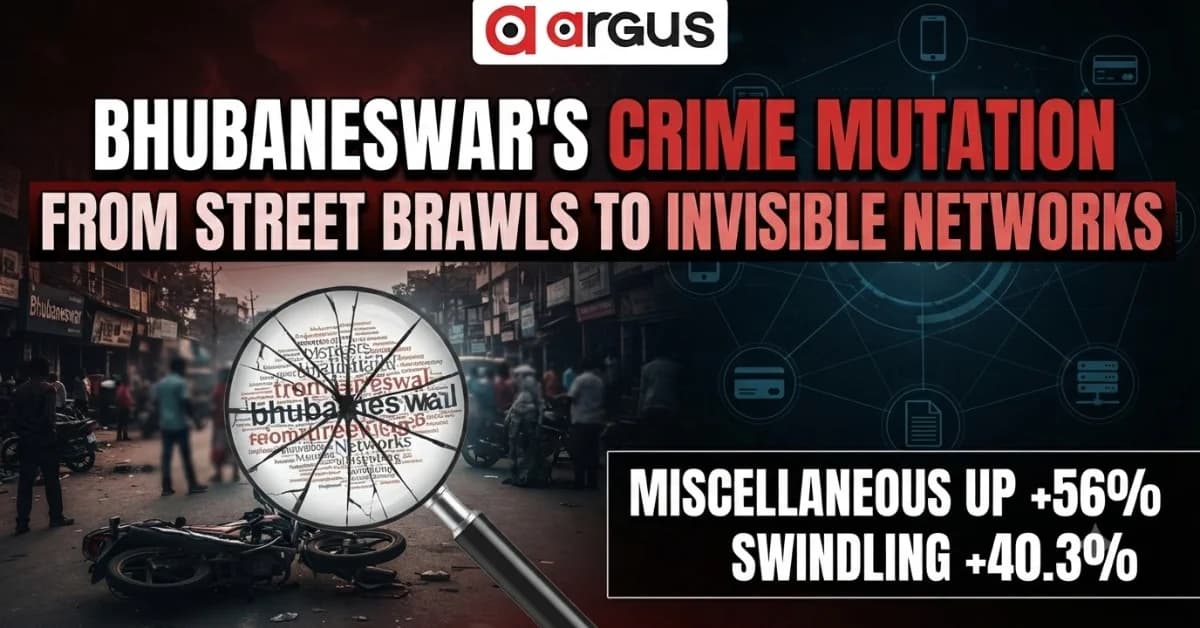
Miscellaneous offences in the twin cities surged by 56% over a six-month period, pointing to a rise in both everyday urban aggression and hidden facilitation crimes.
Financial swindling cases jumped by 40.3%, rising from 611 to 857 cases, highlighting an expansion in digital and networked monetary fraud.
With Dr. Saravana Vivek M taking charge as the new Bhubaneswar DCP, policing challenges are shifting from visible street gangs to mapping complex, sub-visual criminal networks.
Bhubaneswar: Crime in the twin cities appears to be changing not merely in volume, but in character.
The six-month crime statistics released by the Commissionerate Police reveal a striking divergence: while some traditional, high-visibility property crimes have declined or remained contained, the broader category of miscellaneous offences has surged by 56 per cent and swindling has risen from 611 cases to 857 – a 40.3 per cent jump.
That combination deserves closer examination.
The numbers do not by themselves establish that every miscellaneous case is connected to a fraud syndicate. But taken together, the trends point towards an evolving urban crime environment in which physical force and conventional street offences are increasingly sharing space with conspiracy, abetment, criminal mischief, public nuisance and financially motivated deception.

📱 Get Argus News App
✨In criminological terms, this can be understood as a movement from visible, hierarchical forms of organised crime towards smaller, fluid and less conspicuous criminal networks.
For the twin cities, that may be the more significant crime story emerging from the six-month data.
The 2,522-case question: What is hiding inside 'miscellaneous' crime?
The 56 per cent increase in miscellaneous cases translates into an addition of about 2,522 cases in six months.
The importance of this number lies not simply in its size, but in what this category contains.
Miscellaneous offences include a range of crimes and violations such as public nuisance, abetment of crime, criminal mischief, conspiracy and animal-cruelty-related offences, including cases that can involve cattle theft or illegal movement of livestock.
These are apparently disparate offences.
But from a crime-pattern perspective, they can reveal something about the environment in which more complex criminal activity operates.
A public nuisance or criminal-mischief case may remain an isolated neighbourhood offence, but an imporatnt indiactor of agression ingraining into Twin city society.
An abetment or conspiracy case, however, potentially points towards the existence of additional actors behind the immediate offender.
That distinction is crucial.
A conventional street-crime model looks for the person who committed the offence.
An emerging network-crime model asks a different question:
Who arranged it, facilitated it, financed it, provided the documents, supplied the account, made the connection or created the conditions for it to happen?
That is where the miscellaneous-crime surge becomes analytically important.
From gangs to micro-networks
The older image of organised crime is relatively straightforward: a known gang, a known leader, identifiable associates, territorial influence and visible use of force.
Such organisations are comparatively easier to identify as organisations.
The emerging model is less visible.
A property dispute may involve one group. A documentation intermediary may operate separately. A mule-account provider may have no visible connection with either. A digital operator may sit in another city. A local person may merely facilitate the introduction.
The participants need not operate as a permanent gang.
They can assemble for a particular criminal operation and disappear afterwards.
This is criminal atomisation – organised criminal activity becoming fragmented into smaller, fluid components.
The result is a low-signature, high-yield model of crime.
There may be no dramatic robbery, no armed gang moving through a neighbourhood and no permanent criminal territory.
Instead, the crime may leave behind a phone number, a bank account, a forged document, a digital transaction, a vehicle registration or a chain of intermediaries.
The criminal network exists, but its visibility is dramatically reduced.
The swindling spike is the financial end of the equation
The rise in swindling provides the other half of the picture.
Cases have risen from 611 to 857, representing a 40.3 per cent increase.
Again, the figures do not establish a one-to-one causal relationship between miscellaneous offences and swindling.
But the two trends raise an important policing question: what infrastructure allows financial fraud to scale?
Large-scale fraud rarely depends only on the person who makes the final fraudulent call or sends the final digital link.
It can involve layers of facilitation – identities, accounts, documentation, communication channels, intermediaries and money-transfer mechanisms.
That is why the relationship between conspiracy and execution becomes important.
The conspiracy is the architecture.
The swindling is the monetisation.
The person visible at the end of the transaction may therefore be only one node in a much larger chain.
The other warning inside the 'miscellaneous' spike: aggression becoming embedded
There is another, equally important reading of the 56 per cent surge in miscellaneous cases — and it has little to do with cybercrime or organised financial fraud.
Public nuisance and criminal mischief can be read as indicators of aggression entering the everyday social fabric of the twin cities.
A robbery or burglary has a clearly identifiable victim, offender and crime scene. Public nuisance and criminal mischief are different. They often emerge from day-to-day friction — neighbourhood disputes, confrontations, intimidation, vandalism, public altercations and conflicts spilling into the street.
Any individual case may remain a small, isolated neighbourhood offence.
But when such offences rise substantially across an urban population, the trend deserves a different sociological reading.
It can indicate that aggression is increasingly becoming a way in which ordinary disputes and local conflicts are expressed and settled.
That makes the miscellaneous category important even where no organised criminal network is involved.
From crime by gangs to aggression in everyday life
This is perhaps the most under-examined dimension of the six-month crime figures.
The traditional crime narrative focuses on gangs, robbery, burglary, dacoity and other visibly criminal acts. But a rapidly expanding city can also experience a different form of insecurity – the normalisation of confrontation in everyday public life.
Parking disputes can become confrontations.
Neighbourhood disagreements can turn into criminal mischief.
Personal disputes can spill into public spaces.
Verbal intimidation can escalate into physical acts.
What begins as ordinary social friction can consequently enter the criminal-justice system as nuisance, mischief or related offences.
The significance therefore lies not in labelling every such case as organised crime, but in recognising that the boundary between ordinary civic friction and criminal behaviour may be becoming increasingly thin.
The twin cities are therefore facing two different mutations
This is where the six-month data becomes more revealing.
At one end is the street-level mutation:
public friction → confrontation → nuisance → criminal mischief → local intimidation.
At the other is the network-level mutation:
conspiracy/abetment → facilitation → digital or financial deception → swindling.
The two should not automatically be treated as the same phenomenon.
But both point to a changing crime environment.
One indicates the possibility of aggression becoming more deeply embedded in everyday urban interaction.
The other indicates the possibility of criminal activity becoming more dispersed, networked and financially sophisticated.
That makes the 56 per cent rise in miscellaneous cases considerably more important than its statistical label suggests.
The real question before the Commissionerate is therefore not merely how to contain individual offences.
It is how to understand what is changing underneath those offences – in neighbourhood behaviour on one side and criminal organisation on the other.
Why declining robbery and burglary also matter
The changing crime profile becomes clearer when the miscellaneous and swindling figures are read alongside traditional property offences.
According to the six-month statistics supplied by the Commissionerate Police, robbery has declined by 3.2 per cent while burglary is down 16 per cent.
Those figures should not be interpreted as proof that conventional crime is disappearing.
But they do show a divergence.
The offences requiring physical access, physical confrontation or obvious physical evidence are not displaying the same upward trajectory as fraud and the miscellaneous category.
That creates a potentially important distinction between high-signature crime and low-signature crime.
A broken lock announces a crime. A fraudulent transaction may initially look like a legitimate transaction.
A street robbery creates an immediate crime scene. A digital fraud may leave the victim discovering the loss hours later.
A violent gang creates a visible policing problem. A dispersed network creates a data problem.
And that difference changes the nature of policing required.
The 'sub-visual' character of the new crime
A useful analytical description of this emerging pattern is sub-visual crime – not an official police classification, but a way of describing offences whose operational footprint remains below the visibility threshold associated with conventional gang crime.
The defining feature is not that these crimes are literally invisible.
It is that they are less immediately visible as organised crime.
The network may operate inside legitimate systems:
banking platforms;
telecommunications;
property transactions;
documentation systems;
digital payment channels;
vehicle and transport networks;
ordinary neighbourhood relationships.
That creates what can be called a symbiotic criminal environment.
The criminal does not necessarily attack the system from outside.
The criminal exploits the system from inside.
This is why a rise in miscellaneous offences becomes significant even when individual cases appear small.
The apparently minor offence can sometimes represent the local infrastructure around a much larger operation.
Animal-cruelty and cattle-theft cases add another layer
The presence of animal-cruelty-related offences within the miscellaneous category also deserves examination, particularly where cases involve cattle theft or illegal transportation.
Such activity, when organised, requires more than an individual act of theft.
It can involve procurement, transportation, temporary holding locations and knowledge of routes.
That does not mean every animal-cruelty or cattle-theft case is syndicate-driven.
But where repeated incidents show common vehicles, locations, accused persons or transport patterns, the cases can potentially reveal networked activity operating between the urban core and its peripheral corridors.
This is precisely where crime analysis becomes more valuable than simply counting FIRs.
The emerging policing challenge: follow the connection, not only the case
The six-month figures therefore raise a larger question for the Commissionerate Police.
Can apparently separate offences be analysed for their common connections?
That is the essence of intelligence-led policing.
A criminal-mischief case and a financial-fraud case may have nothing to do with each other.
But if the same phone number, vehicle, bank account, intermediary, address or associate repeatedly appears across cases, the individual FIRs can potentially become pieces of a larger network.
The objective is not to assume a connection.
It is to test whether one exists.
That means crime mapping, digital evidence analysis, financial trails, communications analysis and cross-case intelligence become increasingly important.
The challenge shifts from identifying only the offender at the point of crime to identifying the facilitators and connecting nodes behind multiple offences.
Where Vivek Shravan fits into this changing crime landscape
It is against this backdrop that the arrival of Dr Saravana Vivek M as Bhubaneswar DCP becomes operationally significant.
His move to the capital comes after his tenure as Berhampur SP, where policing involved several cases featuring organised and violent criminal activity.
Recent Berhampur investigations under Vivek included the probe into a planned attack in which police recovered a firearm, ammunition and a sword, and investigators suspected a wider conspiracy involving associates.
More recently, his police team also pursued a witness-intimidation case involving alleged use of a jail doctor's phone, examining call records, WhatsApp records and CCTV footage.
That experience is relevant because it demonstrates an investigative approach that does not stop at the immediate incident.
The witness-intimidation investigation, for instance, required police to examine the communication device, call records, CCTV footage and the chain of access to the phone.
That is precisely the investigative mindset required when crime becomes increasingly networked.
From gang intelligence to network intelligence
The transition from Berhampur to Bhubaneswar therefore presents a different policing challenge.
In a conventional gang environment, intelligence can revolve around:
Who
is the gang leader?
Who are the associates?
Where is the gang
operating?
What weapons are being used?
Which rival group is
involved?
The emerging twin-city crime environment demands another set of questions:
Who
connects apparently unrelated offenders?
Which accounts receive
the money?
Which phone numbers recur?
Who provides fraudulent
documentation?
Which intermediaries repeatedly appear?
Which
locations repeatedly occur across different categories of cases?
Why the aggression or rowdyism growing in society?
That is the transition from gang intelligence to network intelligence.
And the new DCP's experience in handling cases involving multiple actors, technical evidence and organised criminal activity could be relevant to that transition.
The real test: reading the background crime
The challenge for Vivek in Bhubaneswar is therefore unlikely to be confined to controlling the most visible offences.
The larger analytical test will be whether the Commissionerate can read the background crime beneath the headline crime.
If miscellaneous cases continue to rise, the important question will not simply be how many cases were registered.
It will be:
What exactly is driving the increase?
If the rise is predominantly explained by public nuisance and isolated criminal mischief, it represents one kind of urban challenge – ingraining of rowdism in society.
If repeated clusters of abetment, conspiracy, documentation-related offences, property disputes and other facilitation crimes begin intersecting with financial fraud, it points towards another.
That distinction matters because the policing response would have to be different.
And another new challenge before the newly appointed DCP Vivek Shravan becomes broader than conventional crime control is: he inherits a capital in which crime appears to be changing simultaneously at the street level and beneath the surface.
The emerging picture can therefore be summarised in three layers.
First, conventional street crime like robbery and burglary are not showing the same growth trajectory in the six-month data. But aggression at the street level is rising. Street or parking brawls turning into headlines like the Balianta mob lynching type cases.
Second, background criminal activity: miscellaneous offences have risen sharply, bringing conspiracy, abetment, criminal mischief, nuisance and related offences into greater focus.
Third, financial extraction: swindling has jumped 40.3 per cent, from 611 to 857 cases.
The three layers should not automatically be treated as one criminal chain.
But their simultaneous movement provides enough of a pattern to warrant closer network-level examination.
That is the real significance of the six-month crime statistics.
The twin cities may not necessarily be witnessing simply more crime.
They may be witnessing crime changing its operating model.
And for Vivek Shravan, the operational challenge in Bhubaneswar could consequently be less about finding the next visible gang and more about discovering the invisible connections between seemingly unrelated crimes.
The
crime scene is moving from the street to social, and to the network.
The policing question is whether the network can be mapped before it
becomes the next syndicate/gang.
Also Read: EXCLUSIVE|Tactical Shift in Capital Policing: New Bhubaneswar DCP Saravana Vivek M Positions Force Against Street Crime & Cyber Fraud