



Special Report | From Instagram DM to Village Tree: How an Extra-Marital Affair Sparked a Kangaroo Court in Odisha, and Why Time for State to Go Maharashtra Way
Key Points
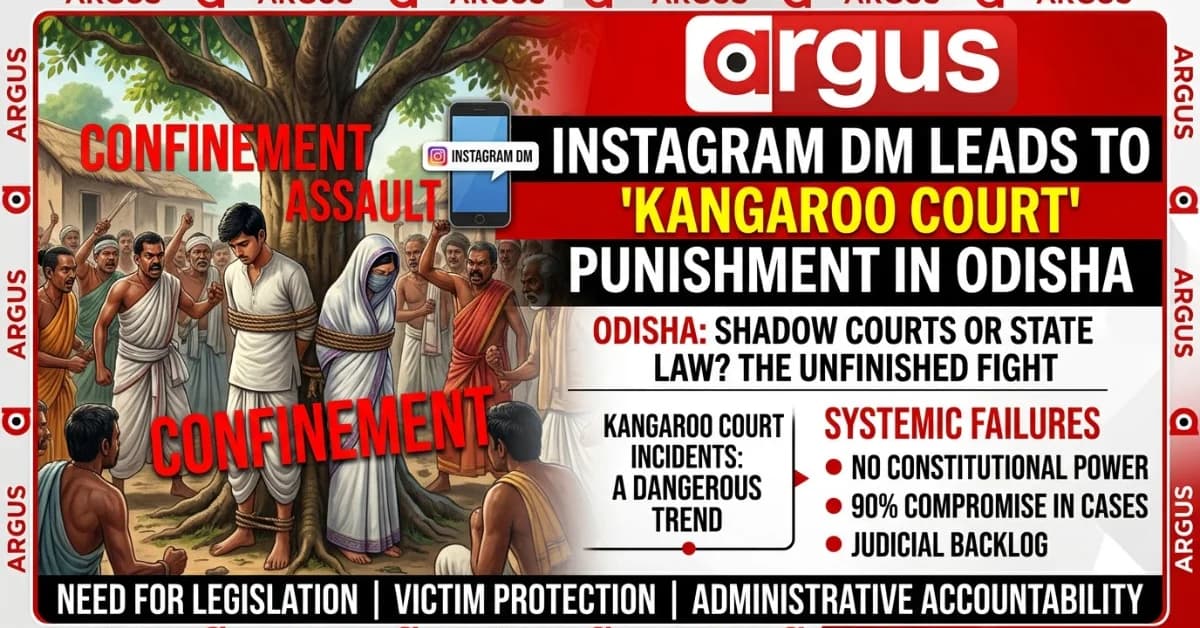
An Instagram romance in Odisha's Mayurbhanj district led villagers to detain a couple, tie them to a tree, and subject them to a kangaroo court trial.
Despite the 2018 Supreme Court decriminalisation of adultery, informal village assemblies continue to illegally assume the role of moral and criminal judges.
Experts argue that Odisha needs a dedicated legislative model similar to Maharashtra and Karnataka to dismantle the social machinery of illegal kangaroo courts.
Bhubaneswar: A relationship that reportedly began with an Instagram direct message has now collided with one of Odisha's oldest forms of informal social control – a village kangaroo court. The punishment belonged to an entirely different world.
A 22-year-old youth from Ratila village and a married mother of two from Yoka village allegedly developed an intimate relationship after connecting through Instagram. But when the relationship reportedly came into the physical world, the matter moved not to a police station or a court of law, but into the hands of villagers.
According to the allegations in the case, the couple were caught by villagers, tied to a tree with ropes, kept in unlawful confinement and subjected to prolonged interrogation and physical assault. The alleged proceedings were conducted physically by traditional Majhis and village elders, who purportedly assumed the role of a jury and punishment-giving authority.
The case, therefore, has again put glare on the kangaroo court trend in many districts in the State. The moot point here is: how a relationship originating in a borderless digital space can still end up being judged through an informal social authority that has no constitutional or judicial power to punish citizens.

📱 Get Argus News App
✨The alleged affair itself is a separate legal question.
An accusation of adultery does not justify violence, confinement or public punishment. Nor does the decriminalisation of adultery mean that a spouse has no legal remedy. Matrimonial law provides its own avenues for dealing with allegations of infidelity.
What it does mean is that the alleged affair and the alleged kangaroo-court punishment have to be examined as two legally separate questions.
One concerns the relationship.
The other concerns whether a group of private citizens unlawfully deprived other citizens of their liberty and subjected them to violence.
And under India's constitutional framework, the second cannot be converted into a lawful punishment merely because a village considers the first morally unacceptable.
The significance of the case lies in the unusual combination of adultery, social media and extra-legal punishment.
The relationship may raise serious questions within the marriage and family. Adultery can have consequences in matrimonial proceedings and can remain relevant as a ground for divorce. But that does not create a licence for a village assembly to conduct its own criminal trial.
The distinction is crucial: one alleged wrong cannot become the legal justification for another.
From Inter-Caste Marriage to Adultery: The Kangaroo Court Trend
Much of Odisha's recent kangaroo-court reporting has involved inter-caste relationships, marriages against community norms, alleged violations of clan rules or disputes involving traditional social practices.
The present case marks a different trigger.
Here, the alleged relationship involved a married woman, making adultery the central moral and social accusation.
But the constitutional position is different from the village position.
The Supreme Court's 2018 Joseph Shine v Union of India judgment struck down Section 497 of the IPC and decriminalised adultery. The judgment did not declare adultery socially desirable or erase its consequences in matrimonial law. The Supreme Court subsequently clarified that adultery may remain a moral wrong, a civil wrong and a ground for dissolution of marriage.
That distinction matters enormously in the present case.
Adultery is not a criminal offence merely because a village considers it immoral.
At the same time, decriminalisation of adultery does not mean that an alleged affair automatically becomes legally irrelevant. A spouse can pursue remedies available under matrimonial law. What does not follow is the creation of a parallel punishment system outside the Constitution.
What the Constitution Says – And What the Village Cannot Do
The Constitution does not recognise a Majhi, caste assembly or village committee as a criminal court.
The Supreme Court has repeatedly rejected the idea that informal assemblies can take law into their own hands. In Shakti Vahini v Union of India, the Court dealt specifically with the threat posed by khap panchayats and honour-related violence and directed States to create preventive, remedial and punitive mechanisms.
The principle is straightforward: community opinion may exist; community punishment cannot replace the State's justice system.
A village assembly can report an alleged offence to the police. It can raise a social or community concern through lawful means. It cannot detain citizens, assault them, impose a criminal fine, publicly punish them or issue its own sentence.
The alleged acts in the Ratila-Yoka case therefore have to be examined independently of the morality of the relationship. If unlawful confinement, assault, intimidation or other offences are established, those acts have to be dealt with under criminal law.
The Supreme Court has been particularly clear that informal bodies cannot assume the role of law-enforcement agencies merely because they claim to be protecting community values.
Tracking Odisha's Kangaroo-Court Trail: 2013–2026
Though NCRB and Odisha Police do not maintain a separate crime head called “kangaroo court,” Such incidents can enter the criminal justice system through different offences. Therefore, the following table has been prepared taking into account the cases that were reported in media reports. A glance at the trend also indicates that the rise may partly reflect increasing smartphone penetration, viral videos and greater digital reporting.
|
Period |
Estimated documented cases/year |
Pattern in available reportage |
What changed |
|---|---|---|---|
|
2013–2016 |
1–2 |
Low visibility |
Cases largely remained within villages; social ostracism and Ekagharia rarely entered mainstream reporting |
|
2017–2020 |
3–4 |
Growing visibility |
Smartphone penetration increased documentation; community fines and punishment of relationships became more visible |
|
2021–2023 |
5–7 |
Clearer public visibility |
Head-shaving, public humiliation, parading and social-media videos increasingly exposed incidents |
|
2024–2026 |
8–12+ |
High visibility / severe incidents |
Physical punishment, alleged confinement and public humiliation received wider attention; the 2025 Rayagada forced-ploughing incident became a prominent example |
The recent record does show why the issue can no longer be treated merely as an occasional village dispute.
In July 2025, a Rayagada couple were reportedly tied to a wooden yoke and forced to plough a field after marrying against local community norms; the incident became widely known after video footage circulated.
And in September 2026, a 22-year-old Malkangiri youth, Sagar Sarkar, died by suicide after his family alleged that a village kangaroo court assaulted him and imposed a Rs45,000 fine over his relationship with a married woman. The village committee president denied the allegations, and police investigation followed.
The pattern therefore needs to be described carefully: the available evidence shows increasing documentation and repeated serious incidents; it does not by itself establish that the true incidence has risen at precisely the same rate.
Why Do Kangaroo Courts Still Rule?
The deeper question is not why villagers become angry over relationships.
The deeper question is: why does a group still believe it can convert that anger into punishment?
The FIR Problem: When a Case Begins but the System Struggles to Finish It
An analysis of FIR outcomes over the years in kangaroo-court justices cites a 70% compromise rate. More so, a judicial backlog of more than 19 lakh cases in Odisha make the trial process extra burden for the complainants.
The Structural Problem recorded in such cases are given below:
A victim can be rescued.
An FIR can be registered.
Arrests can be made.
And yet the village social structure may remain exactly where it was.
That is why the debate has moved beyond merely asking whether police registered a case.
The harder question is:
Does the system have a mechanism to protect the complainant until the case reaches its legal conclusion?
According to Bhajman Biswal, a noted human rights defender,
"The recurring instances of couples yoked to plows or chained to trees for days indicate a complete breakdown of local administrative intelligence. The local Sarpanch, Gram Panchayat members, and village watchmen are often silent spectators or active conspirators in these panels. Despite structural warnings from the Orissa High Court to enforce strict deterrents, district administrations remain passive. A warning does not deter a mob; only immediate administrative disqualification of complicit village officials and the denial of state grants to offending villages can halt these shadow courts."
Odisha Could Examine the Maharashtra Model
The more consequential comparison is Maharashtra.
During Devendra Fadnavis's tenure as Maharashtra Chief Minister, the State enacted the Maharashtra Protection of People from Social Boycott (Prevention, Prohibition and Redressal) Act, 2016. The Maharashtra government itself lists the legislation among its laws.
The law's significance is not that it criminalises “love” or family disputes.
It targets the social machinery of boycott itself.
The legislation prohibits assembling with the intention of imposing social boycott and provides for punishment of those who organise or participate in such assemblies. It also provides mechanisms through which a victim or family member can approach police or a Judicial Magistrate directly.
That is the important legislative lesson for Odisha.
The issue is not whether the State should regulate morality.
It is whether the State should allow an informal body to impose coercive punishment in the name of morality.
What Maharashtra Changed
|
Feature |
Conventional criminal-law approach |
Maharashtra model |
|---|---|---|
|
Target |
Individual criminal acts |
Social boycott as a distinct wrong |
|
Assembly |
Prosecution may depend on offences committed |
Assembly intended to impose social boycott itself can attract liability |
|
Caste/community body |
Difficult to prosecute as a collective structure |
Caste panchayat/community bodies are specifically addressed |
|
Victim access |
Police route |
Victim/family can approach police or Judicial Magistrate |
|
Administrative mechanism |
General policing |
Dedicated Social Boycott Prohibition Officer framework |
|
Objective |
Punish individual crimes |
Prevent, prohibit and redress social boycott |
The legislation is therefore not a licence to criminalise community discussion. It draws the line at coercive social exclusion and punishment.
Other States: Where India Stands on Shadow Courts
The comparison is more revealing when the states are placed side by side.
|
State |
Approach |
Position by 2026 |
|---|---|---|
|
Maharashtra |
Dedicated Protection of People from Social Boycott Act |
Specific legislation enacted; statutory framework directly addresses social boycott. |
|
Karnataka |
Karnataka Social Boycott (Prevention, Prohibition and Redressal) Act |
Act enacted in January 2026 after the 2025 Bill; Governor's assent was recorded on January 9, 2026. |
|
Rajasthan |
Judicial directions, policy/SOP route and existing criminal law |
No dedicated social-boycott statute identified by Rajasthan HC in 2026; the High Court directed the State to formulate a policy and SOP and consider comprehensive legislation. |
|
Odisha |
General criminal law + police/administrative intervention |
No dedicated anti-social-boycott statute; incidents continue to surface through individual criminal cases. |
|
West Bengal |
Judicial/administrative intervention rather than a Maharashtra-style dedicated statute |
Requires careful case-specific assessment before claiming a separate statutory model. |
What Odisha Could Legislate – Without Legitimising Adultery or Vigilantism
A possible Odisha framework could concentrate on conduct by the shadow tribunal, not on deciding whether the underlying relationship was morally right or wrong.
Three possible pillars
|
Pillar |
Possible mechanism |
Purpose |
|---|---|---|
|
Dedicated law |
Define and criminalise coercive social boycott, illegal community fines and extra-legal punishment |
Close the legislative gap |
|
Administrative accountability |
District-level nodal officers and mandatory reporting of threatened social-boycott proceedings |
Intervene before violence |
|
Victim protection |
Protection, legal assistance and safe accommodation where necessary |
Prevent coercion into compromise |
There is also a constitutional reason for such a framework.
A formal Panchayati Raj institution derives its authority from law and the Constitution. A self-styled caste or community body does not automatically acquire judicial authority simply because it commands local respect.
A 2026 Rajasthan High Court ruling made precisely this distinction, noting that constitutional Panchayats and traditional khaps operate in fundamentally different legal domains and that khaps have no adjudicatory authority.
Bottomline: The question before Odisha is therefore no longer merely whether another kangaroo court has struck again.
It
is whether the State will continue to deal with each incident after
the punishment has happened,
or build a legal and administrative system designed to stop the
shadow court from convening in the first place.
Also Read: Special Report| Odisha Drowning Deaths Post Exponential Rise: 16 Dead In 48 Hours, State’s Silent Water Crisis More Than Doubled Over A Decade