



Special Report| Odisha Drowning Deaths Post Exponential Rise: 16 Dead In 48 Hours, State’s Silent Water Crisis More Than Doubled Over A Decade!
Key Points
Beyond Festivals: While festival and immersion rituals spike the risks, over 85% of annual drownings occur during everyday activities at village ponds, wells, and local water bodies.
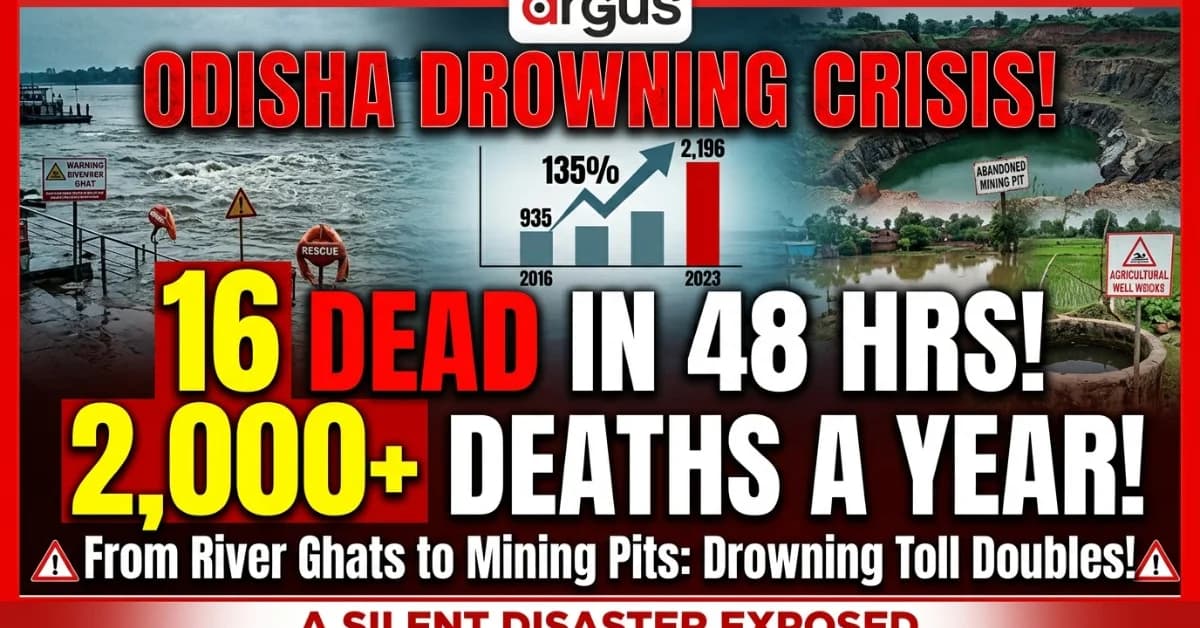
Escalating Crisis: Long-term data reveals a staggering public safety challenge, with annual fatalities crossing the 2,000 mark in recent years.
Bhubaneswar: Sixteen people have died by drowning
across Odisha in just the last 48 hours, turning what are often treated as
isolated water-related mishaps into a stark warning about a much larger
public-safety crisis.
The latest fatalities, reported across multiple districts
during festive gatherings, idol immersions and bathing, have once again exposed
how quickly ordinary water bodies can become death traps.
But the immediate toll is only the visible edge of the
problem. The longer-term data from Assembly statements, Special Relief
Commissioner records and emergency-service reports show drowning deaths rising
sharply over the past decade. The annual toll crossed 2,000 in 2022 and
remained above that mark in 2023, before declining in 2024.
The number that changes the story: more than 2,000 deaths
a year
The available data shows
how dramatically the scale changed:
| Year | Reported drowning deaths |
| 2016 |
935 |
| 2017 | 1079 |
| 2018 | 1406 |
| 2019 | 1441 |
| 2020 | 1095 |
| 2021 | 1398 |
| 2022 | 2119 |
| 2023 | 2196 |
| 2024 | 1589 |
| 2025 | 1832 |
| 2026 | 1100+ (partial) |
That is why the drowning crisis cannot simply be viewed as a seasonal problem confined to monsoon floods or festival immersions.
16 deaths in 48 hours: the latest warning
The latest two-day episode demonstrates how quickly the toll can accumulate.
| District | Deaths in last 48 hours | Reported Circumstances |
| Jagatsinghpur |
4 | Four youths drowned in the
Budha River during idol immersion |
| Sundargarh |
3 | Three minor girls drowned
in the Shankha River while gathering sand for Karma Puja |
| Ganjam |
3 | Fatalities reported during
immersion ceremonies |
| Bhadrak |
1 | Class IX student drowned
during Ganesh idol immersion |
| Koraput |
1 | Resident drowned while
bathing |
| Kalahandi |
1 | Incident recorded during
local immersion |
| Keonjhar |
1 | 44-year-old man drowned
during festive rituals |
| Jajpur |
1 | Body recovered by rescue
personnel |
| Nayagarh |
1 | Elderly person drowned
while bathing |
| Cuttack |
0* | One minor remains missing
in the Mahanadi |
The geographical spread is itself significant. The deaths were not concentrated in a single river system or district. They cut across coastal Odisha, western districts and southern Odisha.
Odisha's drowning problem is not just about rivers
One of the most important findings has been that the danger extends well beyond major rivers and tourist beaches.
More than 85% of annual drowning fatalities, according to the cited state-level data occur at non-commercialised public water bodies during daily activities and local rituals.
That changes the nature of the problem.
| Water body |
Why it becomes dangerous |
| Village ponds & tanks |
Sudden depth changes,
muddy/silty bottoms and lack of fencing |
| River ghats & canals |
Swift monsoon currents,
deep pits and immersion activities |
| Wather body | Why is becomes dangerous |
| Agricultural wells |
Uncovered wells located
close to homes and fields |
| Waterfalls & forest
streams |
Sudden currents and limited
supervision |
| Abandoned mining pits |
Deep water bodies without
adequate public protection |
The risk map: coastal Odisha versus inland Odisha
The baseline analysis categorises vulnerable districts into three broad risk profiles.
| Risk zone |
Districts identified in
supplied data |
Approx. share of 990
mid-year baseline |
Dominant risk |
| Riverine & coastal |
Cuttack, Balasore, Bhadrak,
Jagatsinghpur, Puri, Kendrapara, Ganjam |
~40% |
Rivers, ponds, ghats,
beaches and rituals |
| Torrential & mining |
Keonjhar, Mayurbhanj,
Sundargarh, Sambalpur, Koraput, Rayagada, Jharsuguda |
~35% |
Streams, waterfalls and
abandoned mining pits |
| Rural agricultural &
inland |
Angul, Dhenkanal, Jajpur,
Nayagarh, Bolangir, Kalahandi, Bargarh, Nuapada, Subarnapur, Kandhamal, Boudh,
Deogarh, Malkangiri, Gajapati, Khordha |
~25% |
Wells, tanks and irrigation
channels |
Why the 16 deaths matter beyond Ganesh immersion
It would be easy to attribute the latest fatalities entirely to Ganesh idol immersion. The incident pattern, however, is broader.
Of the deaths recorded in the latest 48-hour period, some
involved immersion, but others occurred during bathing, religious activity and
routine interaction with local water bodies. The Sundargarh deaths, for
example, involved three minor girls in the Shankha River while gathering sand
for a religious festival.
This distinction matters because it points towards a year-round
water-safety problem, with festivals acting as periods when exposure to
hazardous water bodies increases sharply.
The state has identified the hotspots. The challenge is preventing the next death.

📱 Get Argus News App
✨As per available data, Odisha has identified 169
drowning-prone black spots and has proposed a combination of lifeguard
deployment, community first responders, warning systems and physical barriers.
The proposed measures
include:
· training 3,420 Home Guards for lifeguard duties at high-risk tourist zones;
· training local youths as immediate first responders;
· floating buoys, warning boards and safety ropes around dangerous water bodies;
·
swimming and water-safety programmes for
children.
But the latest fatalities raise a crucial implementation question: how much of the safety architecture reaches the ordinary village pond, river ghat, irrigation channel or immersion point before people enter the water?
A silent disaster hiding in plain sight
Drowning rarely generates the same sustained public attention as a cyclone, flood or major accident. Yet the cumulative numbers are formidable. The data available records 10,383 drowning deaths between 2020 and 2024, while also reporting more than 990 deaths by the middle of 2026.
What cannot be overlooked, however, is the direction of the longer-term trend: Odisha moved from annual drowning deaths below 1,000 in the 2016 baseline to more than 2,100 in both 2022 and 2023.
And now, in just 48 hours, 16 families have been pushed into grief.
The immediate lesson from the latest deaths is not merely that festivals require greater caution. It is that Odisha's water-safety strategy has to reach the places where people actually encounter water every day – the village pond, the river ghat, the open well, the canal and the immersion point.
For a state surrounded by rivers, coastline, ponds and thousands of water bodies, drowning is no longer a collection of isolated accidents. The numbers indicate a public-safety challenge that demands continuous prevention, local surveillance and rapid rescue capacity, not attention only after the next body is recovered.
Also Read: Drowning Case / Minor Boy SweptAway in Mahanadi River Near Kataka's Jagatpur; ODRAF, Fire Services LaunchSearch