



Odisha’s Growing Cough Syrup menace, 129L Seized last Month: How Centre's New Amendment Could Cripple State's Growing Codeine Narcotics Trade | Special Story
Key Points
* Centre's amendment ends a decades-old rural exemption, forcing all cough syrup sales through licensed pharmacies.
* Western Odisha districts such as Sambalpur, Bargarh and Balangir remain the epicentre of codeine syrup abuse and trafficking.
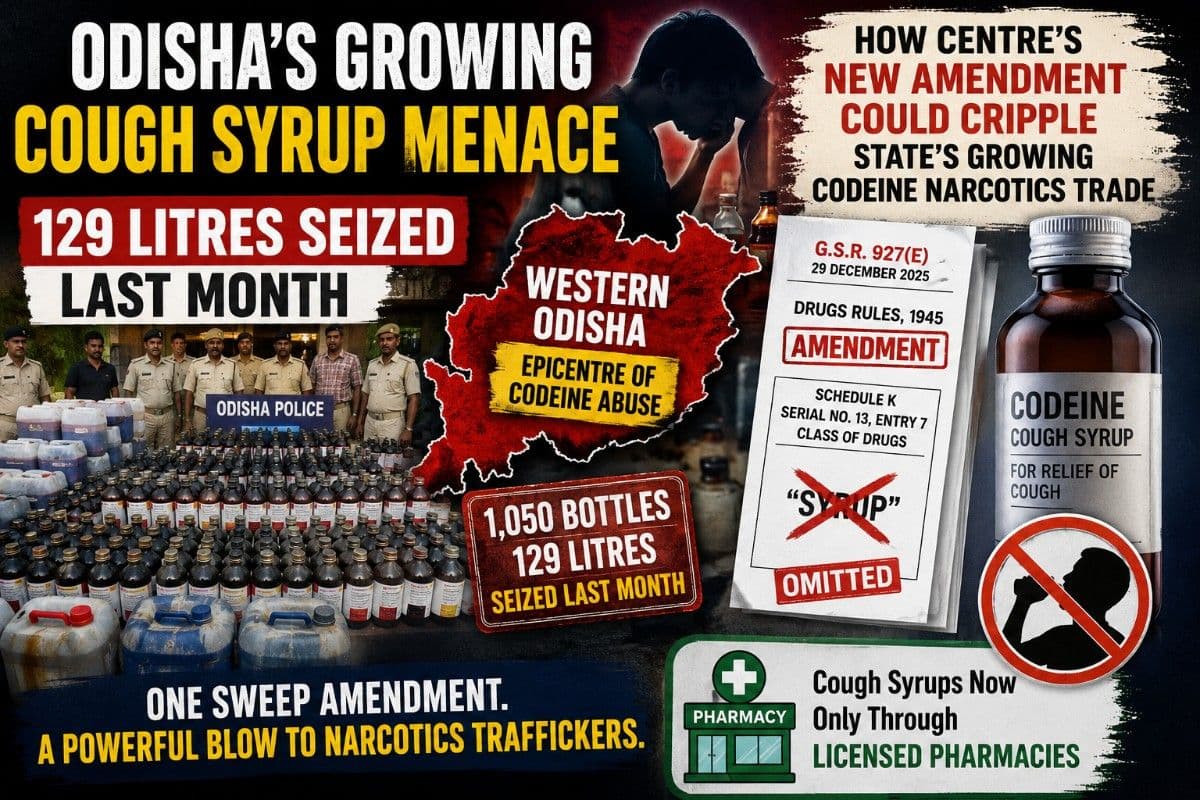
Bhubaneswar: When Odisha has emerged over the past five years as a major hub for the abuse and trafficking of Codeine-Based Cough Syrups (CBCS), often consumed as a cheap substitute for alcohol, a seemingly routine amendment to India's drug regulations may end up dealing a significant blow to the state's rapidly growing narcotics economy.
The scale of the problem is staggering. In a mega crackdown against criminals and drug traffickers last month, Odisha Police seized a whopping 129 litres of CBCS from peddlers and dealers operating across the state. The seizures underscore the alarming spread of its abuse and trafficking in State.
According to top sources in the Narcotics Control Bureau (NCB), Bhubaneswar, Odisha has evolved not merely into a consumption market but also into a major destination for organised drug networks. Investigations conducted between 2024 and 2025 revealed that leakages from pharmaceutical manufacturing hubs in Gujarat, Madhya Pradesh and Himachal Pradesh were being routed into Odisha through commercial transport and logistics channels.
Against this backdrop, the Union Health Ministry on Tuesday erected what enforcement agencies believe could be the biggest regulatory barrier yet against the illegal CBCS trade.

📱 Get Argus News App
✨By eliminating a decades-old exemption that allowed cough syrups to be sold in villages with populations below 1,000 without full licensing requirements, the Centre has effectively closed a loophole that traffickers allegedly exploited to push addictive syrups into rural markets.
The Twist
The amendment does not ban cough syrups. Instead, it ensures that every bottle – whether sold in a metro city or a village with fewer than 1,000 residents – must move through a licensed pharmacy and comply with standard drug-control regulations.
Loophole That Enabled Rural Diversion
Before the amendment, Schedule K allowed certain medicines, including cough syrups, to be sold in villages with populations below 1,000 without requiring the full licensing framework applicable to pharmacies.
That exemption was originally designed to improve medicine access in remote areas where licensed chemists were scarce.
However, enforcement agencies increasingly argued that the provision created an unmonitored distribution channel for CBCS – products that can produce narcotic effects when consumed in excessive quantities.
By deleting the word “Syrup” from the exemption list, the Centre has effectively ended this special treatment.
Now, whether in Bhubaneswar, Balangir, Bargarh, Sambalpur or a remote tribal village, cough syrups can legally be sold only through licensed pharmacies following prescribed regulatory norms.
Why Odisha Matters
The timing of the amendment is significant.
While weeks ago, Odisha Police intensified anti-narcotics operations across the state, uncovering large-scale cough syrup trafficking networks, last year seizure were the eye-openers.
- Seizure of more than 7,900 bottles of codeine-based cough syrup in Bargarh.
- Recovery of 880 bottles of illicit Eskuf syrup in Balangir.
- Statewide seizure of over 73,000 bottles during coordinated crackdowns.
- Arrest of 181 individuals and registration of 61 criminal cases linked to illegal cough syrup trafficking.
The Special Task Force (STF) in Bhubaneswar alone recovered more than 26,000 bottles, exposing sophisticated supply chains involving courier networks, warehouses and interstate transport routes.
These numbers reveal that cough syrup abuse is no longer a fringe issue but a significant narcotics challenge in the State.
Western Odisha: The Epicentre
Investigators have identified a distinct “Western Odisha Belt” as the state's primary hotspot.
Districts such as Sambalpur, Bargarh, Balangir and Subarnapur have witnessed repeated seizures involving thousands of bottles at a time.
NCB sources say CBCS are popular among sections of rural youth because they are cheaper than alcohol and easier to conceal than conventional narcotics.
Traffickers often move consignments through interstate corridors connected to West Bengal, Bihar and other neighbouring states.
The latest amendment strikes directly at this ecosystem by eliminating the possibility of legally stocking cough syrups through unlicensed retail outlets in remote areas.
The National Context
Odisha's challenge mirrors a larger national problem.
Across India, enforcement agencies have reported massive diversions of pharmaceutical products into illicit drug markets.
West Bengal has recorded some of the country's largest seizures of codeine-based cough syrups, while Assam and several northeastern states have reported alarming addiction trends among teenagers.
The Supreme Court has repeatedly expressed concern over the misuse of codeine-based cough formulations, warning that such substances are "destroying generations" when sold without adequate controls.
The government now appears determined to strengthen oversight across the entire supply chain.
Another Angle: The Child Safety Factor
The amendment is not solely about narcotics. And here too it has an Odisha link.
When recently, 22 children died in MP due to CBCS consumption, MHA report revealed that the same batch CBCS from TN based Phrama co has been distributed in Odisha and Puduchhery.
The Union Health Ministry had then swiftly swung into action calling for recall of the batch of CBCS lot in the State.
By forcing all syrup formulations into licensed supply chains, regulators hope to improve accountability and enable faster product recalls if contamination is detected.
This is particularly important for paediatric medicines, where contaminated syrups have been linked to fatal outcomes in some states.
Impact on Common Man?
For urban residents, very little may change.
Cough syrups remain legal and available through licensed pharmacies.
However, rural consumers could feel the impact immediately.
The Benefits
- Stronger protection against counterfeit and contaminated medicines.
- Better pharmacist supervision.
- Reduced access to addictive CBCS for minors.
- Improved tracking of medicine distribution.
The Challenges
- Villagers may need to travel farther to access cough medicines.
- Doctor consultations and prescriptions could increase treatment costs.
- Daily wage earners may face inconvenience when seeking treatment for minor ailments.
The Bigger Message
The amendment sends a clear signal: the government views codeine syrup abuse both as a drug-control issue and public health emergency.
For Odisha, where cough syrup trafficking has evolved into a lucrative underground business stretching from urban courier hubs to rural distribution networks, the rule change could become a major disruption.
Whether it significantly reduces addiction and illegal trade will depend on enforcement. But by closing one of the last legal grey zones in rural distribution, New Delhi has handed Odisha's police and NCB a powerful new weapon.
Even as the
battle against codeine abuse is far from over, for traffickers who thrived in
the gaps of the old system, the space to operate just became much smaller.
Also Read: NHRC Steps In After 17-Year-Old Tribal Girl Trafficked, Sold, Sexually Assaulted: Why Odisha's Trafficking Crisis Defy 36 Specialized Police Units| Exclusive
Related Topics
Explore more stories