



Odisha Textbook Printing Error Probe Reaches Decisive Stage? Crime Branch DG Drops Big Hint, Key Details Inside |Special Report
Key Points
Bhubaneswar: The investigation into the Odisha school textbook printing error case appears to have reached a decisive phase.
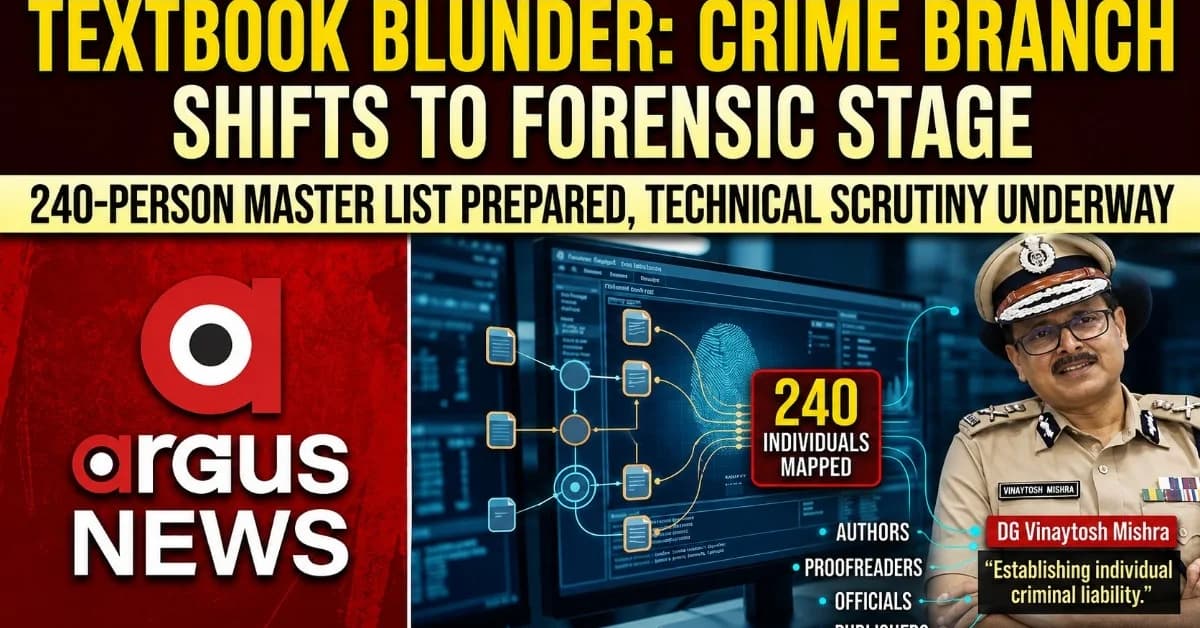
Odisha Crime Branch Director General Vinaytosh Mishra on Tuesday dropped the strongest indication yet about the progress of the high-profile probe, stating that investigators have prepared a master list of around 240 persons connected with the textbook preparation ecosystem and that technical investigation is now underway.
The statement assumes significance as the Crime Branch had remained publicly silent over the past week, with no fresh interrogations or visible investigative activity reported. Far from indicating a slowdown, the DG's remarks suggest the probe has shifted into a data-driven forensic stage before the next round of questioning.
Crime Branch Signals Shift to Technical Investigation

📱 Get Argus News App
✨Addressing the media, DG Vinaytosh Mishra said the Crime Branch has identified nearly 240 individuals linked to the preparation, review, proofreading, approval and printing of the controversial school textbooks and that investigators are conducting detailed technical scrutiny before moving ahead.
His statement comes after nearly a week during which there were no reports of fresh questioning or summons by the Special Investigation Team (SIT). Such a pause is generally considered significant in complex white-collar investigations, where investigators first consolidate documentary and digital evidence before confronting suspects. The latest remarks indicate that the Crime Branch has moved beyond preliminary fact-finding and is now verifying evidence through forensic and technical analysis.
Master List of 240 Suggests Entire Textbook Supply Chain Mapped
The preparation of a master list comprising around 240 individuals is perhaps the biggest clue yet about the direction of the investigation.
Rather than treating the issue as an institutional failure of SCERT alone, investigators appear to have identified every critical functionary involved in the textbook production chain.
The mapped individuals are understood to include:
- Subject experts and textbook authors responsible for preparing content.
- Review committee members and academic evaluators.
- Proofreaders who certified manuscripts before printing.
- Officials from SCERT and OSEPA involved in approvals.
- Private publishers, contractors and printing press operators executing textbook contracts.
The exercise suggests the Crime Branch has reconstructed the complete administrative and operational workflow of the textbook production process, enabling investigators to assign responsibility at each stage instead of relying on broad institutional accountability.
Has the Investigation Reached Decisive Stage?
The DG's remarks strongly indicate that the investigation has entered what investigators often describe as the structural phase of a white-collar probe.
Instead of expanding the list of suspects, the Crime Branch now appears focused on establishing who performed which role, when decisions were taken, who approved disputed content, and where the system failed.
This stage is crucial because the case is no longer about identifying whether mistakes occurred – the government has already established that 1,678 factual, grammatical, typographical and printing errors appeared in textbooks for Classes I to VIII.
The challenge now is fixing individual criminal liability.
The probe is registered as CID-CB PS Case No. 08 of 2026 under provisions of the Bharatiya Nyaya Sanhita dealing with criminal breach of trust, disappearance of evidence, common intention and criminal conspiracy.
Earlier, former SCERT Director Manoj Padhi and several senior officials faced suspension and disciplinary action after the preliminary inquiry. The state government also recalled the defective textbooks and ordered fresh corrected editions.
Digital Forensics May Hold the Key
The absence of visible questioning over the past week now appears to have been part of a deliberate investigative strategy.
According to investigators' approach indicated by the DG's statement, the Crime Branch is presently matching seized physical records with digital evidence, including manuscript versions, approval trails, government correspondence, server logs and electronic communications.
The objective is to create an evidence-backed chain before summoning each identified individual.
By completing digital verification first, investigators can confront those under scrutiny with specific documentary proof – such as approval records, manuscript revisions, timestamps or communication trails – rather than relying solely on oral statements.
This technical investigation is also expected to help investigators establish the modus operandi behind the massive textbook blunder.
The Crime Branch is believed to be examining whether the errors resulted from systemic negligence and financial irregularities in the textbook production process or whether there was any deliberate manipulation, as alleged by Chief Minister Mohan Charan Majhi, who had earlier spoken of a possible conspiracy to embarrass the newly elected BJP government.
Bottomline
DG Vinaytosh Mishra's disclosure marks the clearest indication yet that the Crime Branch investigation has moved into its most decisive phase.
The
preparation of a comprehensive 240-person master list suggests
investigators have already mapped the entire textbook preparation ecosystem and
substantially established the probable modus operandi. The ongoing technical
and digital forensic examination now appears aimed at identifying the precise
point where accountability lies, enabling the Crime Branch to separate
procedural lapses from criminal conspiracy and ultimately establish the "whodunit"
behind Odisha's unprecedented school textbook blunder scandal.
Also Read: How Crime Branch Will Unravel the Odisha Textbook Errors ‘Conspiracy’ or ‘Sabotage’: The Forensic Trail Behind 1,678 Errors| Special Report
Related Topics
Explore more stories