



How Crime Branch Will Unravel the Odisha Textbook Errors ‘Conspiracy’ or ‘Sabotage’: The Forensic Trail Behind 1,678 Errors| Special Report
Key Points
Bhubaneswar: Taking the investigation beyond administrative accountability into the realm of criminal liability, Chief Minister Mohan Charan Majhi has directed the Director of the State Council of Educational Research and Training (SCERT) to lodge a complaint with the Crime Branch (CB), signalling the government's determination to test its public assertion that the unprecedented textbook blunders may be the result of a "conspiracy" or "sabotage" aimed at embarrassing the newly formed BJP government.
Official sources indicated that the Crime Branch is likely to constitute a four-member Special Investigation Team (SIT), headed by an officer of Superintendent of Police rank, to probe the case.
Reports suggest SCERT Director Bijay Kumar Sahu has already proceeded to the Crime Branch headquarters with documents relating to every stage of textbook preparation – from manuscript drafting and editorial scrutiny to proofreading, printing and publication.
The challenge before the Crime Branch is enormous.

📱 Get Argus News App
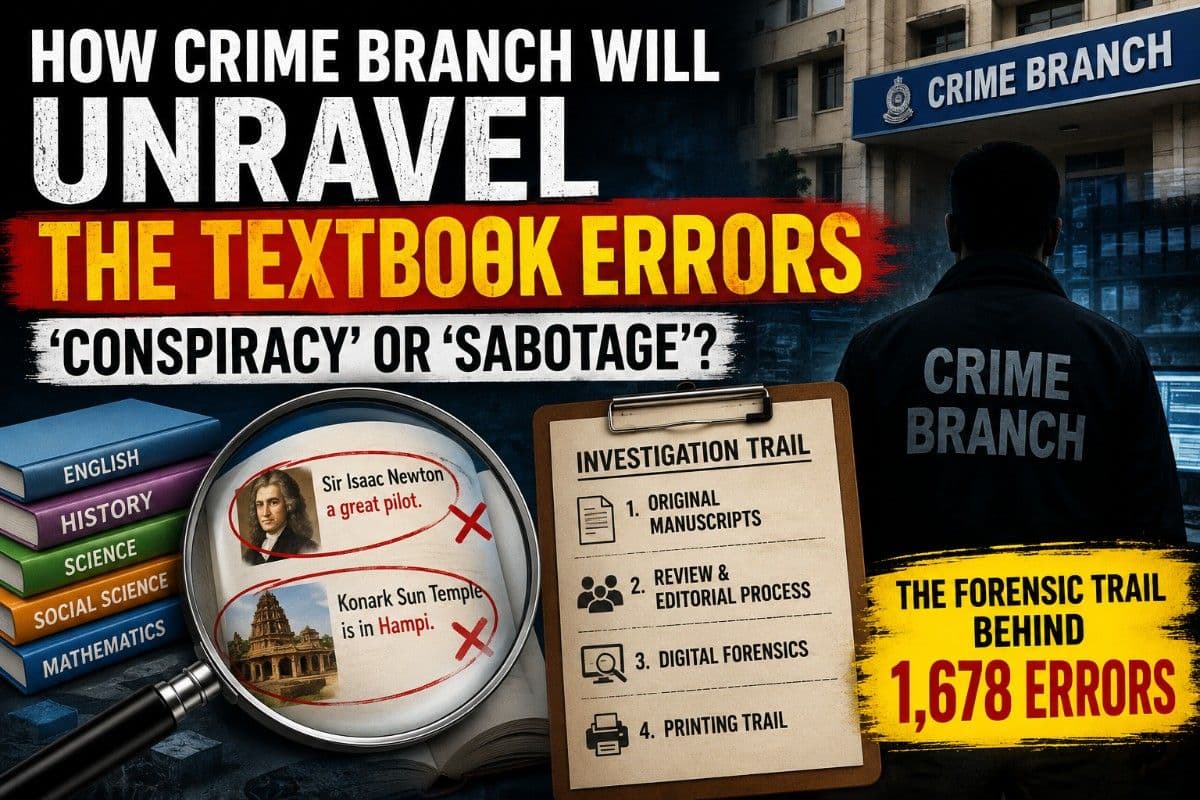
✨The errors are not limited to spelling mistakes or typographical slips. They include glaring factual absurdities such as portraying Sir Isaac Newton as a "great pilot" and replacing Odisha's iconic Konark Sun Temple with Hampi in school textbooks.
Such errors have prompted investigators to ask a fundamental question: Could subject experts, who are specialists in their respective disciplines, have authored such content, or were the manuscripts altered somewhere in the publication chain?
That question is expected to define the Crime Branch investigation.
How the Crime Branch Is Expected to Proceed
Rather than treating the case as a conventional administrative lapse, investigators are expected to reconstruct what forensic experts describe as the "Life of a File" – tracking every stage through which a manuscript travelled before becoming a printed textbook.
The objective would be to identify the precise point where the integrity of the content was compromised.
Stage 1: Examining the Original Manuscripts
The investigation is expected to begin with the original manuscripts prepared by subject experts.
SCERT's standard operating procedure requires academicians, teachers and subject specialists to prepare the first draft.
Crime Branch investigators are likely to:
- seize the original digital manuscripts;
- compare them with printed textbooks;
- examine successive versions of the files;
- verify whether the original drafts actually contained the disputed content.
If the original manuscripts correctly mention Konark and contain no absurd factual claims, investigators can immediately rule out the manuscript writers and shift focus to subsequent stages.
The CB is also expected to question manuscript writers individually and verify whether their submitted versions match the official records.
Digital access logs may also be examined to identify who had editing privileges after the manuscripts were submitted.
Stage 2: Scrutinising Review and Editorial Processing
The next layer involves SCERT's internal review mechanism.
Under established procedures, every manuscript undergoes scrutiny by senior subject experts, curriculum panels and editorial committees responsible for checking factual accuracy, language and pedagogical suitability.
CB sleuths are expected to reconstruct this review process by examining:
- committee proceedings,
- editorial remarks,
- correction sheets,
- approval records,
- internal communications,
- digital revision history.
The CB would attempt to determine whether reviewers overlooked the errors or whether alterations were introduced after academic approval.
If investigators discover that reviewers approved accurate content but subsequent versions differ, suspicion would shift to later stages.
Stage 3: Digital Forensics and Proofreading
This could become the most critical phase of the investigation.
Since many errors appear systematic rather than random, digital forensic experts are expected to examine whether files were altered through automated editing tools, machine translation software or unauthorised digital access.
The Crime Branch may undertake:
- forensic examination of document metadata;
- comparison of successive digital versions;
- recovery of deleted or modified files;
- identification of software used during editing;
- examination of server logs and user access records.
Investigators are also expected to search for patterns suggesting bulk automated replacement rather than isolated human mistakes.
If identical categories of factual errors appear across multiple books, investigators may examine whether automated scripts or mass editing tools were used.
The objective would be to establish precisely when, how and by whom the content changed.
Stage 4: Following the Printing Trail
The printing process represents the final opportunity to detect and prevent errors before textbooks reach students.
Crime Branch is expected to obtain:
- pre-press proof copies;
- printer approval records;
- final print-ready PDFs;
- communication between SCERT and printing agencies;
- contractual obligations relating to proofreading.
Investigators are likely to compare the approved digital proofs with the printed textbooks.
If the printer received correct files but printed altered content, the investigation could focus on the printing agency.
Conversely, if the printer received already corrupted files, attention would shift back to officials responsible for approving the final version.
Building the "Whodunit" Timeline
The Crime Branch investigation is expected to reconstruct a complete forensic timeline.
It will seek answers to four crucial questions:
- What exactly did the manuscript writers submit?
- What changes occurred during review and editing?
- Who approved the final printable version?
- Did the printed books faithfully reproduce the approved files?
By identifying the first point where the official version diverged from the final textbooks, investigators hope to identify not merely what went wrong but who possessed both the authority and opportunity to alter the content.
If Fault Is Found at Different Stages, What Will Crime Branch Do?
The investigation is expected to take different directions depending on where the break in the publication chain is detected.
If Subject Experts Are Found Responsible
Should investigators establish that erroneous information existed in the original manuscripts themselves, the focus will shift to the selection of manuscript writers.
Crime Branch may examine:
- whether qualified experts were appointed;
- whether reference materials supplied to them were authentic;
- whether incompetence, negligence or deliberate fabrication was involved.
if evidence suggests deliberate falsification or coordinated manipulation, investigators may examine the possibility of criminal conspiracy (BNS Section 61) or fabrication of records (BNS Section 228).
If the Review Committee Failed
If manuscripts were accurate but incorrect material was approved during review, investigators are expected to examine accountability at the editorial level.
Crime Branch may:
- identify every approving authority;
- verify whether objections were ignored;
- examine whether mandatory review procedures were bypassed.
Evidence showing that officials knowingly cleared erroneous content despite warnings could significantly strengthen allegations of deliberate misconduct (sections 200, 201 BNS).
If Proofreading or Digital Processing Is Responsible
If investigators establish that files were altered after academic approval, digital forensics will assume central importance.
Crime Branch may attempt to identify:
- user accounts responsible for modifications;
- unauthorised access;
- software used to alter documents;
- deleted digital evidence;
- automated editing patterns.
The investigation would seek to determine whether alterations resulted from unauthorised intervention or deliberate manipulation slapping BNS sections 335, 337, and 340.
If the Printing Agency Is Responsible
If approved proofs were correct but printed books contained different content, investigators are expected to examine the role of the printing contractor.
The probe may focus on:
- compliance with contractual obligations;
- quality-control procedures;
- proof approval records;
- whether unauthorised changes occurred during pre-press processing.
If contractual obligations relating to professional proofreading were ignored while payments were claimed, investigators may also examine possible financial irregularities, along with criminal conspiracy.
How Crime Branch Will Attempt to Establish Criminal Intent
To substantiate allegations of conspiracy or sabotage, CB would ordinarily look for evidence indicating knowledge, intention or deliberate procedural violation.
Such evidence may include:
- internal emails warning about errors before printing;
- deletion or suppression of objections raised by junior officials;
- bypassing mandatory review stages prescribed under SCERT procedures;
- unauthorised digital edits;
- unexplained access to official files;
- financial or contractual irregularities indicating possible wrongful gain.
Digital trails – including metadata, server logs, revision history and user access records – are likely to become as important as the printed textbooks themselves.
An Unprecedented Crisis in Odisha's Textbook History
Education department records over the past three decades indicate that Odisha has witnessed textbook delays, occasional printing mistakes and isolated factual inaccuracies.
However, there is no known precedent since the 1980s for the discovery of more than 1,678 factual errors across Class I to Class VIII textbooks in a single academic session.
Traditionally, minor errors were rectified through corrigenda, departmental circulars or revised editions in the following academic year. Textbook preparation followed a structured process involving subject experts, academic review panels, editorial scrutiny and proofreading before printing.
The 2026 controversy, however, has unfolded under the state's newly overhauled curriculum framework aligned with the National Education Policy (NEP) 2020. The sheer scale and nature of the errors – many of them plainly absurd rather than merely technical – have transformed what might once have been viewed as an administrative lapse into a matter of criminal investigation.
For perhaps the first time in Odisha's educational history, a textbook controversy has crossed from academic scrutiny to a full-fledged Crime Branch probe.
That makes the episode unprecedented on two counts: the scale of the errors and the nature of the state's response.
The investigation will now determine whether the errors were the result of an organised conspiracy or sabotage, and can it be substantiated with legally admissible evidence.
Until then,
all eyes remain on the Crime Branch. Its ability to reconstruct the digital and
documentary trail will decide whether the unprecedented textbook blunder become
one of Odisha's most significant criminal investigations in the education
sector.
Also Read: Not Just 1,678 Errors, CM Mohan Majhi Sees a Conspiracy: Read the Anatomy of Sabotage| Exclusive
Related Topics
Explore more stories