



Odisha Police YB Khurania / Odisha Police 5-day Mega Swoop on Criminals: How Big Policing Objectives Achieved
Key Points
Bhubaneswar: In the fag end of Odisha DGP Yogesh Bahadur Khurania’s tenure, the big swoop by police on criminals will have a far-reaching and salutary impact on crime control in the state at a time when the crime rate, especially violent crime rates, has peaked.
It seems this sudden, aggressive surge across the state reveals a calculated, highly analytical strategy to suppress a volatile criminal landscape before a transition of power.
When viewed through the lens of recent, exclusive crime data, the five-day "sanitisation operation" conducted from May 12 to May 16, 2026, serves as a direct response to a complex law-and-order environment.
The Backdrop

📱 Get Argus News App
✨To understand the sheer scale and urgency of the five-day crackdown, one must look at the sobering statistical backdrop confronting the state’s top brass:
Baseline Threat: 2024 NCRB data shows Odisha’s Indian Penal Code (IPC) cases stood at a high crime rate of 366.9. The crime rate has risen further in recent months.
True Volume: When Special and Local Laws (SLL)—which cover specific offenses like narcotics, excise, and arms violations—are factored in, the total crime rate jumps significantly to 458.8.
Volatility Factor: Most pressing of all, the violent crime rate peaked at a dominant 161.6, indicating that a significant portion of criminal activity in the state carries the threat of physical harm or severe lawlessness.
With an SLL inflation of nearly 92 points and a violent crime rate driving the narrative, the police administration faced a critical mandate: lower the ambient temperature of state crime, tie up loose ends, and disrupt the supply chains feeding these numbers.
The Operation: Dissecting the Five-Day Blitz
Under DGP Khurania’s direct order and executed seamlessly across all police ranges by district SPs and Police Commissioners, the five-day drive acted as a massive dragnet. Instead of a slow, reactive approach, the police utilized a multi-pronged tactical assault.
1. Clearing the Backlog
The primary focus was addressing the "free agents" of the criminal underworld—those already on the radar but evasive.
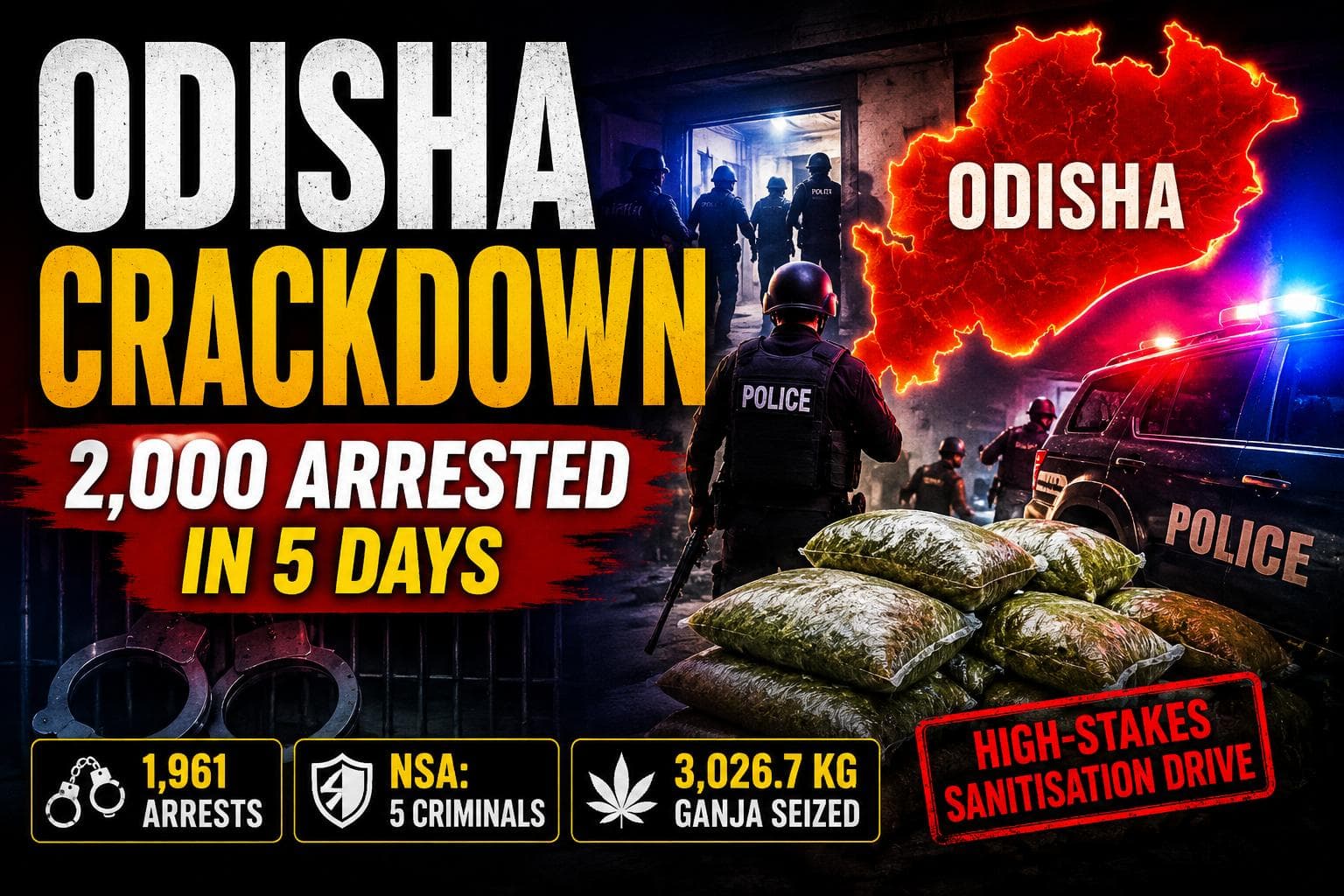
1,771 individuals were arrested via the execution of pending Non-Bailable Warrants (NBWs).
190 absconding accused were tracked down, captured, and swiftly forwarded to court
2. Neutralizing the Top Tier
Recognizing that a high violent crime rate (161.6) is often driven by repeat offenders, the strategy leaned heavily on new and existing preventive laws:
National Security Act (NSA): Invoked against 5 notorious criminals, effectively taking the state's most volatile actors off the board entirely.
The BNSS Pivot: Transitioning into modern criminal jurisprudence, police booked 449 habitual offenders under Section 129 of the Bharatiya Nagarik Suraksha Sanhita (BNSS) and initiated action against another 643 persons under Section 126 BNSS. This massive use of preventive detention served as a clear warning to local gangs to remain dormant.
3. Choking the SLL Underbelly
To target the disparity between the 366.9 IPC rate and the 458.8 expanded SLL rate, the drive aggressively pursued narcotics and illegal trade.
The Ganja Corridor: A staggering 3,026.7 kg of ganja was seized across 31 NDPS cases.
Regional Breakdown: The South-Western Range proved to be the primary pipeline, accounting for a massive 1,943.4 kg of the seizure, followed by the Southern Range (683.04 kg) and the Northern Range (284.08 kg).
Narco Crackdown: Alongside the ganja, police seized brown sugar, vehicles, and registered 716 excise cases, crippling the financial fluidity of these illicit networks.
Impact Analysis
Odisha police blitz of this magnitude yields two distinct impacts:
· immediate disruption
· systemic deterrence.
Immediate Shock to the System
By combining warrant executions with massive contraband seizures, the Odisha Police achieved simultaneous goals. They took active criminals off the street while cutting off the cash flow (via the excise and narcotics crackdown) that funds further criminal enterprises. Dropping a multi-ton seizure on the ganja supply chain right before a leadership change destabilizes cartel operations, forcing them into a defensive, disorganized posture.
For the state administration, the timing of this sanitisation operation accomplishes three institutional goals:
De-risks the Transition: It leaves the incoming leadership with a cleaner slate, significantly lowering the immediate threat of a major crime spike during the command handover.
Applies the New Code Effectively: Aggressively utilizing BNSS provisions (Sections 126 and 129) establishes a firm operational blueprint for how the Odisha Police will handle habitual offenders under the new legal framework moving forward.
Deters Seasonal Crime: The sheer speed of nearly 2,000 arrests in 120 hours sends a psychological shockwave through the state's criminal factions, signaling that an impending leadership transition does not equal a lapse in vigilance.
The Final Word
Odisha’s
high SLL and violent crime metrics required a heavy, systemic response. By
launching a synchronized, statewide assault, the police administration didn't
just manage the numbers—they disrupted them. As the current tenure draws to a
close, this five-day sanitisation drive stands as a textbook example of closing
a leadership chapter with a decisive enforcement action that stabilizes the
state's security apparatus.
Also Read: NCRB 2024 Odisha Report: Why Short-tempers Run High in State as Petty Arguments Turn Lethal
Related Topics
Explore more stories