



Odisha No Longer Just India's Cannabis Capital: A Silent Synthetic Drug Market is Taking Root | Exclusive
Key Points
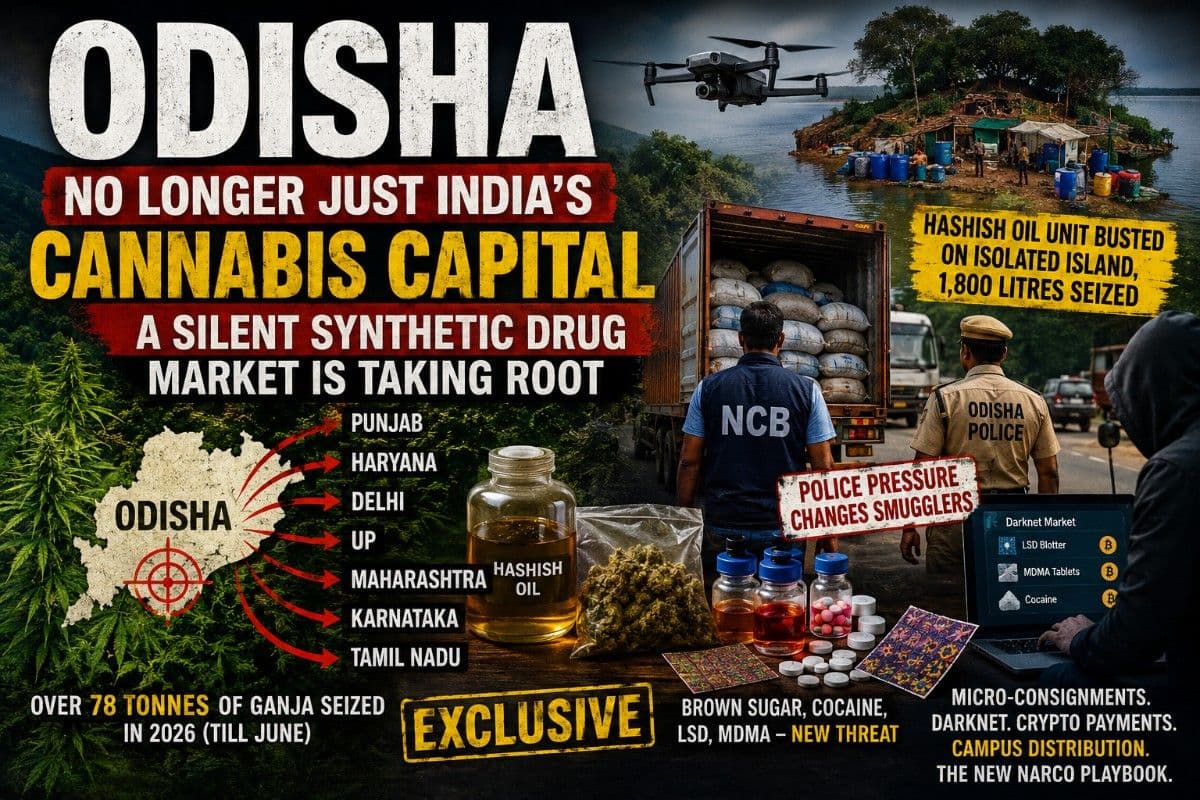
* As police tighten the noose on bulk ganja trafficking, syndicates are shifting to hashish oil production, hidden vehicle cavities and digital micro-consignments.
* Clinical evidence and recent investigations indicate LSD, MDMA and cocaine have quietly entered Odisha's consumer market, posing a new challenge for cyber-driven narcotics policing.
Bhubaneswar: For years, the phrase "Udta Punjab" has symbolized India's drug menace. But away from the spotlight, another state has quietly cemented its place on the country's narcotics map – l not primarily as a consumer, but as its largest supplier of cannabis.
Official data available with Narcotics Control Bureau (NCB) and State Police reveal that Odisha has consistently recorded among the country's highest cannabis seizures over the past six years, underlining the scale of cultivation and trafficking networks operating across its southern districts.
From Punjab and Haryana to Uttar Pradesh, Delhi, Maharashtra, Karnataka and Tamil Nadu, Odisha-grown ganja continues to feed major consumption hubs across India.
Yet, beneath this familiar story lies a more disturbing transformation.

📱 Get Argus News App
✨While the state continues to battle bulk cannabis trafficking, a quiet but significant shift is underway. Odisha is no longer merely exporting narcotics. It is gradually emerging as a consumer market for brown sugar, cocaine, LSD, MDMA and other synthetic drugs – a transition that is changing the very nature of narcotics policing.
Cannabis Capital of India
The numbers speak for themselves.
NCB data shows cannabis-based drug seizures in Odisha at:
- 2020: 1,38,432 kg
- 2021: 1,71,713 kg
- 2022: 1,84,109 kg
- 2023: 2,12,777 kg
- 2024: 1,43,761 kg
- 2025: 2,15,165 kg
- 2026: 78000 Kg (till June)
These figures consistently place Odisha as India's biggest cannabis-producing and trafficking states.
The state's dense forests across Malkangiri, Koraput, Rayagada, Gajapati, Kandhamal and adjoining regions continue to provide ideal terrain for illegal cultivation, with interstate trafficking routes stretching deep into northern, western and southern India.
Law enforcement agencies estimate that much of the cannabis seized in Tamil Nadu, Karnataka, Telangana, Maharashtra and parts of North India traces its origins to Odisha's southern belt.
Police Pressure Changing Smugglers
However, intensified enforcement has forced syndicates to rethink their strategy.
The destruction of more than 48,000 acres of illegal cannabis cultivation during recent enforcement drives has significantly disrupted traditional supply chains.
Rather than abandoning operations, traffickers have evolved.
One of the clearest examples emerged earlier this year when Odisha Police busted via drone search an illegal hashish oil extraction unit on an isolated island inside the Jalaput reservoir in Koraput district, recovering nearly 1,800 litres of processed cannabis oil.
Instead of transporting raw ganja alone, syndicates are now manufacturing concentrated cannabis extracts in remote islands and forest sanctuaries that are difficult to access by road and harder to detect through conventional policing.
Similarly, interstate investigations have revealed increasingly sophisticated concealment techniques.
Recent NCB and DRI operations uncovered specially fabricated vehicle cavities, welded false ceilings inside trucks, hidden compartments beneath driver cabins and modified SUVs carrying consignments originating from Odisha for destinations in Tamil Nadu, Maharashtra and Karnataka.
Simple concealment beneath vegetables or agricultural produce has largely given way to professionally engineered transport mechanisms designed specifically to evade highway inspections.
Odisha's Narco Landscape Changing
The transformation is not limited to trafficking.
Official seizure data suggests Odisha is steadily becoming a consumer state for multiple categories of narcotics.
While cannabis dominates, seizures of opium-based derivatives have shown a changing pattern.
Opium-based drug seizures increased from 35 kg in 2020 to 522 kg in 2021, peaked at 1,107 kg in 2022, before stabilising around 190-205 kg during 2024 and 2025.
More importantly, cocaine – which was absent from official records until 2021 – made its first appearance in 2022.
Synthetic drugs, including ATS, MDMA and LSD, remained almost invisible in official seizure statistics until 2025, when the state's first officially recorded synthetic drug blots entered the database.
On paper, the numbers appear insignificant.
But another dataset tells a very different story.
The Clinical Evidence Police Cannot Ignore
Long before
large seizures began appearing in official statistics, de-addiction centres had
already detected the changing pattern of drug use.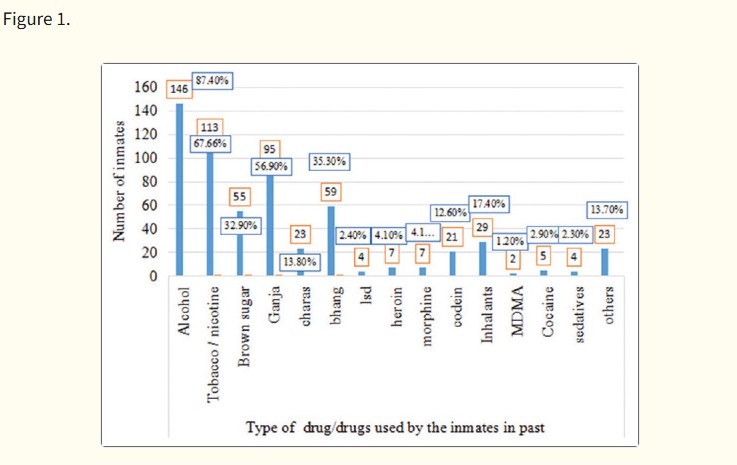 A 2004
clinical study among inmates undergoing treatment in Bhubaneswar revealed that
synthetic and premium narcotics had already entered the state's consumer
ecosystem.
A 2004
clinical study among inmates undergoing treatment in Bhubaneswar revealed that
synthetic and premium narcotics had already entered the state's consumer
ecosystem.
Among treatment-seeking inmates:
- 87.4% admitted alcohol use.
- 67.7% reported tobacco consumption.
- 56.9% had used ganja.
- 32.9% had consumed brown sugar.
- 17.4% admitted inhalant abuse.
- 12.6% had used codeine.
- 4.1% had consumed heroin.
- 4.1% had used morphine.
- 2.9% admitted cocaine use.
- 2.4% reported LSD consumption.
- 1.2% had used MDMA.
At first glance, the figures for LSD, MDMA and cocaine appear small.
But for epidemiologists and narcotics investigators, their very presence is significant.
It confirms that these substances had already found consumers in Odisha despite virtually no corresponding seizure records.
This represents what experts describe as the clinical-enforcement gap – where addiction centres detect substances much earlier than police interception statistics.
Shift to High-Value Micro Drug Networks
Unlike truckloads of ganja, synthetic drugs operate under an entirely different business model.
The new narcotics economy is built around micro-consignments.
Instead of transporting kilograms, traffickers move grams.
Instead of highway trucks, they rely on courier parcels.
Instead of cash transactions, they increasingly use encrypted messaging platforms, cryptocurrency, masked digital payments and darknet marketplaces.
The objective is simple.
If police seize a truck carrying 500 kg of ganja, the syndicate loses everything.
But if the same value is divided into dozens of courier packets containing LSD, MDMA or cocaine, interception of one parcel hardly affects overall profits.
The remaining packets continue reaching customers.
This strategy dramatically reduces risk while increasing profitability.
Student Campuses Emerging as Distribution Hubs
Urban Odisha is also witnessing a worrying shift in retail distribution.
Recent investigations by the NCB and Odisha Police indicate that traffickers are increasingly targeting engineering colleges, universities in Bhubaneswar and Cuttack.
A notable case involved the arrest of an engineering student accused of receiving synthetic drug consignments through commercial courier services.
Separate enforcement operations uncovered brown sugar distribution networks operating within university campuses, where secluded locations were allegedly used as local drop points.
Rather than traditional street peddlers, syndicates are increasingly relying on student intermediaries familiar with campus life and peer networks.
First Half of 2026 Reflects Two Different Battles
Operational data from various enforcement agencies during the first half of 2026 demonstrates that Odisha is simultaneously fighting two very different narcotics wars.
The first remains the traditional cannabis economy.
Enforcement agencies have seized approximately:
- Over 78 tonnes of ganja
- More than 1,800 litres of hashish oil
- Over 22 kg of brown sugar
- More than 1.02 lakh bottles of codeine-based cough syrup
The second battle is against highly concealed synthetic narcotics.
Unlike cannabis, these are intercepted only in tiny quantities – often measured in grams or individual blots – but their market value and addictive potential are exponentially higher.
Why Conventional Policing is No Longer Enough
The emergence of synthetic drugs presents challenges that conventional policing was never designed to address.
Highway checkpoints can detect truckloads of cannabis.
They cannot detect a few LSD stamps hidden inside a greeting card or MDMA tablets concealed within an e-commerce parcel.
Similarly, local police stations often encounter jurisdictional barriers because procurement may occur through darknet platforms hosted abroad, payments may be routed via cryptocurrency, and deliveries may pass through multiple courier networks before reaching consumers.
Consequently, narcotics policing must increasingly shift towards:
- cyber intelligence,
- darknet monitoring,
- cryptocurrency tracking,
- courier surveillance,
- postal intelligence,
- financial analytics, and
- inter-state information sharing.
A New Phase in Odisha's Drug Challenge
Odisha's identity on India's narcotics map is changing.
It continues to be one of the country's largest cannabis source states.
But that is no longer the entire story.
The state is simultaneously witnessing the rise of a concealed synthetic drug ecosystem operating through digital networks, courier logistics and urban student markets.
The quantities remain small.
The profits are enormous.
And unlike cannabis plantations hidden in forests, these new supply chains leave almost no physical footprint.
For Odisha Police, Excise, the STF and the Narcotics Control Bureau, the challenge ahead is no longer just destroying cannabis fields.
It is
dismantling invisible digital supply chains before today's isolated synthetic
drug cases become tomorrow's full-fledged urban narcotics epidemic.
Also Read: From Naxal Hotbed to Wildlife Trafficking Gateway: How Malkangiri Emerging as Odisha’s Most Active Smuggling Transit Hub| Special Report