



From Naxal Hotbed to Wildlife Trafficking Gateway: How Malkangiri Emerging as Odisha’s Most Active Smuggling Transit Hub| Special Report
Key Points
* Investigative data exposes the village of MPV-65 as a recurring consolidation nerve center for large, commercial-scale shipments.
* Trafficking networks have upgraded from fragmented motorcycle deliveries to sophisticated, multi-state syndicates using customized SUVs and Boleros.
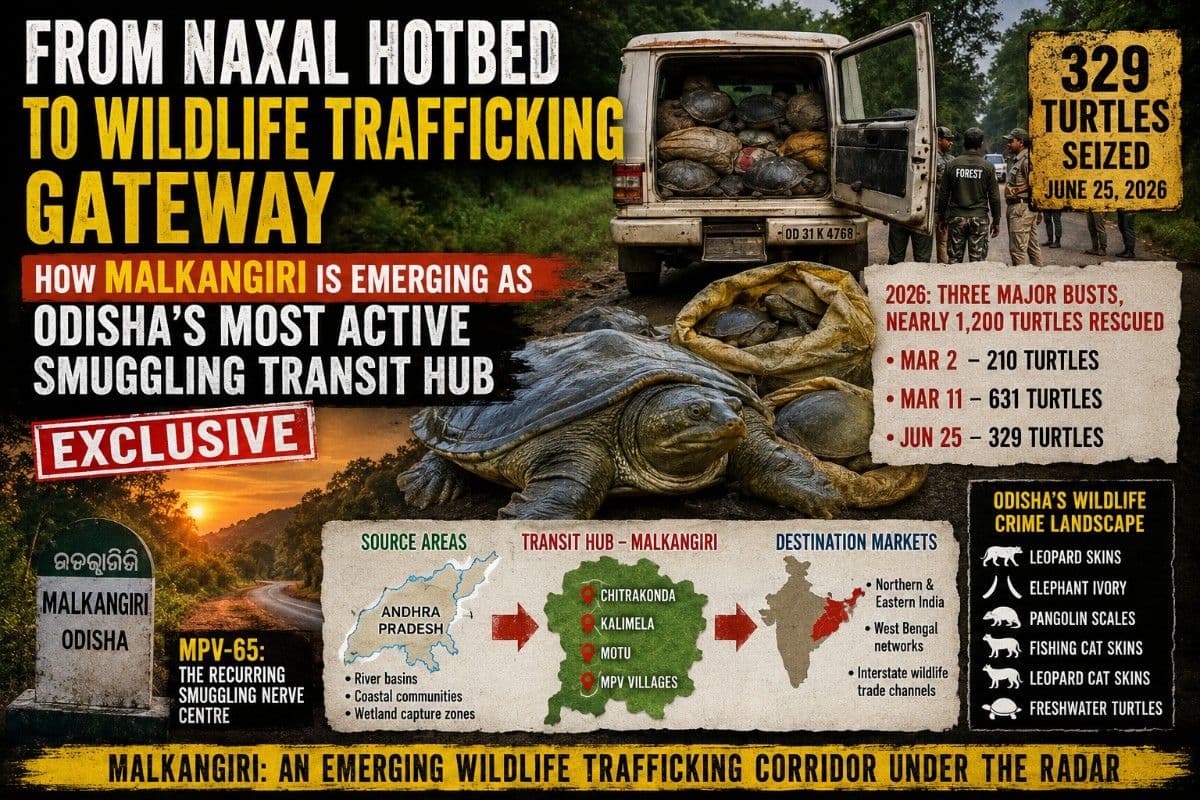
Bhubaneswar/Malkangiri: The seizure of 329 Indian Flapshell turtles from a Bolero near Padmagiri Chhak in Odisha's Malkangiri district on June 25 may appear, at first glance, to be yet another routine wildlife crime interception.
But a deeper examination of wildlife crime records, Forest Department seizure logs, STF operations, and Assembly-tabled data reveals something far more significant.
Malkangiri is no longer merely a peripheral forest district vulnerable to sporadic wildlife offences. It is increasingly emerging as one of eastern India's most active wildlife trafficking transit corridors, connecting source regions in Andhra Pradesh to lucrative markets further north.
The evidence lies not only in the frequency of seizures but also in the changing scale, logistics, and sophistication of operations uncovered during the last two years.

📱 Get Argus News App
✨A Dramatic Spike in 2026
What makes the latest seizure particularly significant is the pace at which cases are being detected.
Between 2020 and 2025, Malkangiri typically witnessed one or two notable turtle trafficking cases annually.
However, in just the first six months of 2026, forest officials have already intercepted three major consignments involving more than 1,100 turtles.
The chronology is striking:
March 2, 2026
Forest personnel intercepted an abandoned SUV near MV-62 village and recovered 210 live turtles packed inside ten gunny bags after traffickers fled into nearby forests.
March 11, 2026
In one of the largest wildlife rescues in southern Odisha, authorities seized 631 Indian Flapshell turtles weighing nearly 2.2 tonnes during a joint operation near the Motu border. Seven traffickers were arrested, including two from Andhra Pradesh's Krishna district and five local handlers.
June 25, 2026
The latest operation near Padmagiri Chhak led to the rescue of approximately 329 turtles and exposed another trafficking chain linking Andhra Pradesh and Malkangiri.
The numbers alone tell an important story.
Within less than four months, authorities have recovered nearly 1,200 turtles from three separate operations – an intensity of trafficking activity that was previously unseen in the district.
Rise of MPV-65: The Smuggling Nerve Centre
One location repeatedly surfaces in wildlife crime records: Malkangiri Potteru Village 65 (MPV-65) village under Kalimela Range.
Investigators tracking turtle trafficking networks say the village appears repeatedly across seizure reports spanning several years.
The pattern is difficult to ignore.
- June 2020 raids targeted networks linked to villages in the Motu-Kalimela belt.
- November 2021 operations intercepted traffickers operating in the same geography.
- A record seizure involving over 1,000 turtles in late 2025 was linked to the MPV-65 axis.
- The June 2026 case once again led investigators back to the same operational zone.
Officials familiar with the investigations describe the village as a "consolidation point" rather than a harvesting location.
Small consignments are allegedly collected over days or weeks before being aggregated into commercial-scale shipments capable of transporting hundreds or even thousands of turtles in a single movement.
The Logistics Have Changed
Perhaps the clearest indicator that organized syndicates are becoming more deeply involved is the evolution of trafficking methods.
Wildlife crime records reveal a distinct shift.
2020–2022: Decentralized Operations
- Shipments generally involved 40–140 turtles.
- Transportation relied on motorcycles, local vehicles and small delivery networks.
- Syndicates operated through fragmented local collectors.
2025–2026: Commercial-Scale Networks
- Consignments routinely exceed 300 turtles.
- Some hauls have crossed the 1,000-animal mark.
- Customized SUVs, Boleros, pickup vans and trucks are increasingly being used.
- Supply chains involve handlers across multiple districts and states.
The transition suggests a move from opportunistic trafficking to professionally organized wildlife crime operations backed by larger financial investments.
Why Malkangiri?
The district's geography offers traffickers several advantages.
Situated along Odisha's border with Andhra Pradesh and intersected by remote forest beats around Chitrakonda, Motu and Kalimela, the region provides multiple low-surveillance routes.
Investigators say turtles are often sourced from Andhra Pradesh's river systems, particularly around Kakinada and the Krishna basin, where catches remain relatively inexpensive.
The animals are then moved into Malkangiri before being routed northward.
The economics are compelling.
While traffickers may procure turtles at relatively low costs near source areas, prices multiply substantially as consignments move toward larger commercial markets in eastern India. Some shipments are suspected of ultimately feeding luxury meat markets and illegal exotic pet trade channels beyond state boundaries.
A Transit Hub, Not a Source Landscape
Unlike elephant poaching hotspots or leopard conflict zones, Malkangiri's emerging role is primarily that of a transit corridor.
The district is increasingly functioning as a logistical bridge between:
Source Areas
- Andhra Pradesh river basins
- Coastal fishing communities
- Wetland capture zones
Transit Areas
- Chitrakonda
- Kalimela
- Motu
- MPV village clusters
Destination Markets
- Northern and eastern India
- West Bengal trafficking networks
- Interstate wildlife trade channels
The repeated interception of large consignments suggests authorities are uncovering only a portion of a much larger movement pipeline.
Odisha's Wider Wildlife Crime Landscape
The developments in Malkangiri are unfolding against a broader backdrop of intensified wildlife enforcement across Odisha.
Tracking wildlife crime records between 2019 and 2026 reveals a major shift in enforcement capability following the entry of the Odisha Police Special Task Force (STF) into wildlife crime investigations.
Leopard Skin Seizures
- 2019: 3
- 2021: 20 (decade high)
- 2022: 13
- 2023: 10
Elephant Tusk Seizures
- 2019: 36
- 2021: 25
- 2022: 48 (peak year)
- 2023: 46
- 2024-25: 29
State wildlife headquarters data further indicates that cumulative ivory recoveries touched 117 tusks during the extended 2020-early 2026 period.
Major operations have exposed trafficking involving:
- Leopard skins
- Pangolin scales
- Elephant ivory
- Fishing cat skins
- Leopard cat skins
- Freshwater turtles
The high seizure figures have often created the impression that poaching itself has exploded.
Senior wildlife officials, however, argue that the numbers reflect a different reality.
The establishment of STF-led intelligence networks, increased interstate coordination and forensic support from specialized institutions have dramatically improved detection rates.
In many cases, what appears to be rising wildlife crime may actually be improved enforcement visibility.
Odisha on India's Wildlife Crime Map
Data compiled by the Wildlife Crime Control Bureau (WCCB) over the last decade consistently identifies eastern and central India as major wildlife trafficking corridors.
India's illegal wildlife trade today is broadly dominated by four high-value categories:
1. Big cat body parts and skins.
2. Elephant ivory.
3. Pangolin scales.
4. Freshwater turtles and tortoises.
If northern India remains critical for tiger and leopard trafficking routes, eastern India has increasingly emerged as a major reptile trafficking landscape.
Within that geography, Odisha occupies a unique position.
The state sits between source ecosystems in central India, coastal wildlife habitats, and eastern transit markets. Its long interstate borders with Andhra Pradesh, Chhattisgarh, Jharkhand and West Bengal make it strategically attractive for trafficking syndicates.
What distinguishes Malkangiri is that it now appears to be evolving from a peripheral route into a specialised wildlife logistics corridor –particularly for freshwater turtles.
Bigger Message Behind June 25 Seizure
The Padmagiri Chhak interception was not merely another wildlife rescue.
It exposed a larger trend that has quietly been developing over several years.
The repeated appearance of the same villages, the increasing size of consignments, the growing involvement of interstate operators, and the concentration of cases within a single district point toward the emergence of a structured trafficking ecosystem.
For enforcement agencies, the challenge is no longer simply stopping individual shipments.
It is dismantling the financial and logistical architecture that allows hundreds of protected animals to move repeatedly through the same corridor.
The seizure
of 329 turtles may therefore be remembered less for the number rescued and more
for what it revealed: Malkangiri is rapidly becoming one of the most important
battlegrounds in Odisha's fight against organized wildlife trafficking.
Also Read: Why Odisha Has Become a Prime Target for Job Fraud Syndicates| Special Report