



No Thermal Drones? No Problem: How Bhubaneswar Cops Used Desi Ingenuity to Save Stranded Woman in Ratanpur Reserve Forest| Special Report
Key Points
Bhubaneswar: It was a race against darkness.
A young woman, who had just escaped an alleged sexual assault attempt inside the dense Ratanpur Reserve Forest near Khordha, was alone, terrified and disoriented. Around her stretched kilometres of thick jungle. Above her was only the moonless night sky.
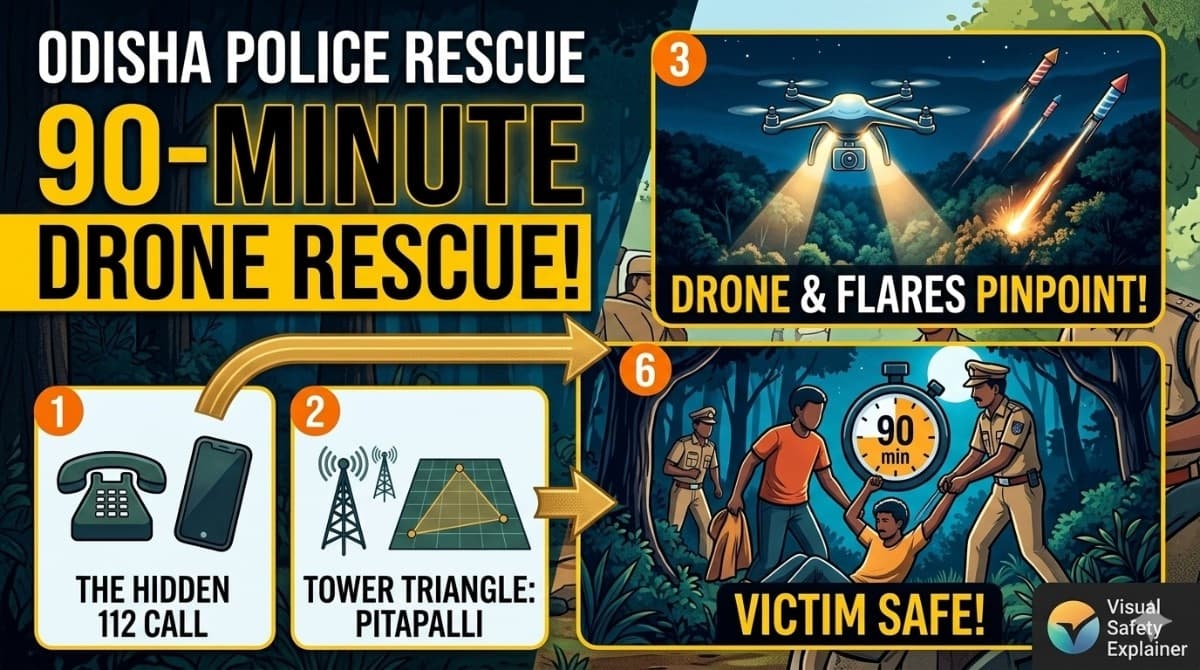
With no idea where she was, no visible landmark, and her mobile phone's GPS switched off by default, she made one desperate call to 112, Odisha's emergency response helpline.
Ordinarily, locating a stranded person in such terrain at night demands sophisticated thermal-imaging drones capable of detecting body heat through vegetation. The Bhubaneswar-Cuttack Police Commissionerate have no such capability.

📱 Get Argus News App
✨Yet, what unfolded over next 90 minutes was a remarkable display of improvisation, technology and old-fashioned policing.
Combining mobile tower triangulation, drones fitted only with LED searchlights, coordinated ground teams, and an ingenious use of rocket flares and fireworks, Commissionerate Police accomplished what many would have considered nearly impossible.
The rescue instantly recalled Kerala's much-publicised Kothamangalam forest operation, where thermal-imaging drones played a decisive role in locating stranded women. Odisha Police, however, achieved a similar outcome without that technological advantage – relying instead on tactical innovation and human intelligence.
From Khordha Bus Stand to Darkness of Ratanpur Forest
The ordeal began at the bustling Khordha Bus Stand, where the woman was allegedly offered a lift on a motorcycle by the accused Sunil Patra.
Instead of taking the expected route, he travelled along National Highway-16 towards the Pitapalli area before diverting into the isolated Ratanpur Reserve Forest, a rugged landscape known for its dense canopy and poor visibility.
Inside the forest, the accused allegedly attempted to sexually assault her.
Summoning extraordinary courage, the woman resisted, broke free and ran blindly into the forest.
She escaped the attacker – but soon realised she was hopelessly lost.
Surrounded by darkness, unable to identify any direction and fearing the accused could still be nearby, she quietly kept her mobile phone hidden and dialled 112.
That single call became her lifeline.
Operation Night Hunt: When GPS Failed, Detective Policing Took Over
The biggest challenge confronting police was immediate.
Since the victim's phone had location services disabled, the emergency control room could not obtain precise GPS coordinates.
Instead, officers first relied on cell tower triangulation, narrowing her possible location to a broad sector inside the Pitapalli-Ratanpur forest.
ACP Zone-III immediately mobilised nearly 50 personnel from Infovalley, Jatani and Khandagiri police stations, sealing likely exit points while drone teams were deployed overhead.
But the drones themselves had limitations.
Unlike
thermal drones, they carried only standard optical cameras with LED
searchlights that could illuminate only the forest canopy – not someone hiding
beneath thick foliage.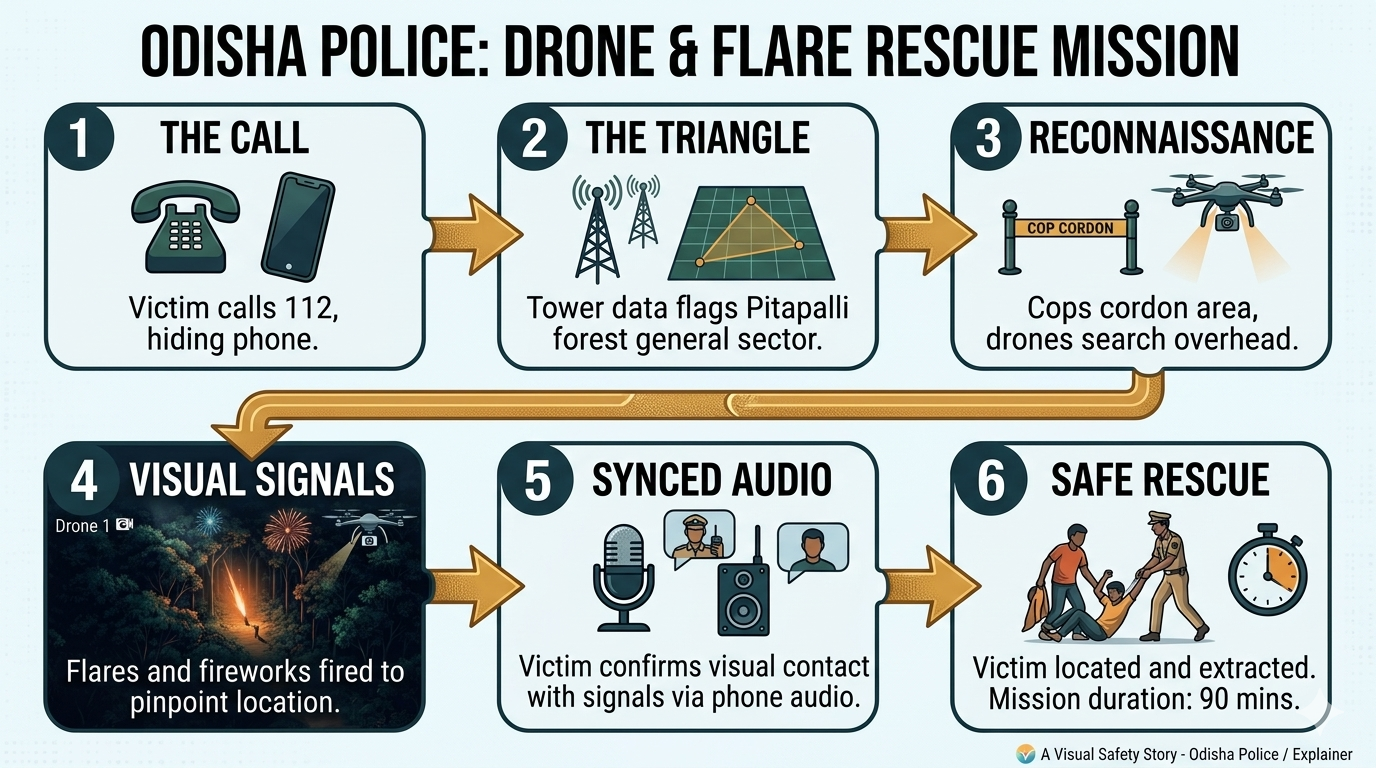
Realising technology alone would not solve the problem, police adopted an unconventional strategy.
Rather than trying to locate the victim visually, they decided to make the victim locate them.
Rocket fireworks and flares were fired into the night sky above different sectors of the forest.
Meanwhile, the woman remained continuously connected to the 112 operator.
Every time a flare exploded overhead, she was asked:
"Can you see it? Which direction is it?"
Her responses enabled police to progressively narrow the search area.
Ground teams advanced towards the sector identified through the synchronized audio-visual communication while drones hovered overhead.
Within roughly 90 minutes, officers finally located the woman sitting beneath a tree, traumatised but alive.
The rescue demonstrated that while sophisticated equipment enhances policing, tactical thinking and coordination can sometimes compensate for technological limitations.
Kerala Did It with Thermal Drones. Odisha Did It with Ingenuity
The rescue inevitably draws comparisons with the November 2024 Kothamangalam forest rescue in Kerala.
In that incident, three women fled into the dense Kuttampuzha forest after encountering a herd of wild elephants and became stranded overnight.
Kerala Police and the Forest Department mounted a large-scale rescue using thermal-imaging drones, capable of detecting human body heat even through dense vegetation. Local tribal trackers familiar with elephant corridors supplemented the technological search, and the women were rescued after an overnight operation.
Odisha's rescue differed significantly.
Without access to thermal drones, Commissionerate Police relied on a blend of:
- Cell tower triangulation;
- Standard surveillance drones;
- Continuous communication through the 112 helpline;
- Ground search teams; and
- Visual signalling using flares and fireworks.
The contrast underlines how tactical innovation can bridge technological gaps, but it also exposes a capability deficit that could become critical in future emergencies.
Lessons Beyond One Rescue
The operation offers important lessons for both citizens and policymakers.
Safety Tips for Citizens
- Always keep Emergency Location Services (ELS) or GPS enabled, especially while travelling alone.
- Share your live location with trusted family members whenever using ride services or accepting lifts.
- If trapped, stay connected with emergency responders instead of moving aimlessly.
- Preserve your phone battery and avoid unnecessary calls.
- If possible, remain in one location after informing police.
What Government Must Do
While the rescue showcased exceptional professionalism by Commissionerate Police, it also highlighted a significant technological gap.
Urban police forces increasingly respond not only to crime but also to search-and-rescue operations in forests, flood zones and disaster-hit areas.
Equipping Odisha Police with thermal-imaging drones, AI-assisted aerial surveillance systems, advanced GPS tracking tools and specialised night-search equipment should no longer be viewed as a luxury but as an operational necessity.
The July 19 night rescue proved one thing beyond doubt: courage and ingenuity saved a life.
The next
rescue, however, should not have to depend on fireworks lighting up the night
sky. It should have the backing of technology that allows police to find
victims before time, darkness or danger overtakes them.
Also Read: Why No Breakthrough Yet in IIC Beauty Mohanty's Death? Probe Awaits Key Forensic Evidence Amid No Clear Motive | Special Report
Related Topics
Explore more stories