



Odisha Law and Order / Odisha Police Rounds Up 1,771 Criminals, But Why Do High-Profile Crimes Still Grab Headlines? | Analysis
Key Points
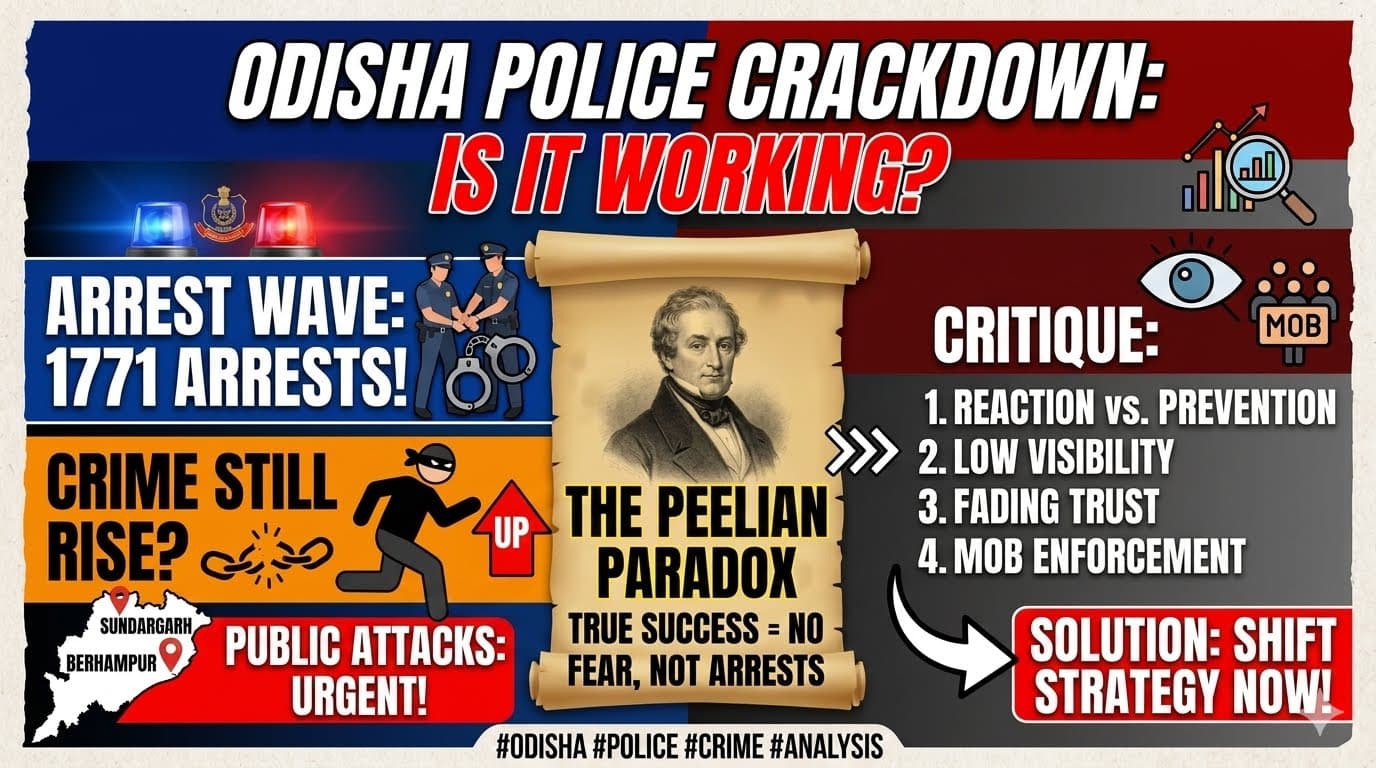
Bhubaneswar: When the Odisha Police announced the arrest of 1,771 offenders in a sweeping five-day statewide crackdown between May 12 and 16, law and order circles received the news well. Many saw it as a major policing action that was long overdue.
The operation looked like a textbook assertion of state power. Officers executed non-bailable warrants, detained habitual offenders, seized large quantities of narcotics, recovered firearms, and invoked the National Security Act (NSA) against select criminals.
Yet, within days of the operation, Odisha witnessed a disturbing chain of violent incidents. The viral Berhampur public assault case and the organized street attack in Sundargarh are prime examples.
This contradiction raises a deeper question: Why do violent crimes continue even right after massive police crackdowns?

📱 Get Argus News App
✨Peelian Principles: A Lesson for Odisha Police
With big crimes still hogging headlines after this major swoop, observers are reminded of the famous Peelian Principles of Law Enforcement. These principles state: "The true measure of policing lies not in the volume of arrests, but in the absence of crime and fear on the streets."
After all, these ongoing crimes are not caused by manpower shortages or a lack of political will. They happen because of a structural flaw—the missing "canons of policing."
The Missing Links
Modern policing theory makes a sharp distinction between short-term enforcement drives and sustainable policing. While enforcement focuses on quick raids, seizures, and visible force, true policing requires:
- Prevention
- Territorial control
- Deep intelligence penetration
- Community legitimacy
- Rapid response certainty
- Continuous state presence
Odisha’s recent anti-crime drive was operationally strong. However, the big crimes that followed suggest the deeper ecosystem may still be unbalanced. Here are the key missing links:
1. Prevention Over Reaction
A study of the post-crackdown incidents reveals they were not random eruptions. Many showed clear signs of:
- Pre-existing gang rivalries (Berhampur case)
- Planned revenge mobilization
- Local territorial assertion (Sundargarh case)
- Predictable retaliation patterns
The Berhampur assault, for instance, was carried out in full public view. This theatrical display suggests the attackers believed they had enough room to act before police intervened. Similarly, the shootout in Sundargarh – where unidentified miscreants opened fire at a coal businessman’s house – points to extortionist gangs asserting local dominance.
The system still seems to react to crime events rather than stabilizing the criminal ecosystem before violence erupts.
2. Thin Territorial Policing
The recent spate of headline-grabbing crimes points to low police visibility. Murders, assaults, and mob attacks occurred on public roads, in busy markets, and in crowded areas.
Classical policing doctrine suggests that criminals avoid violence where police visibility is continuous, beat intelligence is deep, and response time is unpredictable. Crimes happening in full public view indicate weak territorial control by the police in districts like Ganjam and Sundargarh. In many areas, policing still appears event-centric: highly active after a crime, but less embedded before things escalate.
The Rise of Mob Enforcement
A worrying trend in the state is the rise of mob enforcement. Incidents like the Balianta case suggest something deeper than simple criminal aggression. They point to declining public faith in formal justice.
When communities believe the legal system is too slow, or that local influence shields criminals, crowd punishment begins to replace institutional enforcement. The canons of policing teach us that this is a legitimacy issue, which is fatal for democratic policing.
The Evolving Challenge
Case studies show that Odisha’s criminal landscape has changed. Older policing models focused heavily on individual history-sheeters and warrant executions. Today, newer networks operate as fluid ecosystems involving:
- Interstate movement
- Gambling economies
- Narcotics financing
- Transport syndicates
- Digital coordination
- Loose gang clusters
Dealing with these modern networks requires intelligence-led policing rather than just arrest-led policing.
What the UP Model Reminds Us
In addressing these missing links, it is worth looking at how Uttar Pradesh adopted a far more layered policing model over the last several years.
While public attention largely focused on encounters and bulldozers, UP invested heavily beneath the optics in:
- Forensic infrastructure
- Commissionerate policing
- AI-assisted surveillance
- Integrated criminal databases
- Predictive intelligence
- Rapid response systems
The UP model evolved from short-term drives into continuous ecosystem pressure. Known gang networks were financially targeted, digitally mapped, territorially monitored, and procedurally tracked. The key lesson is that criminal ecosystems only weaken when state pressure is continuous and intelligence-driven, not periodic.
Why the Massive Swoop Did Not Resonate on Ground
The Odisha crackdown was large and highly visible. However, criminal groups always test whether state pressure will last after the headlines fade. This is where the most important policing canon applies: effective policing is continuous, not episodic.
If criminal groups believe that raids are temporary and local dominance will soon return, violence resurfaces quickly. The incidents seen across Odisha between May 17 and May 25 indicate precisely such a stress test phase.
Therefore, the next phase of Odisha policing must focus on:
- Deeper beat intelligence
- Stronger community policing
- Predictive threat mapping
- Faster prosecution cycles
- Permanent network disruption
True
policing success is not measured only by how many criminals fill the jails. It
is measured by making violence itself too difficult to organize.
Also Read: Murder Crime / Rayagada Abduction and Killing: NCRB 2024 Report shows Murder Due to Personal Enmity 3rd Leading Motive in Murders in Odisha
Related Topics
Explore more stories