



Love Affair Suicides in India: Why Men Die More Often, But Odisha Tells a Different Story| Exclusive
Key Points
Bhubaneswar: India's latest suicide data linked to "love affairs" reveals a disturbing reality hidden behind romantic relationships. While heartbreak-related suicides overwhelmingly claim more male lives across the country, Odisha stands out as one of the rare exceptions where the gender gap is almost non-existent.
The numbers expose a striking paradox.
At the national level, men continue to bear the heavier burden of emotional distress arising from failed relationships, rejection, family opposition and broken marriages. Yet in Odisha, women are dying at nearly the same rate as men due to love-affair-related trauma, raising important questions about changing social dynamics and mental health vulnerabilities.
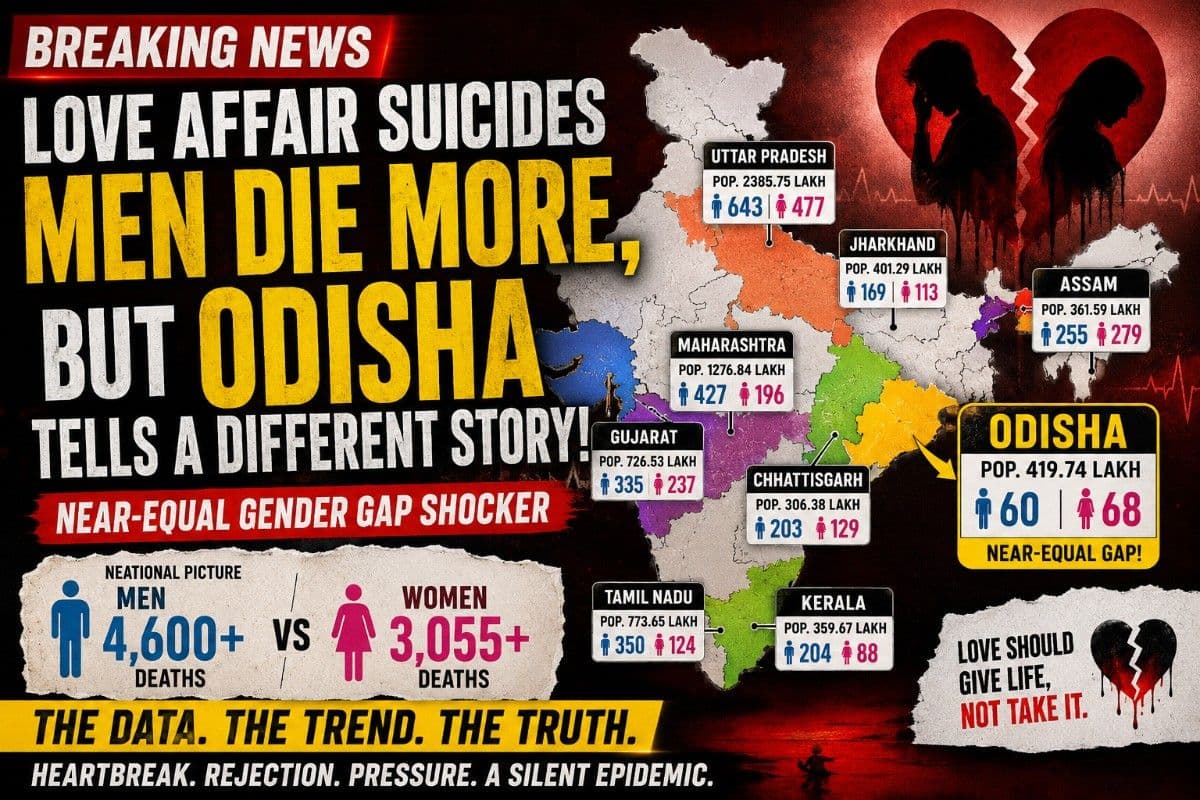
According to the NCRB data, India recorded thousands of suicides attributed to love affairs, with men accounting for a significantly larger share of victims. Uttar Pradesh alone reported 643 male and 477 female suicides linked to love affairs. Maharashtra recorded 427 male and 196 female deaths, while Tamil Nadu reported 350 male suicides compared to just 124 female cases.

📱 Get Argus News App
✨However, when population size is taken into account, the picture becomes even more revealing.
South Lethal Strike Higher Than UP
Uttar Pradesh, India's most populous state with nearly 23.86 crore people, reported 1,120 love-affair suicides. But Tamil Nadu, with a population of just 7.74 crore, recorded 474 such deaths. Kerala, home to around 3.60 crore people, reported 292 cases.
This means the per-capita incidence of love-affair-related suicides is significantly higher in southern states such as Tamil Nadu and Kerala than in Uttar Pradesh, suggesting that social, cultural and psychological factors that may be playing a bigger role in the states.
Why Are Men More Vulnerable?
Mental health experts have long pointed to a troubling pattern in India: men are less likely to seek emotional support during personal crises.
For generations, Indian men have been conditioned to appear strong, resilient and emotionally self-sufficient. When relationships collapse, marriages are blocked by families, or partners leave, many men find themselves isolated.
Unlike women, who often maintain stronger emotional support networks through friends and family, men frequently internalize grief. The resulting feelings of rejection, humiliation and loss of identity can trigger impulsive and self-destructive behaviour.
The trend is visible across most major states.
Even in Gujarat, where 335 men and 237 women died due to love-affair-related reasons, the male count remains substantially higher. Maharashtra and Tamil Nadu show even wider gender disparities.
The States That Defy the National Pattern
Two states stand out for entirely different reasons.
Assam is the only major state where female suicides linked to love affairs exceed male suicides. The state reported 279 female deaths compared to 255 male deaths.
Odisha presents another unique case.
The state recorded 128 love-affair-related suicides, including 60 men and 68 women. While the overall number is relatively low compared to larger states, the gender ratio is among the most balanced in the country.
This makes Odisha one of the few states where women are nearly as vulnerable as men in matters of romantic distress.
Why Is Odisha Different?
Experts point to a social transition underway in Odisha.
Over the past decade, more young women have entered higher education, professional employment and independent social spaces. They are increasingly exercising greater freedom in choosing partners and shaping personal relationships.
However, traditional barriers have not disappeared.
Family opposition, caste considerations, community pressure, concerns about reputation and fear of social judgment continue to influence relationship outcomes. When modern aspirations collide with traditional expectations, the emotional consequences can be severe.
For many young women, a failed relationship is not merely a private emotional setback. It can affect family relations, future marriage prospects and social standing within closely connected communities.
The result is a narrowing gender gap in emotional vulnerability.
Unlike the national trend where men overwhelmingly dominate the statistics, Odisha's numbers suggest that both men and women are experiencing comparable levels of psychological distress arising from romantic relationships.
The Bigger Warning
The Odisha data highlights a broader national concern.
The story is no longer just about male vulnerability. It is increasingly about the inability of both genders to cope with emotional trauma in a society where discussions around relationships, rejection and mental health remain stigmatized.
As India modernizes and young people gain greater freedom in choosing partners, emotional support systems have not evolved at the same pace.
The statistics from Odisha serve as an early warning that heartbreak is no longer a gendered crisis. It is becoming a shared mental health challenge demanding urgent intervention, counselling support and greater societal acceptance of emotional vulnerability.
Behind every
number lies a life lost not to love itself, but to the crushing pressures that
often surround it.
Also Read: Love crime / 'Love Stories' Turning Lethal: Rise in Relationship-Driven Murders Across India, Odisha sees Uptick
Related Topics
Explore more stories