



How Three Crime Syndicates Turned Balasore into Odisha's Fastest Growing Firearms Hub; Why Police Still Playing Catch-Up| Special Report

Key Points
Balasore has transformed into Odisha's fastest-growing firearms hub, shifting rapidly from crude country-made weapons to sophisticated 7.65mm semi-automatic pistols.
Three localized criminal networks—narcotics cartels, real estate land mafias, and highway heist crews—are actively fueling the district's soaring gun culture.
Standard law enforcement strategies are struggling to contain the crisis by focusing heavily on immediate gun couriers while leaving deep interstate supply chains and financial networks intact
Bhubaneswar/Balasore: It was barely past midnight when terror rolled into Darada under Basta police limits.
Two men on a Bullet motorcycle slowed before a petrol pump along the busy highway. Their faces were concealed. One calmly stepped off, pulled out a pistol and pointed it at the fuel station employees. There was no shouting, no panic, no hesitation. The weapon alone did the talking. Within minutes, cash worth several lakhs was gone. Before anyone could react, the duo disappeared into the darkness.
The CCTV
footage was chilling not because of the robbery itself, but because of the
confidence with which the assailants handled the firearm. It wasn't a crude
country-made weapon being waved around nervously. It was a professional
intimidation—swift, calculated and executed with precision.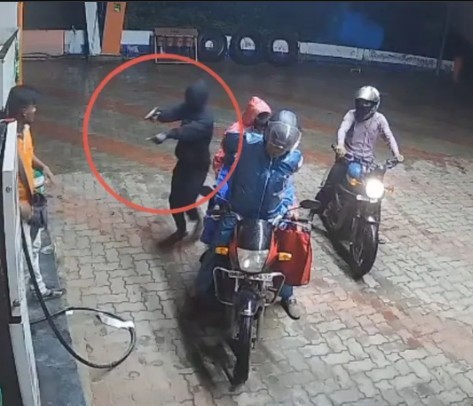
The
incident, which grabbed national television headlines on July 4, has once again
exposed an uncomfortable reality.
The pistol was not the story.

📱 Get Argus News App
✨The ease with which it used was.
And that is precisely what has transformed Balasore into one of Odisha's most worrying firearm hotspots.
Arda Bazaar Murder Was Not an Exception
Only days before the Darada robbery, another gun crime shook the district.
In Arda Bazaar, assailants pumped multiple bullets into a local trader in broad daylight before fleeing. Witnesses described the attack as something more reminiscent of a gang execution than a local criminal assault.
Between the execution-style killing and the petrol pump robbery, a disturbing pattern has emerged.
Firearms are no longer being used only by hardened gangsters or interstate criminals.
They are increasingly becoming the preferred weapon for extortion, robbery, land disputes and settling scores.
A close examination of Balasore's crime landscape over the past two decades reveals that this transformation has not happened overnight.
It has been engineered by three powerful criminal ecosystems operating across different geographical belts of the district.
Three Crime Syndicates, Three Territories, One Growing Gun Culture
Unlike traditional organised crime dominated by one cartel, Balasore today is under the influence of three distinct but interconnected criminal syndicates.
Each has its own economic engine.
Each has its own operational geography.
But all of them increasingly depend on illegal firearms.
1. Border Narcotics Syndicate: Jaleswar–Arda Bazaar Belt
The northern belt adjoining West Bengal has quietly become one of Odisha's most active narcotics transit corridors.
Brown sugar, ganja and other contraband regularly move through the interstate routes connecting Kharagpur, Jaleswar and Balasore.
Investigations into multiple arrests over recent years indicate that firearms often travel alongside narcotics consignments.
For these syndicates, pistols are no longer status symbols.
They are business tools.
Weapons protect drug consignments, intimidate rival gangs and ensure safe passage through transit routes.
Police interrogations in several arms cases have repeatedly pointed towards procurement channels originating from illegal gun-making hubs in Munger in Bihar and clandestine manufacturing pockets in West Bengal.
Balasore is less a manufacturing centre than a consumption and distribution hub.
Its location makes it ideal.
2. Real Estate and Extortion Network: Balasore Town–Remuna Corridor
As Balasore expands rapidly, land has become one of the district's most lucrative commodities.
Rising property values around Balasore town, Remuna and surrounding industrial corridors have triggered fierce competition among land brokers, musclemen and organised extortion groups.
Unlike earlier years when intimidation relied on swords and crude bombs, today's land mafias increasingly prefer sophisticated pistols.
The objective is psychological dominance.
A single firearm displayed during negotiations often achieves what violence once required.
Investigators say contract intimidation, forced distress sales and extortion have increasingly become intertwined with illegal firearm possession.
Several recoveries made by Balasore police over the last few years point towards this emerging nexus.
3. Highway Robbery and Sand Mafia: Basta–Darada–Subarnarekha Belt
The July 4 petrol pump robbery perfectly illustrates the third criminal ecosystem.
Basta's location near NH-16 and its proximity to the West Bengal border make it ideal for highly mobile robbery gangs.
These are motorcycle-borne teams that strike commercial establishments located close to highways before escaping across district or state boundaries.
The Darada petrol pump robbery followed precisely this model.
Arrive quickly.
Threaten with a firearm.
Collect cash.
Disappear before police blockades become effective.
Running parallel to these gangs is another powerful player – the illegal sand mining network operating around the Subarnarekha river basin.
Control over illegal sand ghats has created violent rivalries where firearms increasingly supplement traditional country-made weapons.
While the sand mafia may still use locally fabricated guns in many cases, investigators say the distinction between highway robbers, transport criminals and mining operators is becoming increasingly blurred.
The Geography That Favours Crime
Balasore suffers from a geographical disadvantage that criminals have turned into a strategic advantage.
The district sits at the intersection of Odisha, West Bengal and major national transport corridors.
NH-16.
Passenger trains.
Interstate buses.
Rural border roads.
Together they create multiple entry points for illegal firearms.
Instead of transporting large consignments, traffickers increasingly move small batches hidden among ordinary passengers or alongside narcotics.
Even when one consignment is intercepted, replacement stocks arrive quickly.
This explains why arrests have failed to reduce firearm availability.
Police Have Not Been Sitting Idle
To suggest that Balasore Police have ignored the problem would be inaccurate.
Under intensified anti-arms drives, the district has significantly increased enforcement.
During 2025 alone:
- 47 Arms Act cases were registered.
- 31 accused were arrested.
- 11 illegal firearms were seized.
- 18 live rounds were recovered.
Night blockades, highway interceptions and intelligence-led raids have become far more frequent than in previous years.
Recent operations have also combined Arms Act provisions with NDPS cases wherever narcotics and weapons were recovered together, making bail more difficult for offenders.
Senior officers have also shifted focus from reactive policing to preventive highway surveillance.
These measures have undoubtedly disrupted several local arms suppliers.
Yet the numbers reveal another reality.
Despite increasing seizures, firearms continue appearing in fresh crimes.
Where the Policing Model Still Falls Short
The biggest weakness is not in catching gun carriers.
It is in dismantling gun networks.
Most investigations conclude after recovering a weapon and arresting the immediate carrier.
What often remains unexplored is the weapon's journey.
Where exactly was it manufactured?
Which interstate courier transported it?
Who financed its purchase?
Which local syndicate ordered it?
Without tracing this complete supply chain, every arrest merely removes one courier while the network survives intact.
Ballistic profiling of recovered weapons remains limited.
Financial investigations into organised crime are still far less aggressive than narcotics investigations.
Equally significant is the absence of institutionalised real-time coordination with neighbouring police units in West Bengal and Bihar to strike at manufacturing sources rather than just intercept deliveries.
Why the Guns Keep Coming
Balasore's firearm problem is no longer simply a law-and-order issue.
It is the product of three powerful criminal economies feeding one another.
Drug trafficking generates cash.
Land disputes generate demand.
Highway robberies generate quick profits.
Illegal mining finances local muscle.
Illegal firearms provide the common language connecting them all.
As long as policing will not launch a crackdown on financiers of gun trade and source point of firearms, seizures alone are unlikely to reverse the trend.
The Darada petrol pump robbery and Arda Bazaar shooting are therefore not isolated crimes.
They are warning signals.
Behind every pistol displayed in public today lies an organised supply chain stretching hundreds of kilometres beyond Balasore, and huge finances keeping the gun culture running.
Until that
network is systematically broken – from the illegal workshops of Bihar and West
Bengal to the financiers operating within Odisha – the district risks
witnessing more crimes where the trigger is pulled long before the police
arrive.
Also Read: Odisha Police Needs Urgent 'Operation Clean Sweep': The Truth Behind Broad Daylight Bhubaneswar Gang Violence Drops Big Statewise Hint| Special Report
Related Topics
Explore more stories