



EXCLUSIVE|Tactical Shift in Capital Policing: New Bhubaneswar DCP Saravana Vivek M Positions Force Against Street Crime & Cyber Fraud
Key Points
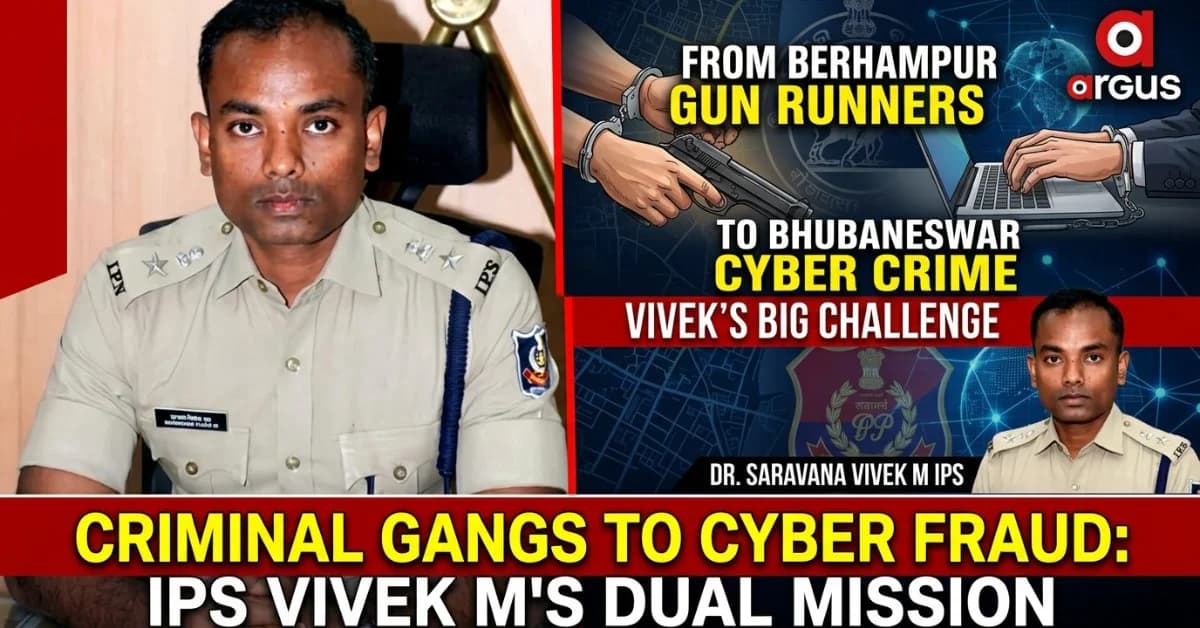
IPS officer Dr Saravana Vivek M moves from Berhampur SP to take charge as the new Deputy Commissioner of Police (DCP) for Bhubaneswar.
His unique background spans tactical field enforcement against organised crime and complex financial investigation experience from his Vigilance tenure.
He succeeds Jagmohan Meena, bringing a more operational and enforcement-oriented profile to handle Bhubaneswar's multi-layered metropolitan crime challenges.
Bhubaneswar: From dismantling gun-running networks and tackling violent criminal syndicates in Berhampur to policing Odisha’s increasingly complex capital, Dr Saravana Vivek M now faces a very different urban policing challenge.
The 2015-batch IPS officer has been moved from SP, Berhampur, to DCP, Bhubaneswar, in Tuesday’s four-officer reshuffle. His movement is the first major link in a chain of postings that has simultaneously placed Abhinav Sonkar in Berhampur and Ajinkya B. Mane in Dhenkanal.
The profile of Vivek is particularly relevant to the capital assignment. An MBBS graduate before entering the civil services, he has also served as SP, Vigilance, giving him exposure to anti-corruption operations, financial investigation and complex economic offences. His earlier Berhampur assignment added another dimension – direct field experience against violent and organised local crime.
That combination effectively gives Vivek two different policing toolkits: an investigative understanding of financial and technical crime, and field experience in dealing with physically organised criminal networks.

📱 Get Argus News App
✨Why Bhubaneswar needed a different policing profile
The Bhubaneswar assignment is structurally different from the one Vivek is leaving.
The capital has to simultaneously handle conventional street crime, organised criminal activity, land-related disputes, narcotics, cyber fraud, VIP-security requirements and political demonstrations.
Cybercrime, brown-sugar trafficking, land grabbing, VIP security and frequent protests are among the principal urban policing challenges confronting Bhubaneswar.
That is significant because the criminal ecosystem of a capital city is not confined to the visible street.
A conventional robbery or gang clash produces an identifiable crime scene. A cyber-fraud network can operate through several jurisdictions. A land-grabbing network can involve intermediaries, forged documents and financial transactions. Narcotics networks can involve supply chains extending beyond the city.
This is where Vivek's Vigilance background becomes relevant.
His documented experience includes complex anti-corruption mandates and financial-audit-oriented investigation. His Berhampur tenure, meanwhile, gave him experience with organised criminal structures and illegal firearms. The new posting therefore places an officer with both investigative and field-enforcement experience in a city where crime is increasingly a mixture of physical networks and digital/financial networks.
The Vivek policing model
Vivek's policing approach is tactical and enforcement-oriented, particularly against organised crime.
His Berhampur experience is described in terms of tackling illegal firearms, gang rivalries and extortion networks. A track of his Berhampur tenure describes his approach as involving visible deployments, raids and direct field intervention.
That policing style has an obvious advantage in a city where street-level deterrence remains important.
But Bhubaneswar will require an adaptation.
The capital cannot be policed only through physical enforcement. Cyber fraud, digital financial crime, land-related fraud and narcotics require intelligence collection, financial tracking, digital evidence and inter-agency coordination.
The challenge for Vivek will therefore be to transfer the enforcement intensity associated with his Berhampur tenure into a much larger urban ecosystem where the criminal networks are often less visible.
From Berhampur's violent crime to Bhubaneswar's hybrid crime
The contrast between the two assignments is substantial.
Berhampur has been a commercially dense having volatile policing environment involving gang rivalry, illegal country-made firearms, inter-state mouser trade, crude-bomb manufacture, extortion, land and sand mafias and group clashes.
Bhubaneswar's challenge is more heterogeneous.
It combines conventional street crime with cyber scams, narcotics, land-related criminal activity, demonstrations and the security requirements of the state capital.
Thus, Vivek is not moving from one version of the same policing problem to another.
He is moving from a territorially concentrated violent-crime environment to a multi-layered metropolitan policing environment.
His Berhampur experience could help in dealing with organised networks that operate physically on the ground. His Vigilance experience could become relevant to the financial trail behind more sophisticated criminal activity.
The Meena-to-Vivek transition
The transition is also important because Vivek succeeds Jagmohan Meena, whose resignation from the IPS was formally accepted by the Centre in September 2026.
Both IPS officers have two different administrative approaches.
Meena's tenure emphasised on institutional reform, police-public empathy, time-bound investigation and force welfare, including attention to stress management.
Vivek's profile is more operational, with emphasis on field intervention, organised crime and visible enforcement.
This does not mean that the two models are mutually exclusive.
Rather, the capital now has an incoming officer whose documented experience places greater emphasis on criminal-network disruption and field enforcement, while the institutional systems established during the previous tenure remain part of the police apparatus.
The immediate test
The immediate question will be whether Vivek can combine those two requirements.
Bhubaneswar needs visible street-level policing, but increasingly also needs sophisticated investigation of cyber and financial crime.
It needs control over organised criminal networks without losing the administrative discipline required of a capital-city police commissionerate structure.
Vivek's background may seem particularly relevant in areas such as crackdown on illegal firearms, drug-peddling chains and high-tech cybercrime syndicates.
His success in the new assignment will therefore depend less on simply reproducing the Berhampur model and more on how effectively he adapts that enforcement-oriented approach to Bhubaneswar's hybrid crime environment.
The
change consequently represents more than an officer-to-officer
replacement. It brings a different operational profile into the
capital at a time when the city's policing demands increasingly span
the street, the financial system and cyberspace.
Also Read: EXCLUSIVE| Who Will be Bhubaneswar DCP After Meena: Three Officers Emerge As Government Weighs Capital's Next Policing Face
Related Topics
Explore more stories