



EXCLUSIVE| Who Will be Bhubaneswar DCP After Meena: Three Officers Emerge As Government Weighs Capital's Next Policing Face
Key Points
Jagmohan Meena’s resignation as Bhubaneswar DCP has opened a major administrative and policing vacancy for the Odisha government.
The capital's evolving security landscape demands a balance between street-level visibility, cybercrime management, and sophisticated investigations.
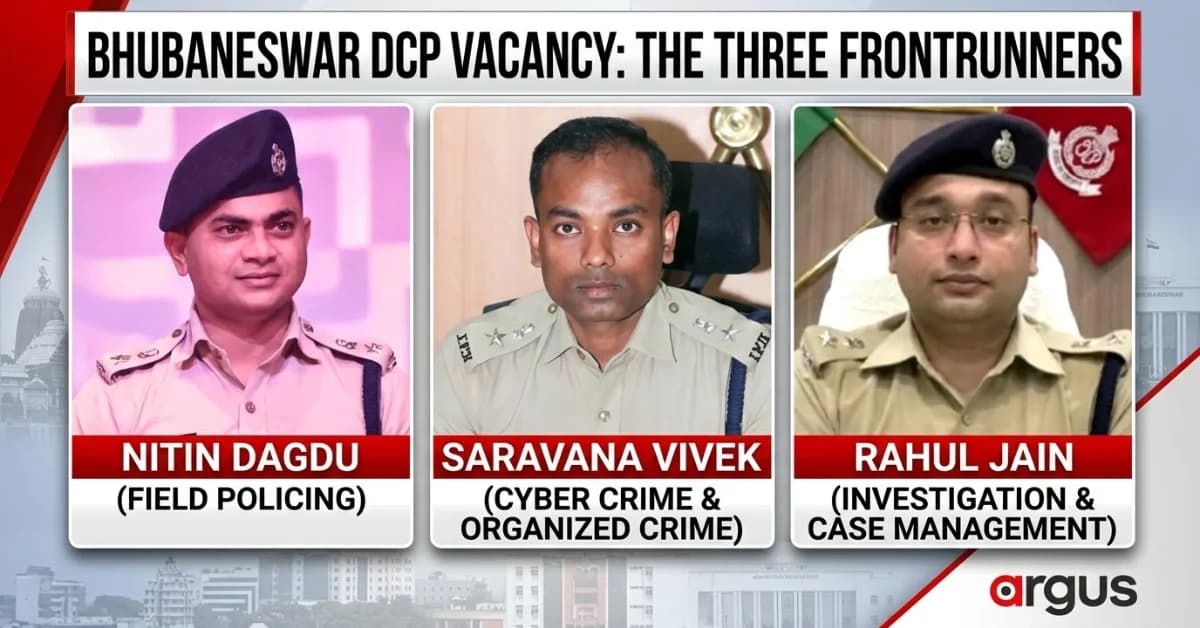
Three prominent 2015-batch IPS officers—Kusalkar Nitin Dagdu, Dr. Saravana Vivek M, and Rahul Jain—emerge as top contenders with distinct operational strengths.
Bhubaneswar: With the resignation of Jagmohan Meena formally accepted, the Odisha government now faces a relatively straightforward administrative vacancy but a far more complicated policing choice: whether to bring in an officer whose immediate value lies in street-level crime control, sophisticated investigation or specialised enforcement.
The President accepted the 2013-batch IPS officer's resignation with effect from September 11, according to the Union Home Ministry notification. Meena had cited personal reasons for leaving the service. The development has opened the way for the state government to decide his successor, with sources indicating that an IPS reshuffle at the SP level could accompany the appointment.
The choice is significant because Bhubaneswar does not operate as an isolated police district. It is part of the Bhubaneswar-Cuttack Commissionerate, where the Commissioner provides the larger command structure and the DCP is expected to translate that strategy into intensive field-level policing.
That makes the vacancy different from an ordinary district SP posting.

📱 Get Argus News App
✨The capital does not necessarily need another layer of administration
The most important feature of the present situation is that the Commissionerate already has a Commissioner at the top.
Consequently, the immediate requirement from the DCP may not simply be another officer with broad administrative experience. The vacancy creates room for an officer who can take direct ownership of crime control, field deployment, investigation quality, public visibility and rapid response.
That distinction becomes important when the present crime environment of the capital is considered.
Bhubaneswar has simultaneously had to deal with conventional street crime, organised criminal activity, cyber and financial fraud, group clashes and incidents capable of generating national attention. The capital's expanding urban and corporate footprint also means that cybercrime cannot be treated as a peripheral police problem.
The incoming DCP therefore has to operate in a policing environment where the traditional distinction between street crime and sophisticated crime is increasingly blurred.
The seniority question narrows the field
A large number of IPS officers could theoretically be considered for the post. But the practical pool is considerably smaller.
Among the 2015-batch officers currently holding important SP assignments are Rahul Jain, SP Angul; Dr Saravana Vivek M, SP Berhampur; and Kusalkar Nitin Dagdu, SP Keonjhar.
Their career stage also makes them particularly relevant to a discussion around a major Commissionerate assignment.
While Saravana Vivek M and Rahul Jain as 2015-batch officers, with their present SP postings beginning in October 2024, while Kusalkar Nitin Dagdu, also a 2015-batch officer, has been SP Keonjhar since May 2023.
Saravana Vivek: The cyber-and-organised-crime option
Dr Saravana Vivek M brings a distinctly different proposition to Bhubaneswar.
His Berhampur tenure has exposed him to a policing environment where conventional crime and organised networks coexist with increasingly sophisticated digital fraud. His profile is therefore particularly relevant to a capital city whose crime challenge is moving beyond physical offences.
For the government, his attraction would lie in the possibility of bringing specialised crime-control experience into the capital at a time when cyber-enabled financial offences have become a major urban policing challenge.
Rahul Jain: The investigation-and-case-management option
Rahul Jain represents another type of requirement.
The 2015-batch officer is presently SP, Angul. His professional profile combines policing with an academic background in commerce and chartered accountancy.
For Bhubaneswar, the relevance of such a profile lies less in conventional territorial policing and more in the increasingly important connection between crime investigation, financial trails, evidence management and prosecution.
The capital's police challenge is not simply to arrest suspects. High-profile cases attract immediate public, political and judicial scrutiny, making the quality of investigation and documentation nearly as important as the initial police action.
Jain therefore becomes particularly relevant if the government's immediate concern is to strengthen the chain between detection, investigation and the eventual legal outcome.
Nitin Dagdu: The field-policing option
Kusalkar Nitin Dagdu presents perhaps the clearest contrast.
The 2015-batch IPS officer has been SP Keonjhar since May 25, 2023. That gives his name a different administrative dimension.
Keonjhar is not a low-pressure policing assignment. Its combination of mining activity, transport routes, industrial interests, tribal areas, land-related tensions and localised public-order challenges gives an SP substantial exposure to difficult field policing.
More importantly for Bhubaneswar, Dagdu's policing model has included a strong public-contact component. The Ama Police framework itself is built around night patrolling with community participation, coordination with private security guards, protection of vulnerable groups and neighbourhood-level vigilance. Odisha's official documentation describes the DCP/SP as the district-level supervisory authority for the programme.
That is directly relevant to a capital increasingly demanding visible policing.
The argument for Dagdu, therefore, is not that Bhubaneswar needs a replication of Keonjhar. It is that a Commissionerate with a Commissioner already handling the larger institutional architecture can benefit from a DCP who spends considerable time on the ground – organising patrols, responding to street crime and maintaining direct public contact.
Why the Commissioner factor matters
The appointment also has to work within the existing Commissionerate command.
A DCP cannot be viewed in isolation from the Commissioner. The two positions have different but complementary responsibilities. The Commissioner provides the broader command and institutional direction, while the DCP has to execute that framework through field policing.
That makes the choice less about finding the officer with the most impressive individual record and more about finding an officer whose strengths complement the existing command structure.
In practical terms, an officer heavily oriented towards specialised investigation may be valuable if the priority is cybercrime and complex cases. A field-oriented officer may be more useful if the immediate concern is visible street policing. A procedural specialist may be preferred if the government wants stronger investigation-to-prosecution outcomes.
The vacancy therefore produces three distinctly different policing propositions.
What has changed the calculation
The context in which the new DCP will arrive is also important.
The capital has recently seen crime incidents that have attracted attention beyond routine local reporting. At the same time, the city continues to face the everyday problems of snatching, extortion, public brawls, traffic-related conflict and neighbourhood crime.
For the government, the challenge is consequently two-layered.
The first is visibility: citizens need to see policing on the streets.
The second is capability: increasingly sophisticated criminal networks cannot be handled through patrols alone.
A DCP who can address only one of those dimensions would leave a gap in the other.
The three names that finally emerge
After the wider pool is narrowed by the practical availability of officers, their present tenures, their experience with different crime environments and the particular requirement of a Commissionerate that already has a Commissioner, three names stand out for three different reasons.
Kusalkar Nitin Dagdu fits the immediate field-policing requirement most directly: a long current tenure in Keonjhar, extensive district-level operational exposure and a visible community-policing orientation.
Dr Saravana Vivek M fits the capital's increasingly complex cybercrime and organised-crime challenge, while his experience in Berhampur gives him exposure to a demanding urban policing environment.
Rahul Jain represents the investigation-and-prosecution side of the requirement, with a profile that could be relevant if the government wants the DCP's emphasis to fall on systematic case management and stronger legal outcomes.
The final choice, therefore, may come down to what Bhubaneswar needs most immediately – not which officer has the most impressive résumé.
If the government wants the DCP to function principally as the Commissioner's field commander, Dagdu's profile acquires greater relevance; if sophisticated cyber and organised crime dominate the assessment, Saravana Vivek becomes particularly pertinent; and if investigation quality and case outcomes are given greater weight, Jain enters the picture strongly.
With
the Meena vacancy now formally open, these three profiles represent
three different answers to the same question: what
should Bhubaneswar's next DCP be asked to fix first?
Also Read: EXCLUSIVE| Odisha DGP Row: Why Supreme Court Deferred Hearing To September 22; Intervenor Turns Odisha’s Police Chief Selection Into A National Legal Test
Related Topics
Explore more stories