



EXCLUSIVE| Preventive Policing vs. Street Deterrence: How New Berhampur SP Abhinav Sonkar Fits Silk City's Volatile Law & Order
Key Points
IPS officer Abhinav Sonkar transitions from Dhenkanal to assume charge as the new Superintendent of Police (SP) for Berhampur.
Known for his public outreach and preventive policing model, Sonkar faces a volatile crime environment marked by gang rivalries and illegal firearms.
The upcoming festive season will serve as an immediate test of his strategy to blend community trust-building with rapid enforcement capacity.
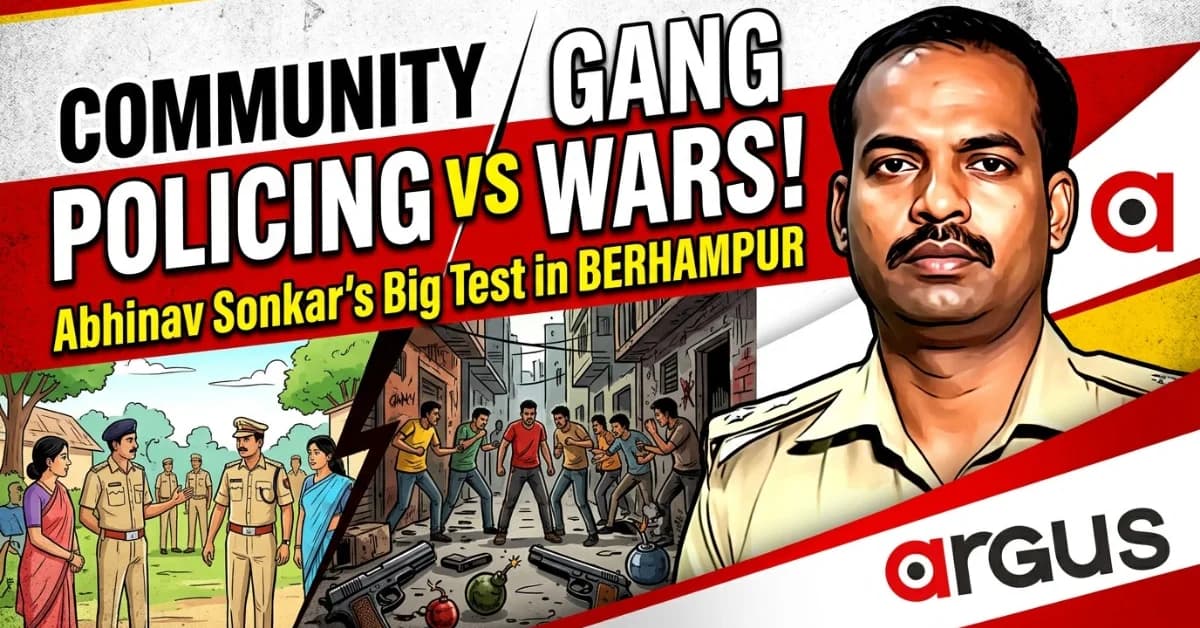
Berhampur: Abhinav Sonkar's next assignment will take him from a policing environment where community outreach, grievance redressal and preventive policing formed an important part of his administrative profile to one where gang rivalry, illegal firearms and extortion create a substantially different operational challenge.
The 2019-batch IPS officer has been transferred from SP, Dhenkanal, to SP, Berhampur, following the movement of Dr Saravana Vivek M to Bhubaneswar. The two postings are therefore directly connected in Tuesday's four-officer chain of transfers.
Sonkar brings with him a distinctive field profile.
During his Dhenkanal tenure, he is credited with institutionalising community-policing mechanisms, grievance-redressal outreach and women-and-child support systems. His policing profile is therefore less centred on purely coercive enforcement and more on building local information and public cooperation.

📱 Get Argus News App
✨Berhampur will test how that model works in a significantly more volatile crime environment.
Why Sonkar has been moved to Berhampur
The immediate reason is straightforward.
Vivek's transfer to Bhubaneswar created the Berhampur vacancy. Instead of initiating another long chain involving several districts, the Home Department moved Sonkar from Dhenkanal into the vacant SP position.
But the administrative movement also creates an interesting change in policing style.
Sonkar's Dhenkanal experience was built around community engagement, grievance handling and preventive mechanisms. Berhampur requires those capabilities, but alongside a stronger capacity for rapid tactical response.
Berhampur crime scene dominates with gang rivalries, illegal firearms, inter-state mouser trade, crude-bomb manufacturing, extortion networks, land and sand mafias and group clashes.
This makes the new assignment different in both tempo and criminal structure.
The Sonkar policing model
Sonkar's principal policing attribute is his emphasis on the public interface.
As per reports, he was credited with deploying the “Ama Police” public-outreach framework in Dhenkanal and strengthening Mahila Shishu support desks. His model seeks to bring the police closer to citizens and use community cooperation as an instrument of crime prevention.
That approach can generate an important policing asset: information.
Criminal networks do not operate entirely in isolation from society. Local residents know vulnerable locations, repeat offenders, extortion patterns and emerging disputes. A police administration that can convert community trust into reliable intelligence can intervene before a dispute becomes a major law-and-order problem.
The challenge is that Berhampur also contains criminal networks that may require direct enforcement rather than only preventive engagement.
Dhenkanal versus Berhampur
The contrast between Sonkar's previous and new districts is central to understanding the transfer.
Dhenkanal's crime environment revolves around industrial and labour disputes, highway thefts, domestic conflicts and opportunistic property crime.
Berhampur is described differently.
Its crime environment is more deeply connected to organised local networks, including illegal weapons, extortion and group clashes. The commercial character of the city also creates additional pressure around land, sand, tenders and festive collections.
That means Sonkar will inherit a district where the policing response often has to move rapidly from prevention to enforcement.
The Vivek legacy
Sonkar also takes charge after an SP whose policing profile was notably different.
Vivek's Berhampur tenure is described as strongly enforcement-oriented, particularly against gun-running networks, gang rivalries and extortion. His approach relied on direct field intervention and disruption of organised criminal structures.
Sonkar therefore inherits both the crime ecosystem and the expectations created by that style of policing.
The question is not whether community policing can replace enforcement.
Rather, the test is whether community policing can become an intelligence layer supporting enforcement.
For example, hotspot mapping, local grievance mechanisms and stronger women-and-child desks can help identify vulnerable areas. But when an organised gang, illegal arms network or extortion syndicate is identified, conventional investigation and enforcement remain necessary.
The festive-season test
The timing adds another dimension.
With Durga Puja approaching, chanda collection, street harassment, crowd management and traffic bottlenecks are the immediate law-and-order concerns in Berhampur.
This is where Sonkar's preventive approach could be tested most visibly.
His Dhenkanal experience with hotspot policing and community outreach provides a mechanism for identifying vulnerable locations before large gatherings begin. But Berhampur's history of violent group conflict means that preventive policing will have to operate alongside rapid-response arrangements.
Can the new model control Berhampur?
The transition consequently represents a shift from one operational emphasis to another.
Vivek's model concentrated heavily on visible enforcement and disruption of criminal networks. Sonkar brings a stronger community and preventive orientation.
Neither profile eliminates the need for the other.
For Berhampur, the practical test will be whether Sonkar can convert his public-interface model into usable intelligence, while retaining sufficient enforcement capacity to respond to organised violence, illegal firearms and extortion.
The change therefore gives Berhampur a different policing emphasis without changing the underlying demands of the district.
The
coming months will show whether the new SP can preserve the
enforcement gains associated with the previous administration while
adding a stronger preventive and community-based layer to policing.
In a city where violent crime and public-order pressures coexist,
that balance will define Sonkar's early tenure.
Also Read: EXCLUSIVE|Tactical Shift in Capital Policing: New Bhubaneswar DCP Saravana Vivek M Positions Force Against Street Crime & Cyber Fraud