



CMO Missing Files: Police Tighten the Noose With Back-to-Back Summons, Evidence Trail Suggests Probe Entering Decisive Phase | Special Report
Key Points
Bhubaneswar: The Commissionerate Police investigation into the sensational disappearance of two high-value inquiry reports from the Odisha Chief Minister's Office (CMO) appears to have entered its most decisive phase yet.
What initially looked like a routine questioning exercise has now evolved into a meticulously sequenced investigation, with each summons, meeting and procedural step indicating that investigators are attempting to build an evidence-backed, legally sustainable case rather than merely record statements.
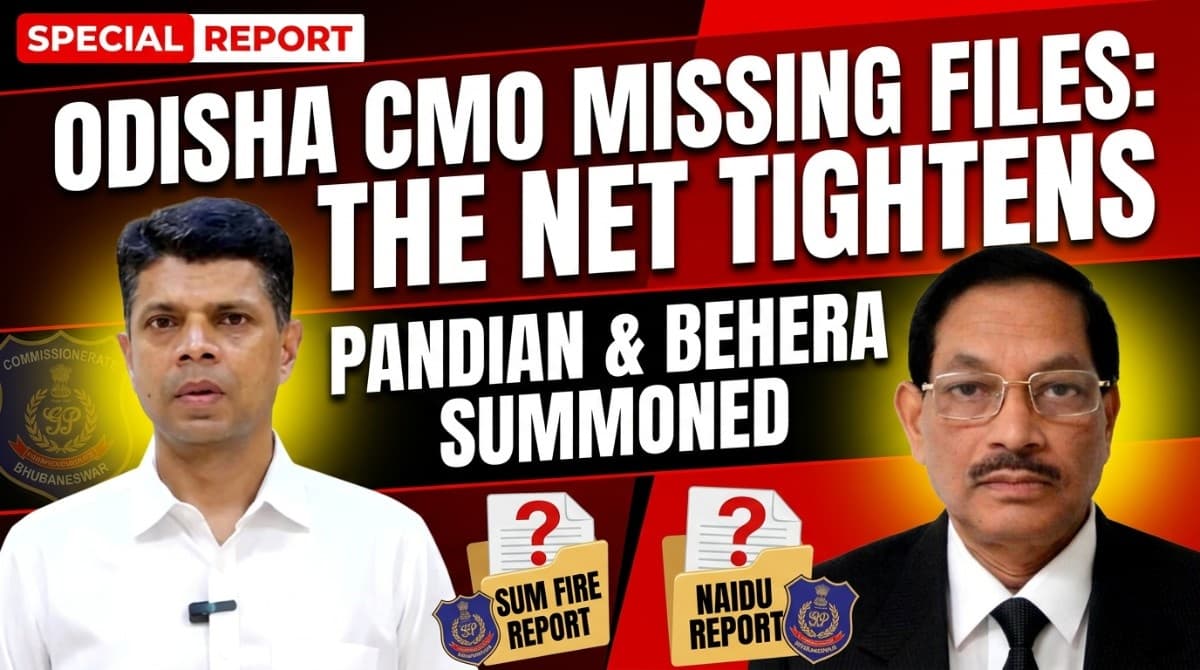
Tuesday's summons to former IAS officer V.K. Pandian was followed within 24 hours by notices to another former top bureaucrat, retired Additional Chief Secretary Upendra Nath Behera, while retired Principal Secretary Rajesh Verma – who skipped his earlier appearance citing illness – was served a fresh notice.
Adding to the momentum, Police Commissioner S. Dev Datta Singh reportedly met the Director General of Police (DGP) on Wednesday before holding a detailed review with the Deputy Commissioner of Police and the Inspector-in-Charge of Capital Police Station, where the FIR has been registered. The sequence suggests the investigation is being monitored at the highest levels of the police hierarchy.

📱 Get Argus News App
✨A Pattern That Indicates Strategy, Not Routine Investigation
The chronology of the police action is perhaps the strongest indicator that investigators are working backwards from evidence instead of relying solely on oral testimonies.
Rather than summoning all former officials simultaneously, the police have adopted a layered approach.
- First, investigators examined digital and procedural aspects of file movement.
- Second, they moved to the person considered the principal administrative gatekeeper to the former Chief Minister.
- Third, they expanded the probe to the senior IAS officers who headed the CMO during different periods when the missing reports entered the office.
Such sequencing enables investigators to compare statements almost immediately, reducing opportunities for witnesses to align their versions.
The re-issuance of notice to Rajesh Verma instead of allowing the investigation to slow down after his non-appearance further underscores that the police are determined to maintain momentum.
Political Will Meets Procedural Precision
Equally significant is the pace at which developments are unfolding.
Within days, the probe has seen:
- Summons issued to successive top bureaucrats.
- Fresh notices replacing missed appearances.
- Senior-level review meetings involving the Police Commissioner, DGP and field investigators.
The developments indicate that the investigation is receiving institutional backing rather than remaining confined to the local police station level.
For investigators, speed also matters because administrative records, digital logs and witness recollections become increasingly difficult to reconstruct over time.
Building an Airtight Case Through Documentary Evidence
The investigation appears to be relying heavily on documentary evidence embedded in the Odisha Secretariat's file movement protocol.
Every permanent government file leaving or entering the CMO is expected to generate multiple documentary footprints.
These include:
- Dispatch Register entries.
- Transit Chalan acknowledgements.
- Receipt ledgers.
- Record Room registers.
- Note-sheet verification.
- Fly-leaf indexing.
- Digital OSWAS workflow entries.
Each stage creates an independent record.
If one link is missing, investigators can identify precisely where the chain broke.
Sources familiar with the administrative procedure indicate that police are attempting to identify not merely who last handled the files, but the exact stage at which the statutory chain of custody failed.
June 4, 2024 Emerging as the Critical Reference Point
Investigators are reportedly treating June 4, 2024 as the central reference date.
On that day, during the government transition overseen by then Chief Secretary Pradeep Kumar Jena, a massive exercise was undertaken to return hundreds of files from the CMO to the Home Department.
According to the procedural trail, every file should have appeared simultaneously in:
- CMO dispatch records,
- Transit acknowledgement documents,
- Home Department receipt ledgers,
- Permanent archive registers, and
- Digital workflow mapping.
If any file disappeared before reaching the transit acknowledgement stage, investigators can substantially narrow down the custody window.
This makes June 4 not merely an administrative exercise but potentially the final legally traceable point before the disappearance.
Why Pandian, Upendra Nath Behera and Rajesh Verma Under Scanner
The officials summoned by police occupied key positions during different phases of the files' lifecycle inside the CMO.
V.K. Pandian
As Private Secretary to the then Chief Minister, Pandian functioned as the principal executive gatekeeper.
Virtually every sensitive file destined for the Chief Minister passed through or under the supervision of his office before final orders.
Investigators are expected to ascertain who exercised final physical custody of the files before they exited – or failed to exit – the CMO.
Upendra Nath Behera
Behera served as Additional Chief Secretary to the Chief Minister during the period when the Justice A.S. Naidu Commission report reached the CMO.
Police are likely examining how the report was received, processed and routed during his tenure.
Rajesh Verma
After succeeding Behera, Rajesh Verma became Principal Secretary to the Chief Minister.
His tenure overlapped with the arrival of the SUM Hospital Fire Inquiry Report.
As Principal Secretary, he headed the statutory administrative processing chain inside the CMO, making his testimony critical in reconstructing file movement.
How the Missing Files Travelled Through the Government System
The investigation revolves around two sensitive reports:
- Justice A.S. Naidu Commission Report.
- SUM Hospital Fire Inquiry Report.
Under the Secretariat Rules of Business, their journey should have followed a fixed administrative route:
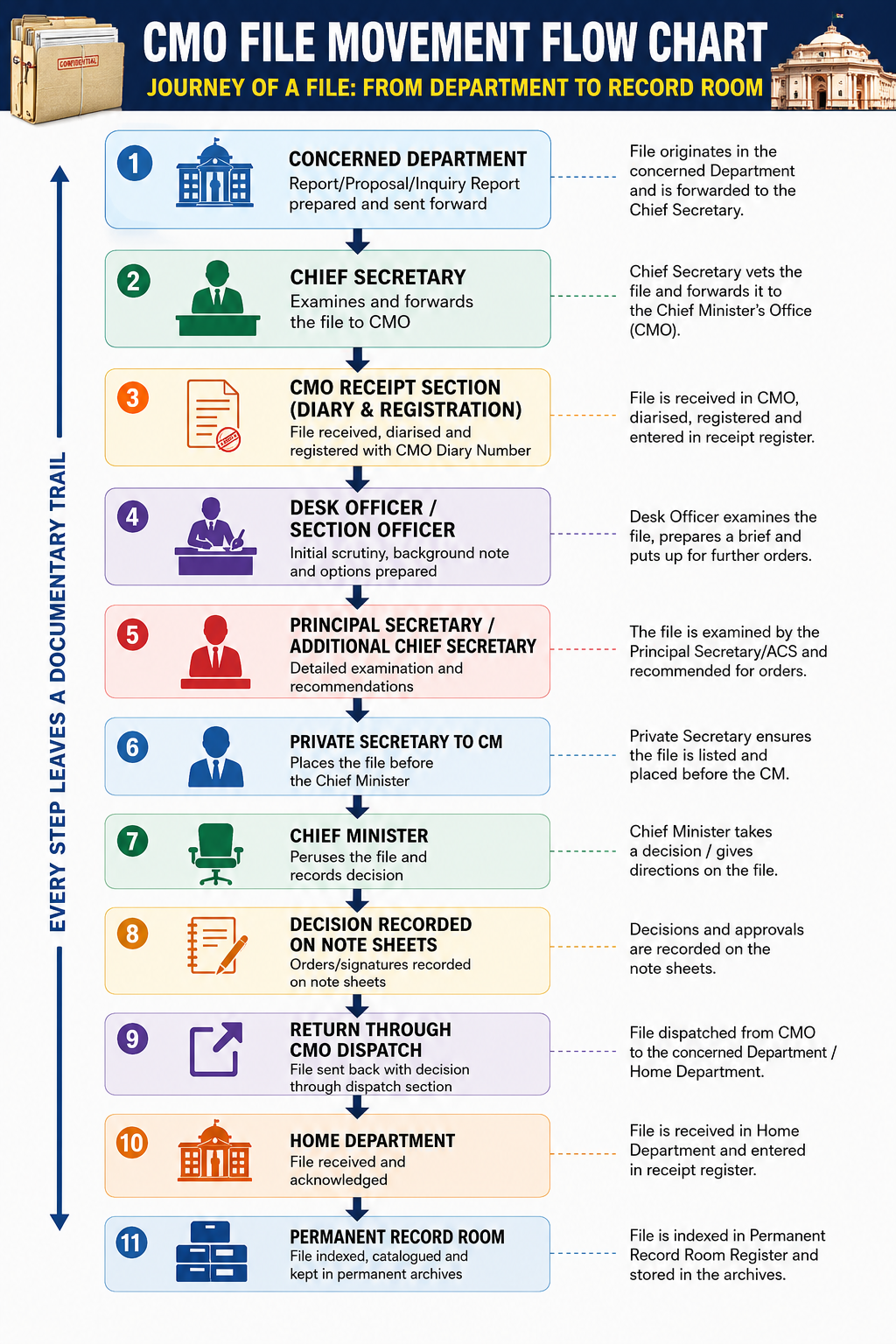
At every stage, statutory registers, diary numbers and digital workflow entries are expected to preserve an audit trail.
The present investigation seeks to identify where this otherwise continuous chain broke down.
Why Even Junior Officials May Become Important Witnesses
The probe is no longer confined to former top bureaucrats.
Investigators are expected to verify records maintained by:
- Diary clerks,
- Receiving officers,
- Desk officers,
- Confidential assistants,
- Officer-on-Special Duty (OSDs),
- Personal Assistants,
- Record room staff.
These officials may not have exercised decision-making authority, but they handled physical movement, registration and dispatch of files.
Their registers and testimonies could independently corroborate – or contradict – the statements of senior officers.
The Core Question Before Investigators
The investigation is no longer centred merely on whether the files are missing.
It is increasingly focused on who had the last legally accountable custody of the Justice Naidu Commission Report and the SUM Hospital Fire Inquiry Report before the June 2024 transition, and whether the statutory chain prescribed under the Odisha Secretariat Rules was broken accidentally, negligently or deliberately.
The succession of summons – from digital administrators to executive gatekeepers and then to the senior IAS officers who successively headed the CMO – suggests the Commissionerate Police are reconstructing the entire chain of custody layer by layer.
If the
documentary trail aligns with witness statements, the investigation could soon
identify not only where the files disappeared but also fix accountability
within the administrative hierarchy that governed the CMO during the previous
regime.
Also Read: CMO Missing Files: Why Odisha Police Want Former CM Naveen Patnaik's Top Aide V.K. Pandian to Arrive With His Phone, Laptop and Cloud Data | Special Report
Related Topics
Explore more stories