



CMO Missing Files: Why Odisha Police Want Former CM Naveen Patnaik's Top Aide V.K. Pandian to Arrive With His Phone, Laptop and Cloud Data | Special Report
Key Points
Bhubaneswar: The latest summons issued to former IAS officer and the then CM Naveen Patnaik’s Private Secy, V.K. Pandian, in the sensational missing Chief Minister's Office (CMO) files case is not merely about securing his appearance before investigators.
The real significance lies in a single clause of the notice directing him to appear with "electronic devices, records or other materials" in his possession or control.
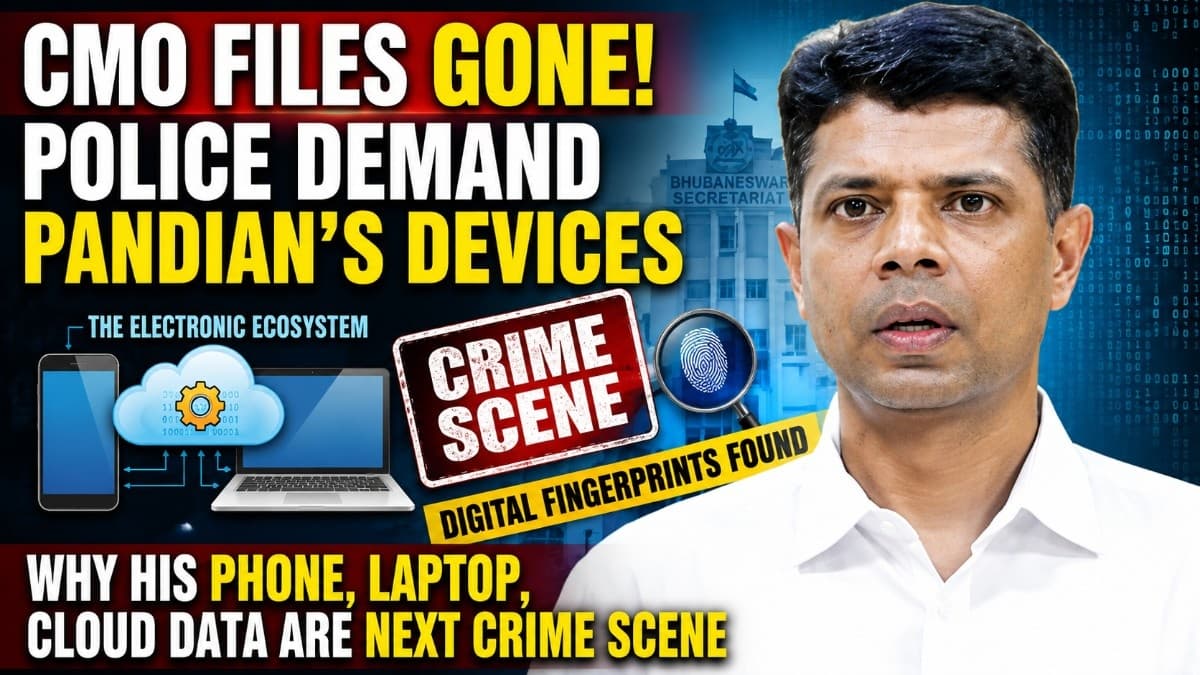
For investigators probing the disappearance of the Naidu Commission report and the SUM Hospital Fire Inquiry report, the electronic ecosystem surrounding the former CMO's most powerful bureaucrat has now become the next crime scene.
The summons marks the investigation's transition from a conventional missing-records probe into what increasingly resembles a white-collar forensic investigation, where digital footprints, metadata, cloud backups and communication trails could prove as important as the missing physical files themselves.

📱 Get Argus News App
✨Investigation Climbs the Administrative Ladder
The sequence adopted by the Capital Police offers perhaps the clearest indication of its strategy.
Investigators first questioned former IT Secretary Manoj Mishra, seeking to understand the government's electronic record-management architecture and the movement of sensitive files through official systems.
The next move was equally revealing. Former Chief Secretary and Principal Secretary to the Chief Minister Rajesh Verma was summoned. His non-appearance, despite the notice, effectively left investigators with little option but to move further up the chain of command.
That chain ends with V.K. Pandian.
For over a decade, Pandian functioned as the administrative nerve centre of Naveen Patnaik's Chief Minister's Office. Virtually every sensitive government file, Cabinet note and judicial commission report passed through the institutional hierarchy over which he exercised operational control.
From the investigators' perspective, the questioning is therefore less about political stature and more about administrative accountability.
If the documentary trail ends inside the CMO, the inquiry must eventually reach the official who supervised its functioning.
Why the Electronic Devices Matter More Than Paper Files
The police are unlikely to believe that Pandian continues to possess original government files after his retirement.
Instead, investigators appear to be pursuing a broader legal concept – whether electronic evidence relating to those files still exists under his possession or control.
That potentially includes personal mobile phones used during his tenure, private laptops, tablets, cloud storage accounts, personal email archives, encrypted external drives, digital diaries and executive calendars maintained outside the government's official servers.
The emphasis is not necessarily on the contents of documents alone.
Modern forensic investigations often rely on metadata – timestamps, communication logs, deleted records, backup histories, login trails and synchronization records – to reconstruct how official decisions moved through an administrative system.
Even where no document survives, the digital trail surrounding it frequently does.
Police Looking Beyond Official Channels
One major focus of investigators is expected to be whether any instructions concerning the missing commission reports were communicated outside official government communication systems.
Sensitive administrative directions are sometimes exchanged through informal messaging platforms rather than official correspondence.
If investigators suspect that movement of the Naidu Commission report or the SUM Hospital Fire report was discussed through private messaging applications, they may seek to examine communication histories, device backups and associated metadata.
Similarly, personal email accounts or private cloud storage could become relevant if scanned summaries, executive notes or unofficial reference copies were preserved outside government infrastructure.
The investigation, therefore, is no longer confined to government record rooms.
It now extends into the digital ecosystem surrounding the individuals who occupied the highest levels of the previous administration.
The Questions Likely Waiting for Pandian
Investigators are expected to adopt a layered approach rather than beginning with accusations.
The first objective would be establishing the standard operating procedure inside the Chief Minister's Office.
How were judicial commission reports received?
Who logged them?
Who maintained custody?
Who could authorise their movement?
Once the procedural framework is established, investigators are likely to reconstruct the chronology surrounding the two missing reports.
When did the files last reach the Chief Minister's Office?
Who handled them?
Were they shifted elsewhere under written orders?
Were any verbal instructions issued?
From there, questioning may move towards access control.
Investigators would seek to identify officials who possessed physical access to record rooms, biometric permissions, cabinet keys and file registers.
Finally comes what investigators consider the forensic phase.
Police are expected to confront available digital evidence with Pandian's explanation.
If file movement registers, communication timelines or electronic logs obtained during previous examinations contradict oral statements, investigators could seek explanations for those discrepancies.
Questions may also explore whether digital copies, scanned versions, executive summaries or electronic backups of the inquiry reports were ever created and, if so, where those records are presently located.
Why Police Asked Him to Bring the Devices
The wording of the summons serves another investigative purpose.
By requiring electronic devices and related materials to be produced, investigators effectively preserve potential evidence before it can be altered, deleted or replaced.
If digital trails recovered from other witnesses indicate communication with Pandian's personal devices or accounts, investigators would already possess independent reference points for verification.
Conversely, a complete denial of possessing any relevant electronic material could become legally significant if contrary forensic evidence later emerges.
For investigators, therefore, the devices are not merely storage instruments.
They are potential repositories of timelines, authentication records, communication histories and access credentials capable of reconstructing the administrative life cycle of the missing reports.
A Probe Entering Its Most Sensitive Phase
The missing-file investigation has steadily evolved over the past several weeks – from locating physical records to identifying institutional responsibility and now to reconstructing digital evidence.
The progression of questioning – from officials handling technical systems to senior bureaucrats and finally to the former administrative head of the Chief Minister's Office – reflects a methodical climb through Odisha's erstwhile power structure rather than an isolated summons.
Whether the exercise ultimately uncovers misplaced records, administrative lapses or evidence of deliberate concealment will depend largely on what the forensic examination of electronic evidence reveals.
Bottom Line
The disappearance of the Naidu Commission and SUM Hospital Fire inquiry reports was initially treated as a missing-file mystery inside the Chief Minister's Office. It has now entered a far more consequential phase.
By directing V.K. Pandian to appear with his personal electronic and digital devices, Odisha Police have signalled that the investigation is no longer searching only for files – it is searching for the digital fingerprints left behind by those who handled them.
The former
CMO's most influential official has now formally entered the investigation, and
with that, the missing-file saga has moved decisively into the realm of
forensic white-collar crime.
Also Read: MissingNaidu Commission, SUM Fire Reports: Police Summon Ex-CMO Principal Secretary,Former IT Secretary as SIT Deepens Probe| Special Report
Related Topics
Explore more stories