



CMO Missing Files: How Crime Branch Now Unravel ‘The Whodunit’ behind Naidu Commission, SUM Fire Reports Deletion from Hard Disk| Exclusive Details Inside
Key Points
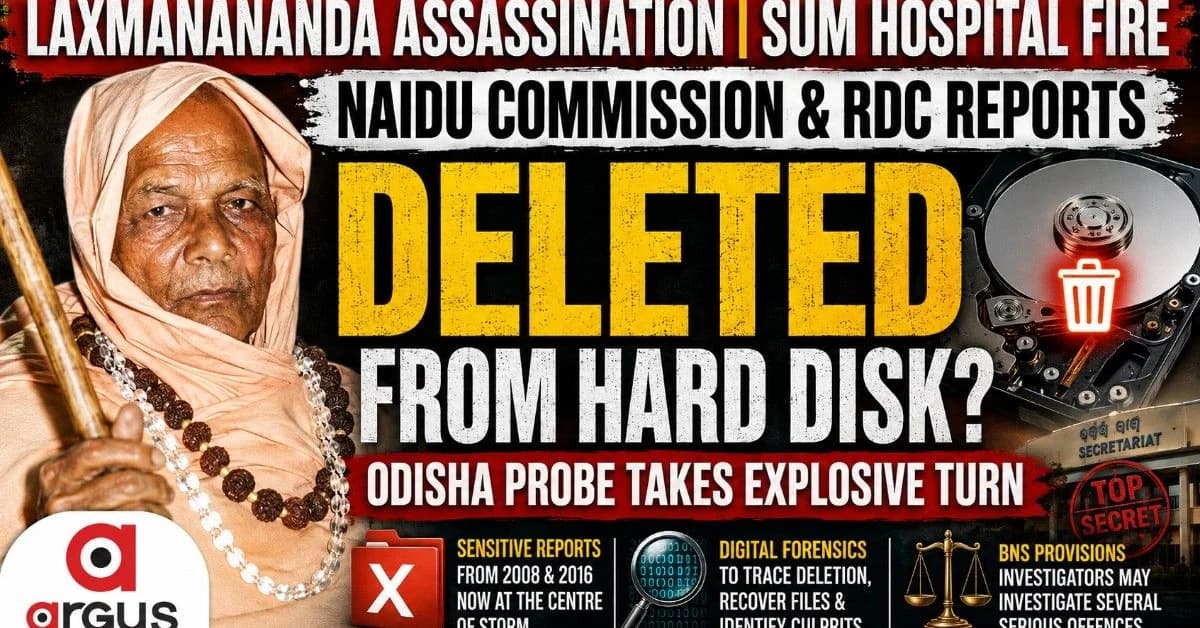
Bhubaneswar: The mystery surrounding the disappearance of the politically sensitive Justice A.S. Naidu Commission report on the assassination of Swami Laxmanananda Saraswati and the Revenue Divisional Commissioner (RDC) inquiry report into the SUM Hospital fire assumed explosive proportions on Monday after Odisha Revenue Minister Suresh Pujari disclosed that the reports were not merely missing but had also been deleted from a computer hard disk.
The revelation shifts the investigation from a case of missing government records to a possible digital evidence destruction probe, potentially opening an entirely new dimension in the Crime Branch investigation.
From Missing Files to Deleted Records
The controversy revolves around two inquiry reports considered among the most sensitive documents handled by the previous government.

📱 Get Argus News App
✨The Justice A.S. Naidu Commission had spent years investigating the 2008 assassination of Swami Laxmanananda Saraswati, an incident that triggered large-scale communal violence in Kandhamal. The second was the RDC inquiry into the 2016 SUM Hospital fire in Bhubaneswar that claimed more than 20 lives.
According to the present government, while routine files were returned from the Chief Minister's Office (CMO) to the Home Department after the June 2024 change in government, these two reports never reached the department.
With the minister now confirming that corresponding digital records were also deleted from a hard disk, investigators are examining is the disappearance deliberate?
How Can Files Be Deleted from a Hard Disk?
Contrary to popular perception, deleting a computer file does not immediately erase its contents. In most computer systems, pressing "Delete" or even "Shift + Delete" merely removes the directory entry or pointer to the file. The actual data generally continues to remain on the storage device until new data overwrites the same sectors.
Forensic experts describe this as "de-referencing" rather than destruction. This is why deleted documents are often recoverable through specialised forensic software unless they have been overwritten multiple times or erased using secure wiping utilities.
Investigators will therefore examine whether these files were simply deleted or subjected to advanced data wiping techniques designed to make recovery significantly harder.
Can the Crime Branch Find When the Files Were Deleted?
The answer is potentially yes.
Modern digital forensic investigation goes far beyond recovering deleted documents. Investigators examine metadata, operating system logs and audit trails that record when files were created, accessed, modified or deleted.
If the computers were running Windows-based systems, forensic experts can analyse file system journals and event logs to reconstruct the timeline of deletion.
Since the Odisha government extensively uses the Odisha State Workflow Automation System (OSWAS) for electronic governance, investigators are also expected to examine server-side audit logs that may record which user account accessed the files, when they were handled and whether they were transferred or deleted.
These digital footprints can help investigators correlate deletion timings with login records, access permissions, CCTV footage and movement of officials inside the Secretariat.
With Deletion Confirmed, Investigation May Shift to Digital Forensics
The minister's confirmation that the files were deleted from a hard disk is likely to alter the direction of the Crime Branch investigation.
Instead of limiting the probe to tracing missing physical files, investigators are now expected to focus equally on digital evidence recovery. Cyber forensic teams may attempt to retrieve deleted documents from storage media while simultaneously analysing metadata, system logs, OSWAS audit trails and administrative access records.
If recovery succeeds, investigators could establish not only the contents of the reports but also reconstruct who last accessed them and the sequence of events leading to their disappearance. If recovery fails, the investigation may increasingly rely on electronic logs, physical movement records, witness statements and circumstantial evidence to establish accountability.
The Whodunit and the Law
The investigation has already reached the highest levels of the previous administration, with notices reportedly issued to senior former officials connected with the Chief Minister's Office and the government's IT infrastructure.
Should investigators gather evidence suggesting deliberate destruction or concealment of official inquiry records, several provisions of the Bharatiya Nyaya Sanhita (BNS) could become relevant, depending on the evidence ultimately collected during the probe.
Among the provisions that investigators may examine are:
|
Alleged offence |
Possible BNS provision* |
Maximum punishment (where applicable) |
|
Destruction or concealment of official documents/electronic records intended as evidence |
BNS provision relating to destruction of documents/electronic records |
Varies according to the offence established |
|
Causing disappearance of evidence |
Relevant BNS provision on disappearance of evidence |
Depends on the underlying offence |
|
Criminal breach of trust by a public servant |
Applicable BNS provision |
Can attract rigorous imprisonment depending on facts proved |
|
Criminal conspiracy |
Relevant conspiracy provision |
Punishment linked to the principal offence |
|
Theft or unlawful removal of official records |
Applicable theft provisions |
As prescribed under BNS |
*The precise sections and charges will ultimately depend on the findings of the Crime Branch investigation and prosecutorial assessment.
Should digital evidence, witness testimony or forensic analysis establish involvement of any individual, investigators could proceed against those found responsible in accordance with the BNS and the Bharatiya Nagarik Suraksha Sanhita (BNSS).
Bottom Line
What began as a mystery over two missing inquiry reports has now evolved into one of Odisha's most politically sensitive digital-forensics investigations.
The government's immediate priority is expected to be recovering the deleted electronic records while simultaneously identifying who had custody of the reports during the transition of power. If the files are restored, the long-standing demand to place the commission findings in the public domain could gain fresh momentum. If they cannot be recovered, the focus may shift entirely to fixing criminal accountability for the disappearance itself.
Either
way, the central questions remain unanswered: Will Odisha ever know what the
Justice A.S. Naidu Commission concluded about the assassination of Swami
Laxmanananda Saraswati? Will the findings of the SUM Hospital fire inquiry
finally become public? Or will the disappearance of the reports become a bigger
story than the reports themselves? The answers now rest with forensic experts,
investigators and, ultimately, the courts.
Also Read: CMO Missing Files: Why Odisha Police Want Former CM Naveen Patnaik's Top Aide V.K. Pandian to Arrive With His Phone, Laptop and Cloud Data | Special Report
Related Topics
Explore more stories