



Amit Shah’s New Tech Armed Commissionerate Police to Bust Banjara Gang, Are Syndicate Days Numbered| Exclusive Analysis
Key Points
Bhubaneswar: Eight arrests in the Capital city in barely a fortnight. Nearly a dozen more gang members rounded up in the last 72 hours in Puri. The Banjara gang appears to be operating at one of its busiest phases in Odisha. Simultaneously, the State Police's counter-offensive has also gathered unprecedented momentum.
The obvious question is: How has this notorious interstate crime syndicate continued to strike at will across different cities despite repeated police action?
Senior police officers believe the answer lies in a policing concept known as "cold trail dynamics."
For years, the hardcore Banjara modules mastered what investigators describe as "phantom footprints" – criminals who leave virtually no digital identity, permanent address or traceable movement.

📱 Get Argus News App
✨Coupled with a classic "hit-and-run" operational model, the syndicate has wreaked havoc not merely in Odisha but across more than half a dozen Indian states.
Unlike conventional organised crime groups, Banjara modules rarely remain in one city long enough to generate actionable intelligence. They arrive by train or long-distance buses, erect temporary settlements on urban fringes, execute a series of thefts over a few days, and disappear before local police can build a criminal profile. Every district police station often investigates the same offenders under different names, allowing the gang to remain invisible across jurisdictions.
The gang's greatest weapon has never been violence – it has been anonymity.
Odisha's Banjara Crime Curve
Although the State Crime Records Bureau does not maintain a separate crime head exclusively for the Banjara gang, police estimates compiled from major operations reveal a steadily expanding footprint after the pandemic.
|
Year |
Estimated Arrests
Trend
2019
12-15
Transit theft modules detected
2020
Below 5
Lockdowns disrupted movement
2021
8-10
Interstate movement resumed
2022
18-22
Organised cells resurfaced
2023
25-30
Larger modules identified
2024
32-35
Festival-focused operations expanded
2025
40+
Multi-city movement intensified
2026*
50+
Highest detection and arrests so far
(*Till July)
Police officers caution that the spike in arrests should not automatically be interpreted as an explosion in crime. Rather, it reflects improved detection of offenders who previously escaped identification under multiple aliases.
Why Arrests Are Suddenly Rising
The recent operations in Bhubaneswar and Puri indicate that Odisha Police has begun systematically dismantling the gang's traditional operating model.
The all-women eight-member module arrested at CRP Square allegedly targeted passengers boarding city buses and crowded commercial zones. Around the same period, Puri Police rounded up another large interstate theft module operating amid Rath Yatra crowds.
What distinguishes these arrests from previous years is that police are increasingly intercepting the gangs before they vanish into another district.
Investigators say the syndicates largely rely on women, minors and elderly members to avoid suspicion. Their operations typically involve multiple coordinated roles – one creating distraction, another lifting valuables, a third immediately transferring the stolen property to another member who melts into the crowd.
The gang also studies crowd behaviour instead of merely exploiting it.
Bus terminals, railway stations, religious congregations, melas, markets and festival processions become carefully selected hunting grounds.
Are Their Days Numbered? Amit Shah's Technology Changes the Game
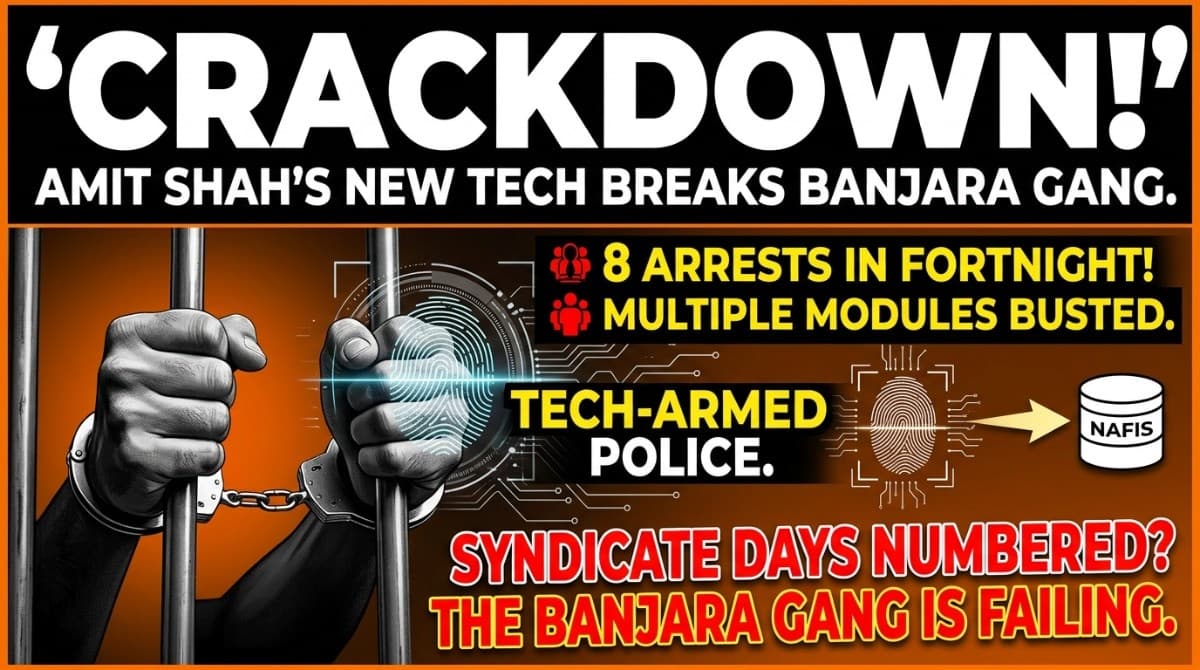
Senior police officials say the biggest disruption to the Banjara network has come not from conventional policing but from technology-driven identification systems introduced by the Ministry of Home Affairs.
The rollout of the National Automated Fingerprint Identification System (NAFIS) in 2022, followed by portable biometric fingerprint scanners and more recently mobile real-time biometric applications, has fundamentally altered how transient interstate criminals are tracked.
Until recently, arrested gang members frequently escaped the legal system by providing fake identities and false addresses. Once granted bail, they shifted to another state under a different name, effectively breaking the investigative chain.
That advantage is steadily disappearing.
Odisha Police has rapidly implemented handheld biometric verification during fringe settlement verification, highway checking, bus terminal surveillance and festival policing. Officers can now capture fingerprints on the spot and compare them against the national database within seconds.
The strategy directly targets what police describe as the gang's "phantom footprint" – its ability to remain digitally invisible.
Once a fingerprint matches a previous arrest anywhere in the country, investigators immediately establish criminal history, making repeat offenders easier to prosecute while substantially reducing opportunities for identity manipulation and bail abuse.
Police sources say this transition marks a shift from reactive policing to preventive policing.
Instead of investigating theft after valuables disappear, officers increasingly identify habitual offenders before they strike.
A Crime Syndicate With a National Footprint
The Banjara network is neither confined to Odisha nor controlled by a single kingpin.
Police investigations across several states indicate the syndicate functions as loosely connected family-based modules that migrate continuously between states.
Their operational footprint stretches across Odisha, West Bengal, Bihar, Jharkhand, Uttar Pradesh, Maharashtra, Rajasthan, Madhya Pradesh and the Delhi-NCR region.
However, their crime pattern varies by geography.
In Odisha, the gang primarily targets crowded buses, railway stations, Rath Yatra pilgrims, Khandagiri Mela visitors and urban commercial centres through pickpocketing, mobile theft and gold chain lifting.
However, a recent trend Odisha recorded has been the involvement of Banjara gang in dacoity. Only in January this year, the Dhenkanal Police had busted a Banjara dacoity gang belonging to Bihar.
In Uttar Pradesh, investigators have also linked some modules to more aggressive nighttime burglaries and dacoities.
Delhi Police has frequently intercepted interstate modules carrying illegal weapons while monitoring border transit routes.
Rajasthan and Madhya Pradesh often function as temporary shelter zones where stolen valuables are allegedly disposed of before the next interstate movement.
Their mobility remains their greatest strength.
Unlike organised mafias with identifiable headquarters, the Banjara syndicate operates through decentralised family cells. Eliminating one module rarely dismantles the wider network.
The Bottom Line
Odisha's latest crackdown suggests the balance is finally beginning to shift.
Technology has started closing the identity gap that allowed interstate criminals to repeatedly evade law enforcement.
Yet experts believe Odisha alone cannot permanently neutralise the syndicate.
Given the gang's seamless movement across railway corridors and highways connecting Odisha, West Bengal, Jharkhand and Bihar, policing must evolve beyond state boundaries.
The template already exists.
The multi-state coordinated operations conducted jointly by Delhi, Uttar Pradesh, Haryana and neighbouring police forces demonstrated how synchronised intelligence sharing, biometric verification and simultaneous raids can severely disrupt mobile criminal Banjara networks early this year.
For eastern India, a similar coordinated operation involving Odisha, West Bengal, Jharkhand and Bihar – backed by nationwide biometric identification systems introduced under the Union Home Ministry – could prove decisive.
Because as investigators increasingly agree, the Banjara gang's greatest weapon was never sophisticated crime.
It was simply remaining invisible.
With that
invisibility now steadily eroding, Odisha Police believe the syndicate's long
run may finally be entering its last chapter.
Also Read: No Thermal Drones? No Problem: How Bhubaneswar Cops Used Desi Ingenuity to Save Stranded Woman in Ratanpur Reserve Forest| Special Report
Related Topics
Explore more stories