



Special Report| What Odisha Gains from INDIA CHEM 2026 Mumbai Mega Meet: the Shift and SWOT Tell A Tale
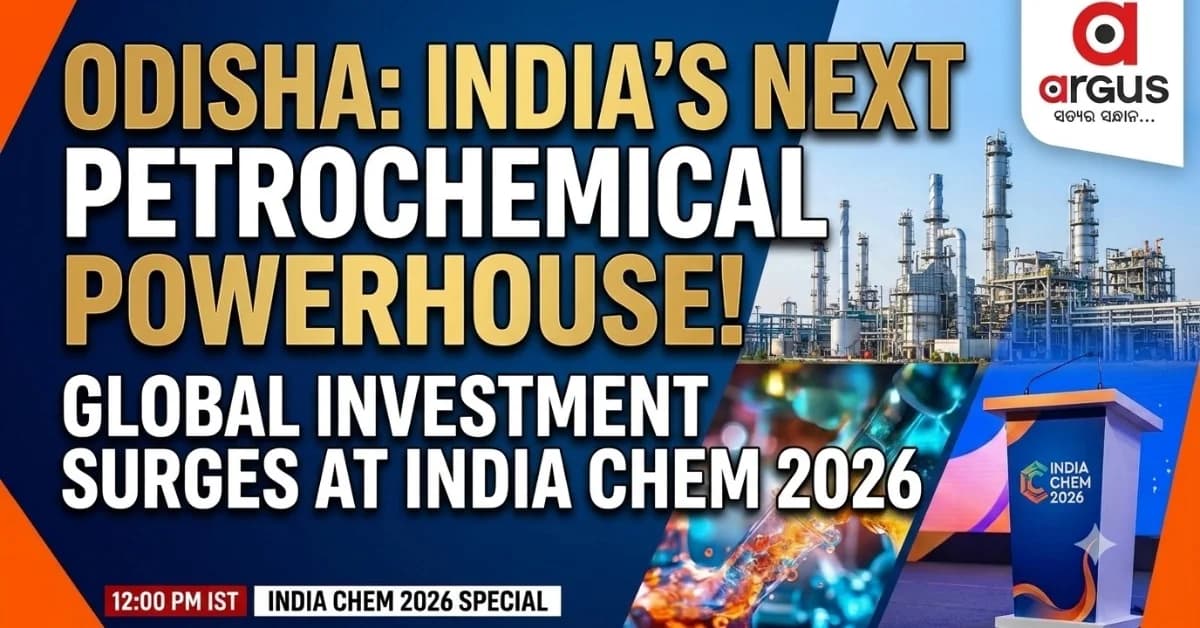
Key Points
The state unveiled a massive ₹1.93 lakh crore investment pipeline, with over ₹60,825 crore already in active implementation.
Odisha is strategically pivoting from a raw mineral supplier to an advanced coastal petrochemical and coal-gasification export hub.
Bhubaneswar: Union Minister for Chemicals and Fertilizers and Health and Family Welfare, J.P. Nadda’s inaugural address at the 14th edition of India Chem 2026 in Mumbai dropped a clear hint on why Odisha is occupying the high table at the NESCO Exhibition Centre in Mumbai.
Nadda said, “Connectivity to ports, railways, airports and roads, along with integrated value chains, are the key considerations for developing globally competitive chemical manufacturing hubs under BHAVYA Rasayan Scheme of Modi govt.”
The statement immediately lifts the veil on why the resource-rich eastern state was chosen to co-chair this mega chemicals conclave, perfectly aligning its port-led infrastructure with India's macro industrial vision.
By co-chairing the Global CEOs Forum at INDIA CHEM 2026 alongside Union Minister J.P. Nadda, Odisha’s Chief Minister, Mohan Majhi, initiated a high-stakes foray into India’s commercial capital.

📱 Get Argus News App
✨This move was not just another routine investment outreach; it was a calculated geopolitical statement designed to transform Odisha from a mineral supplier into a sophisticated, high-margin national chemical and petrochemical powerhouse.
What Odisha’s Foray Tries to Deliver
Chief Minister Mohan Majhi’s aggressive presence in Mumbai signals a fundamental transition in how Odisha intends to create wealth, secure technology, and generate employment.
Phase 1: Traditional Economy
· Process: Extractive Mining
· Output: Low-Margin Primary Metals
The Shift: Upgrading from raw material extraction to high-value processing.
Phase 2: Chemical-Driven Future
· Process: Feedstock Cracking
· Output: High-Value Downstream Polymers
Historically, the core limitation of Odisha's vast mineral wealth was its placement at the lowest rung of the value-addition chain. By pivoting the state policy toward chemicals and petrochemicals, Odisha’s foray injects a massive structural shift:
· Escaping the Commodity Trap: Primary metals face extreme global pricing volatility. Conversely, specialty chemicals, polymers, and performance plastics yield steady, high-margin domestic returns.
· The Downstream Jobs Multiplier: While a mega steel plant is capital-intensive and limited in immediate factory-floor labor diversity, downstream chemical processing hubs – such as plastic parks, technical textile units, and consumer packaging plants – generate massive, multi-tiered employment pipelines.
· The Structural Evolution: Majhi's strategy directly shifts the state's economic identity from a smoky, primary metal-smelting landscape to an advanced, clean-tech, polymer-synthesizing economic powerhouse.
What Odisha Delivered at the Mega Meet
Odisha did not land in Mumbai with vague promises; it presented a highly technical, infrastructure-backed layout designed to intercept global supply chains. Led by Chief Minister Majhi and Additional Chief Secretary (Industries) Hemant Sharma, the high-level delegation deployed a highly focused three-pronged marketing push:
The Coastal and Inland Corridors
The delegation mapped out an unbroken investment arc stretching from the deep-water ports of Paradip, Gopalpur, and Dhamra on the coast to the inland energetic basins of Talcher and Lakhanpur. This network guarantees a continuous loop of incoming global maritime feedstocks linked smoothly with internal domestic supply corridors.
Pioneering Coal Gasification
In a standout technical presentation, Odisha positioned itself as India’s absolute leader in coal gasification technology. By highlighting the landmark Lakhanpur project, the state showed global CEOs how it can convert vast local coal reserves into syngas, alternative fertilizers, and chemical intermediates – offering an independent, domestic safeguard against volatile imported crude oil.
A Unifying Industrial Ecosystem
Odisha officially detailed its plan to build a dedicated, large-scale Chemical Industrial Park. The facility offers plug-and-play manufacturing plots seamlessly integrated with local academic anchors like the Institute of Chemical Technology (ICT-IOCB) and CIPET, promising investors a steady pipeline of highly trained chemical engineering talent.
Impact Assessment: Will the Message of Foray Drive Home?
For years, corporate India viewed the West Coast – specifically Gujarat and Maharashtra – as the default home for heavy chemical processing. Will Odisha's fresh pitch successfully alter that deeply ingrained corporate bias?
Yes, the message is highly likely to drive home, supported by hard, verifiable fiscal traction rather than mere promotional literature:
1. The Scale of Capital Traction: Odisha didn't pitch as a newcomer; it presented an established track record of 56 chemical and petrochemical companies that have already proposed a massive ₹1.93 lakh crore ($23+ Billion) in investments over the past 24 months.
2. High Conversion Rate: Crucially, over ₹60,825 crore of those projects have already transitioned from blueprints to active implementation. This high grounding rate proves to watching global CEOs that Odisha’s single-window clearance mechanism functions efficiently.
3. Strategic Port Proximity: During the intense, face-to-face one-on-one sessions with more than 20 major multinational chemical boards, Odisha successfully proved its primary competitive advantage: its eastern maritime location. For enterprises looking to target expanding consumer markets in ASEAN, Bangladesh, and East Asia, setting up manufacturing at Paradip or Gopalpur cuts shipping timelines significantly compared to navigating out of west-coast ports.
National Reality Check: Multi-State SWOT & Scale Comparison
To gauge exactly where Odisha stands on the competitive national landscape, we must contrast its infrastructure, natural assets, and market constraints against the reigning giants of India's chemical ecosystem.
The National Chemical Scale Index
· Gujarat: ~₹4.50 Lakh Crore ($54 Billion). The undisputed king, commanding over 60% of India's total petrochemical capacity through the dominant Dahej PCPIR.
· Maharashtra: ~₹2.20 Lakh Crore ($26 Billion). The traditional pioneer, leveraging massive legacy clusters, deep financial integration via Mumbai, and an established workforce.
· Tamil Nadu: ~₹95,000 Crore ($11.4 Billion). A diversified powerhouse, integrating advanced polymer engineering tightly with its automotive and textile hubs.
· Andhra Pradeh: ~₹80,000 Crore ($9.6 Billion). A rising eastern challenger, holding an expansive coastline and an established pharmaceutical API manufacturing base.
· Odisha (Emerging Scale): ~₹65,000 Crore ($7.8 Billion) current active base, backed by a massive ₹1.93 Lakh Crore pipeline under active rollout.
· Madhya Pradesh: ~₹45,000 Crore ($5.4 Billion). A fast-growing internal landmass focused entirely on domestic consumer agro-chemicals and pharmaceutical formulation.
[National Chemical Output Scale Comparison]
Gujarat ████████ ₹4.50L Cr
Maharashtra █████ ₹2.20L Cr
Tamil Nadu ██ ₹95K Cr
Andhra P. ██ ₹80K Cr
Odisha * █ ₹65K Cr
Madhya P. █ ₹45K Cr
-* Plus ₹1.93L Cr Active Pipeline
Comparative SWOT INDEX
Odisha
- Strengths: Unlimited land banks, deep-water ports, ₹61k Cr IOCL Cracker anchor, cheap power.
- Weaknesses: Downstream cluster ecosystem still scaling out.
- Opportunities: Prime export terminal for Green Ammonia, Hydrogen, and Coal Gasification.
- Threats: High frequency of coastal cyclones along the Bay of Bengal.
Maharashtra
- Strengths: Direct financial market access, 300k+ skilled workers, mature R&D labs.
- Weaknesses: High real estate costs, heavy urban congestion in legacy pockets.
- Opportunities: Transitioning to high-margin specialty bio-chemicals & electronics chemistry.
- Threats: Regulatory delays in fresh land allocation compared to faster state bodies.
Gujarat
- Strengths: Market dominance (Dahej PCPIR), mature vendor chains, top ease-of-business rating.
- Weaknesses: Severe saturation in key corridors, high baseline water/power costs.
- Opportunities: Building the world's largest integrated green-hydrogen chemical arrays.
- Threats: Localized environmental bottlenecks and strict emissions limits in saturated areas.
Tamil Nadu
- Strengths: 3 major functional ports, huge local demand from automotive & textile hubs.
- Weaknesses: Complete dependence on imported raw hydrocarbon feedstocks.
- Opportunities: Scaling advanced engineering polymers & smart coatings for electronics.
- Threats: Looming industrial water scarcity during dry summer seasons.
Andhra Pradesh
- Strengths: Vizag-Kakinada PCPIR, expansive coastline, robust bulk drug cluster.
- Weaknesses: Delays in realizing planned petrochemical cracker infrastructure.
- Opportunities: Capturing global pharma ingredient (API) supply lines shifting from China.
- Threats: Direct competition with aggressive, incentive-rich neighbors (e.g., Odisha).
Odisha vs. Madhya Pradesh
While the comparison with coastal leaders rests on maritime trade, comparing Odisha with Madhya Pradesh showcases a fascinating strategic contrast between two of India's fastest-growing resource states: Strategic Competitor Layout (Mobile View)
Core Strategic Focus: Balancing coastal export logistics with inland geographic distribution.
1. Odisha (Coastal Export Hub)
· Access Type: Global Maritime Shipping Gateway via deep-water ports (Paradip).
· Industrial Base: Massive crude feedstock refineries.
· Core Focus: Bulk polymer production and global export.
2. Madhya Pradesh (Inland Logistics Hub)
· Access Type: Central geographic heartland hub (Landlocked / Zero Maritime Access).
· Industrial Base: Secondary downstream refineries (e.g., Bina).
· Core Focus: Domestic agrochemicals and pharmaceuticals.
Logistical Orientations: Odisha is fundamentally structured for maritime export and heavy primary cracking. It leverages deep-water berths to bring in massive supertankers, process the crude, and ship downstream chemicals globally. Madhya Pradesh, being completely landlocked, focuses entirely on internal domestic supply chains, utilizing its central location to distribute chemicals overland across India's vast interior.
· Feedstock Frameworks: Odisha relies on massive primary refinery hubs, anchored by IOCL’s flagship facility in Paradip. Madhya Pradesh derives its chemical strength from internal secondary processing units, showcased by BPCK’s Rs 49000 cr expansion of the Bina Refinery to fuel regional agro-chemical, fertilizer, and domestic pharmaceutical manufacturing.
· Target Markets: Odisha is built to service global markets (ASEAN, East Asia) and India’s coastal economic zones. Madhya Pradesh positions itself as the optimal manufacturing center for domestic-facing industries seeking central distribution networks shielded from maritime vulnerabilities.
The Bottom Line: What Odisha Achieved in Mumbai
Chief Minister Mohan Majhi’s intensive two-day itinerary at India Chem 2026 seems to have delivered concrete strategic advantages for Odisha:
· Breaking the West Coast Monopoly: By co-chairing the platform in Mumbai, Odisha successfully positioned its Eastern Coastline as an equally viable, highly lucrative industrial alternative to the saturated Western corridor.
· Securing the Downstream Pipeline: The delegation moved Odisha up the economic value chain, advancing concrete discussions with over 20 major industry captains to bring downstream plastic, packaging, and performance chemical units into the state’s upcoming specialized parks.
· Enforcing the National Narrative: Odisha firmly anchored its state industrial layout into India's macro $1 trillion national chemical goal.
Through this high-impact
outing, Odisha demonstrated that it is no longer content simply supplying raw
materials to fuel other states' factories.
Also Read: Special Report| Kalinganagar Blitz: How CM’s ₹39,383-Cr Bonanza Pushes Jajpur to Odisha’s Industrial High Table
Related Topics
Explore more stories