



Special Report| Kalinganagar Blitz: How CM’s ₹39,383-Cr Bonanza Pushes Jajpur to Odisha’s Industrial High Table
Key Points
Historic Investment Drive: CM Mohan Charan Majhi inaugurates and performs Bhoomi Pujan for 46 mega & medium industrial projects worth ₹39,383 crore, creating over 42,000 direct jobs.
Jajpur’s Metamorphosis: The district transitions from a raw mining hub (Sukinda/Daitari) into a high-value downstream stainless steel capital with advanced automated infrastructure.
Fueling the $500B Goal: Positioned at Odisha’s industrial "High Table" alongside Khordha and Jharsuguda, Jajpur becomes a major engine for the state’s 10-year macroeconomic strategy.
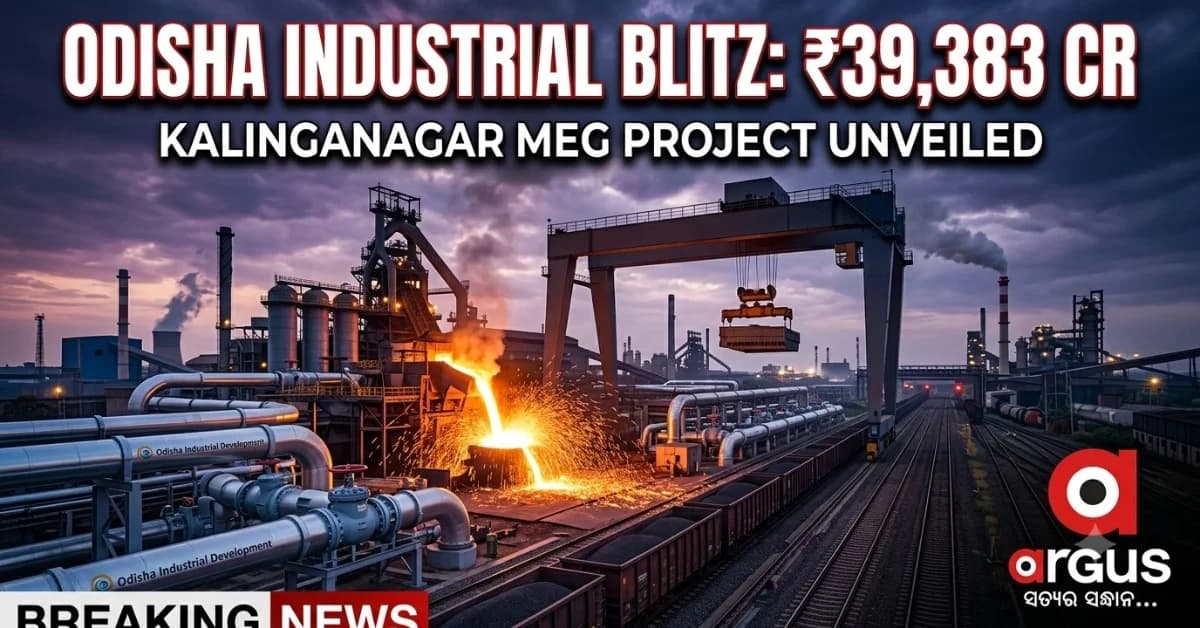
Bhubaneswar: Odisha’s industrial landscape underwent a historic tectonic shift on 14 October 2026, as Chief Minister Mohan Charan Majhi launched a massive infrastructure blitz from the heart of the state’s metal capital.
Performing the Bhoomi Pujan (groundbreaking) and inaugurating 46 medium and mega industrial projects, the Chief Minister set in motion a concentrated investment of Rs39,383 crore spanning 14 districts and carrying a direct employment footprint of 42,512 jobs.
While the policy directives dictate an equitable distribution of capital across Odisha’s geography, the choice of venue was intensely symbolic. By centering this "foundation-laying spree" in Jajpur’s Kalinganagar, the state government effectively certified the district’s graduation into the highest tier of economic governance.
This is the news-driven narrative of a district breaking free from its old image as a raw mineral pit to secure its place at the "High Table" of Odisha's premier industrial economies.

📱 Get Argus News App
✨The Metamorphosis — Jajpur Before and After
To understand the scale of what took shape at Kalinganagar, one must look at the district through a chronological lens. For decades, Jajpur operated within a classic, resource-cursed economic model. It possessed immense wealth hidden beneath the earth but lacked the manufacturing capability to convert that wealth into localized prosperity.
The Old Blueprint: Raw Mining and Out-Migration
Historically, Jajpur’s economic identity was defined by the heavy-dust extraction zones of Sukinda and Daitari. The district was viewed primarily as an upstream supply house. It possessed world-class deposits of chromite and iron ore, but its primary function was extractive. Heavy trucks moved thousands of tonnes of raw, unrefined material out of the district – either straight to ports like Paradip for raw export or to smelting hubs outside its borders.
This structure created a highly volatile local economy. The workforce was sharply split between subsistence paddy farming and precarious, manual mining labor. Because there were few advanced manufacturing setups or white-collar technical ecosystems, the district suffered from chronic youth brain drain. Generations of educated or able local workers migrated to neighboring states like Gujarat, Maharashtra, or Karnataka to find sustainable livelihood opportunities.
Stage | Old Extractive Pipeline | New Integrated Ecosystem
Stage 1,Sukinda/Daitari Mines(High Volatility)|Automated Slurry Lines(Low-Carbon Input)
Stage 2,Raw Ore Export(Truck Logistics)|Downstream Plants(Finished Steel)
Stage 3,Out-of-State Value(Youth Out-Migration)|Local Wealth & Jobs(Retained Talent)
The New Blueprint: Highly Engineered Value Addition
The projects launched by Chief Minister Majhi fundamentally alter this landscape. Jajpur has transitioned into a highly integrated downstream manufacturing capital. Instead of exporting crude iron ore, the region is now capturing the entire value chain within its borders.
The immediate catalyst comes via mega-expansions from heavyweights like Jindal Stainless Limited (JSL) Group, which saw the inauguration of advanced carbon steel and stainless steel projects, and Tata Steel, which introduced a sophisticated network of downstream facilities, grinding units, and filtration systems.
Crucially, the logistical architecture has shifted from carbon-heavy road transport to high-efficiency, automated slurry pipelines. This structural integration alters the region's operational profile: raw inputs now flow smoothly through closed pipelines directly into refining factories. This reduces transport overheads, cuts down local air pollution, and creates a dense manufacturing environment that absorbs secondary engineering, chemical, and industrial gas facilities.
The Analytical Leap — Joining the High Table
Jajpur’s modern acceleration does not simply represent local growth; it redraws the macroeconomic hierarchy of Odisha. For years, the state's economic map was governed by an elite group of districts, each dominating a specific sector. Jajpur's rapid expansion means it now matches the specific structural strengths of each tier-1 hub.
THE HIGH TABLE OF ODISHA INDUSTRY
[KHORDHA] [JHARSUGUDA]
Knowledge & IT Capital Aluminium & Power Giant
(Services) (Smelting)
\ /
\ /
\___ [THE INDUSTRIAL HIGH TABLE] ___/
/ \
/ \
/ \
[JAGATSINGHPUR] [JAJPUR]
Port & Petrochemical Hub The Premium Value-Add
(Paradip Port) Stainless Steel Capital
1. Counterbalancing Khordha’s White-Collar Hegemony
Khordha, anchored by the capital city of Bhubaneswar, has long been the undisputed driver of Odisha’s service sector, IT infrastructure, and startup ecosystems. It attracts white-collar professionals and commands the state's knowledge economy.
Jajpur now stands as the heavy-industry counterpart to Khordha. While Khordha manages the digital and service-oriented capital, Jajpur provides the physical, high-scale asset base that forms the backbone of the state's Gross State Value Added (GSVA). It is transforming from a gritty industrial town into an organized, tech-driven industrial cluster complete with modern townships and technical skill centers.
2. Matching Jharsuguda’s Metal Scale
In western Odisha, Jharsuguda earned its place at the top table as India's "Aluminium Hub," drawing immense capital via integrated power plants and metal smelting blocks.
Jajpur matches this metal density but holds an advantage by cornering the premium stainless steel and specialized alloy markets. Rather than focusing solely on basic smelting, Jajpur's industrial base is designed to supply highly specialized, high-margin materials directly to global automotive, defense, and infrastructure supply chains.
3. Serving as the Engine for Jagatsinghpur’s Maritime Gateway
Jagatsinghpur, driven by the economic powerhouse of Paradip Port, functions as Odisha's primary gateway for international trade, oil refining, and petrochemicals.
With this latest wave of project groundings, Jajpur cements its role as the critical manufacturing interior that feeds this maritime gateway. Connected by expanding rail and highway freight corridors, Jajpur transforms raw inputs brought through the coast into finished cargo, creating a powerful economic corridor across coastal and central Odisha.
4. Moving Beyond Angul’s Volatility
While Angul and Dhenkanal are crucial to the state's economy due to their massive coal mining operations and thermal power grids, they remain highly vulnerable to global commodity price swings.
By focusing on downstream manufacturing rather than just extraction, Jajpur insulates itself from these market shocks. It takes the basic metals and shapes them into consumer-ready products, ensuring more stable revenue streams and higher economic resilience.
Policy, Governance, and the Road Ahead
The scale of this industrial push carries clear political and administrative significance. During his address at Kalinganagar, Chief Minister Majhi explicitly positioned these groundings as a departure from past administrative approaches.
"Before our government came to power, industrial investment was merely a slogan and a medium for publicity," Majhi noted. "However, we have translated every Memorandum of Understanding (MoU) into reality," he added.
The 500-Billion-Dollar Vision
This aggressive rollout is tied directly to a larger macroeconomic target: building a "Samriddha Odisha" (Prosperous Odisha) capable of expanding the state's economy to USD 500 billion within the next ten years. With Odisha currently ranking second in the country for capital investment attraction according to NITI Aayog's index, Jajpur is positioned as a primary site for capital absorption.
To support this influx of capital, the state’s Single Window System has been streamlined to accelerate approvals across the project lifecycle – from initial proposal to factory construction. To date, this system has cleared 560 industrial proposals representing over Rs12.07 lakh crore in potential investment.
Odisha's Macro Pathway at a Glance
* Current GSDP Status: ~7.9% Real Growth (Strong Growth Base)
* Single-Window Approved Proposals: ₹12.07 Lakh Cr
* Total Project Groundings to Date: Over ₹3.50 Lakh Cr
* Target Goal: USD 500 Billion Economy (Within 10 Years)
Balancing Automation with Inclusive Livelihoods
As Jajpur enters this high-tech industrial tier, it faces a complex balancing act: navigating advanced industrial automation while generating widespread, inclusive local employment. Modern downstream steel plants rely heavily on automated systems, which can limit the demand for manual labor.
To address this challenge, the state's strategy focuses on two key initiatives:
1. Targeted Skill Alignment: The government is utilizing the World Skill Center network to train local youth in advanced technical fields such as robotics, industrial automation, and renewable energy systems. This helps transition the local workforce from manual labor to skilled technical roles.
2. Diversifying into Labor-Intensive Sectors: To ensure broader employment access, particularly for women, the state is expanding into high-employment sectors like textiles, apparel, and food processing.
The Verdict
The massive investment rollout
at Kalinganagar marks a turning point for Jajpur. The district has evolved from
a traditional mining outpost into a sophisticated, multi-sector
manufacturing hub. By building a diverse industrial base that retains local
talent and drives high-value manufacturing, Jajpur has firmly established
itself at the center of Odisha's economic future.
Also Read: Astaranga Phase 2: Odisha Cabinet Greenlights Major Blue Economy Push
Related Topics
Explore more stories