



Special Report| How Odisha Plans to Tackle a 200-Million-Tonne Industrial Waste Challenge by 2036
Key Points
Massive Industrial Surge: Odisha is projected to generate up to 200 million metric tonnes of solid waste and 1,600 MLD of effluents by 2036.
Tech-Driven Enforcement: The OSPCB is ramping up real-time OCEMS effluent tracking and geofenced transport logistics to eliminate illegal dumping.
Circular Economy Mandates: 100% of generated fly ash and metallurgical slag will be channeled into road construction, infrastructure, and blended cement.
Bhubaneswar: In a definitive push to balance aggressive Industrial drive with uncompromising ecological stewardship, Odisha Chief Secretary and Odisha State Pollution Control Board (OSPCB) Chairperson Anu Garg convened a high-level operational review at the board’s headquarters.
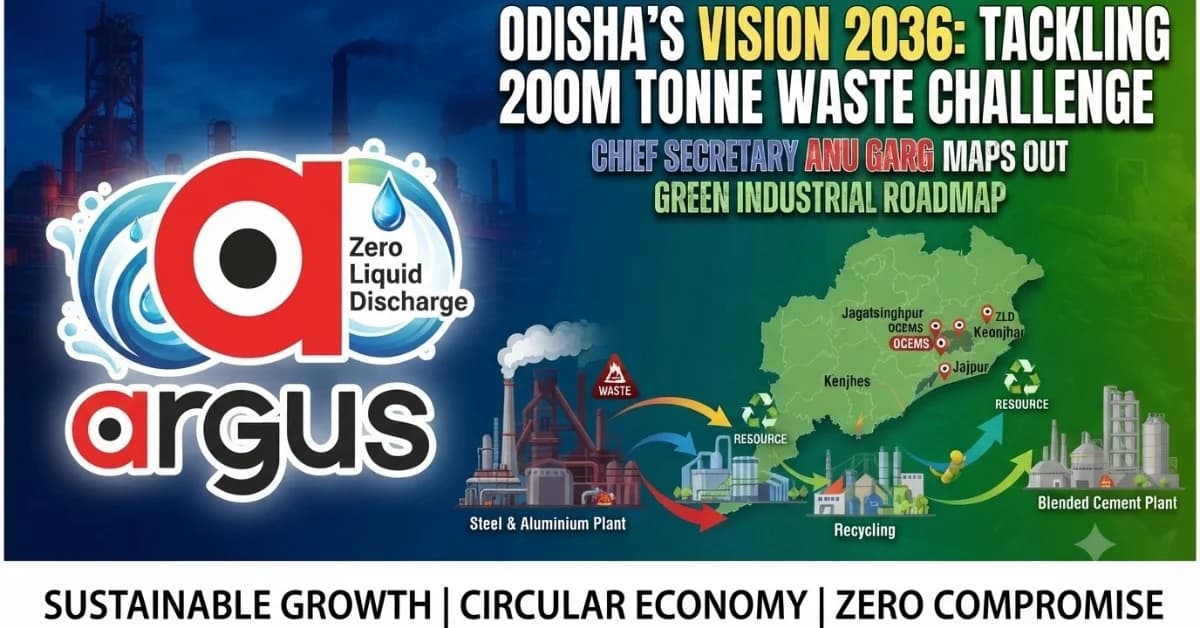
Staring down a projected surge to 200 million metric tonnes (MT) of industrial solid waste and 1,600 MLD (Million Litres per Day) of effluents by 2036, the state government has laid out a stringent, tech-driven regulatory roadmap. The framework is designed to transform environmental liabilities into economic assets, scaling up the state’s circular economy under the Samruddha Odisha Vision 2036.
The Scale of the Challenge: Current Load vs. Expansion Burden
Odisha is in the midst of an unprecedented industrial expansion phase, anchored by massive capital investments in steel, aluminium, power, mining, and specialized chemical sectors. Companies like Vedanta –fuelled by a Rs1.28 lakh crore expansion into a 3 MTPA aluminium smelter and a 4,900 MW captive power plant – alongside steel capacity scaling toward a 130 MTPA target by 2030, are radically reshaping the state's footprint.
Industrial Solid Waste: Current state-wide generation stands at roughly 100 million MT annually (predominantly fly ash, slag, and gypsum). Driven by mega-expansions from players like JSW in Keonjhar and existing utility footprints, this volume is projected to nearly double to 180–200 million MT annually by 2030–2036.

📱 Get Argus News App
✨
Industrial Effluents: Current manufacturing clusters generate 800 to 1,000 MLD of wastewater. With mega footprints like SRF Ltd’s Rs10,000 crore specialty chemical plant in Ganjam and new steel complexes in Jagatsinghpur and Jajpur coming online, effluent loads will scale to 1,600 MLD, placing severe strain on local water basins.
Hazardous & Special Wastes: Accompanied by national electronic waste surges (up 83% over eight years to 1.42 million MT) and incoming high-tech display fabs, electronics manufacturing clusters, and EV/battery storage value chains in Khordha and Ganjam, special waste streams are projected to hit 2.5 to 3 million MT annually.
The Four Strategic Pillars of the OSPCB Roadmap
To ensure that industrialization does not compromise regional ecological integrity, Chief Secretary Anu Garg outlined a four-pillared governance framework combining digital oversight with rigid enforcement:
Regulatory Process: Transitioning fully to single-window online approvals and end-to-end paperless office operations to enhance the ease of doing business while maintaining airtight compliance logs.
Environmental Monitoring: Deploying real-time automated data collection systems and advanced digital tracking across high-emission zones.
Circular Economy Roadmap: Accelerating "Waste-to-Wealth" business models focused on industrial resource circularity, particularly targeting fly ash, slag, and e-waste.
Infrastructure Upgrade: Extensive modernization and capability enhancement of OSPCB’s central and coastal testing laboratories to bolster analytical precision.
Core Actionable Tracks: Crackdown and Circularity
The operational review established immediate, mandatory protocols across key environmental vectors:
1. Effluent Tracking & Zero Liquid Discharge (ZLD)
The OSPCB has been mandated to accelerate the deployment of Online Continuous Effluent Monitoring Systems (OCEMS). These systems stream automated real-time water quality data directly to the central OSPCB dashboard. Heavy manufacturing zones are under strict directives to upgrade internal wastewater treatment plants, with a mandatory push toward Zero Liquid Discharge (ZLD) systems to prevent toxic leakage.
2. Mass Scaling of Fly Ash & Slag Utilization
To curb the accumulation of millions of tonnes of industrial ash and metallurgical slag, the state is enforcing mandatory off-take agreements to channel 100% of generated fly ash into road embankment construction, National Highways Authority of India (NHAI) infrastructure projects, and blended cement manufacturing. To eliminate illegal dumping, the state is expanding its geofenced mobile tracking infrastructure – developed alongside IIT Bhubaneswar – to monitor transit vehicles from factory gates to end destinations.
3. Corporate Accountability & On-Site Processing
Under updated industrial and solid waste bylaws, major industrial hubs meeting bulk waste criteria are legally required to manage and pre-process solid waste on-site. OSPCB field officers have been granted explicit authority to conduct unannounced physical inspections, levy hefty environmental compensation fines, and issue immediate closure notices to defaulting units.
4. Streamlining Co-Processing Authorisations
To eliminate red tape, the regulatory workflow for factories utilizing third-party industrial wastes as alternative fuels or raw materials (such as co-processing in cement kilns) is being fully integrated into the online single-window clearance portal.
Vision 2036: A Closed-Loop Industrial Future
The
overarching philosophy of the meeting centers on transitioning Odisha
away from the linear "take-make-dispose" industrial model
into a closed-loop system that preserves pristine natural resources.
Supported by collaborative frameworks like the "Green Odisha
Initiative" with CEEW, the state is demonstrating that rapid
economic scaling and rigorous environmental defense can – and must
– go hand in hand.
Also Read: Odisha Bags India's Largest Metal FDI: Adani-IHC Partner for ₹1.08 Lk Cr Aluminium Plant to Fuel Downstream EV, Solar Hub in State| Special Analysis