



EXCLUSIVE| TRAI Report: Where Odisha stands in PM Modi’s ‘Data is power’ matrix
Key Points
Access Leader: Odisha outpaces states like Bihar and MP with a rural internet density of 49.48 and an urban density of 134.32 per 100 people.
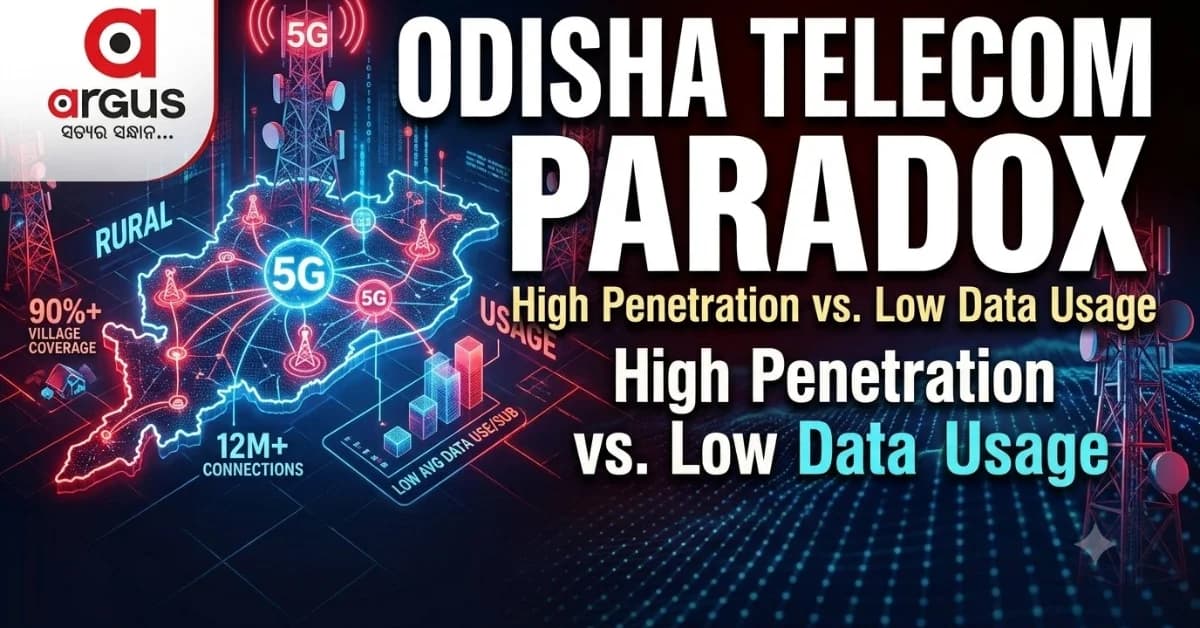
The Usage Paradox: Despite high per-capita connectivity, Odisha accounts for just 2.80% (2,360.79 PB) of India's quarterly data consumption.
Utility Over Entertainment: Lower overall data usage stems from a focus on high-value functional uses (e-governance, agritech, banking) rather than heavy video streaming.
Bhubaneswar: In a landmark address at the global Bloomberg business summit in New Delhi today, Prime Minister Narendra Modi delivered a clear message to tech leaders and international investors: “Data is power.” The Prime Minister emphasized that robust digital networks are no longer just utilities, but the ultimate drivers of grassroots financial inclusion and macroeconomic strength.
However, an exclusive analysis of the latest comprehensive Quarterly Performance Indicators report released by the Telecom Regulatory Authority of India (TRAI) reveals a fascinating a fascinating paradox unfolding right here in Odisha.
The state has built a powerful digital platform, outclassing several larger neighbours in pure network penetration, but when it comes to data power play, the State faces a bump, trailing in byte burning.
This analysis deconstructs Odisha’s unique telecom landscape. We explore why a state so eagerly hopping onto the internet train is not yet burning through gigabytes at the same rate as its neighbors, and what this means for the realization of the Prime Minister's "Data is Power" vision at the grassroots.

📱 Get Argus News App
✨The Odisha Paradox: High Penetration, Low Volume
The headline numbers from the TRAI report paint a picture of a state that has systematically dismantled the traditional rural-urban digital divide. Odisha boasts a total internet subscriber base of 39.92 million, supported by a highly robust rural tele-density of 63.42% and a spectacular urban tele-density of 172.05%.
Similarly, when evaluated on an "internet connections per 100 population" baseline, rural Odisha comfortably outpaces historically comparable states like Bihar, Jharkhand, Chhattisgarh and Uttar Pradesh.
This shows in terms of digital onboarding, Odisha has built a massive, inclusive platform.
· Rural Penetration Leader: As detailed in the official TRAI subscriber sheet, Odisha logs a resilient 49.48 internet subscribers per 100 population in its rural expanse. This leaves major regional neighbors like Madhya Pradesh (38.98) and Bihar (37.36) trailing far behind.
· Urban Tech Surge: In its urban spaces, Odisha reaches a powerful 134.32 internet subscribers per 100 population, outperforming major industrialized hubs like Gujarat (110.89) and Andhra Pradesh (115.97).
This means that on a per-capita connectivity level, Odisha is significantly further ahead in boarding the "data train" than most of its peers.
Yet, out of India's massive quarterly pool of 84,424 Petabytes (PB), Odisha’s estimated consumption sits at a modest 2,360.79 PB (2.80% of the national footprint).
While a quarterly consumption of 2.5 Exabytes is statistically vast, it reveals that individual users in Odisha consume less data on average than users in states with lower overall rural tele-densities.
The National Data Pie: Where Major States Stand
To contextualize Odisha’s position, it is essential to look at how data consumption is distributed across India's primary telecom circles. Sheer population and the concentration of multi-device urban consumers skew absolute data usage heavily toward a few massive economic zones:
State-Wise Estimated Data Usage
All India Overview
* **Total Internet Subscribers:** 1,114.17 Million (100%)
* **Quarterly Data Usage:** 84,424.00 PB
* **Monthly Data Usage:** 28,141.33 PB
1. Bihar
* **Total Subs:** 67.67M (6.07% share)
* **Monthly Usage:** 1,709.51 PB *(Quarterly: 5,128.52 PB)*
| Segment | Subscribers | Monthly Usage |
| **Rural** | 41.94M (3.76%) | 1,059.51 PB |
| **Urban** | 25.73M (2.31%) | 650.00 PB |
2. Madhya Pradesh
* **Total Subscribers:** 57.02M (5.12% share)
* **Monthly Usage:** 1,440.80 PB *(Quarterly: 4,322.40 PB)*
| Segment | Subscribers | Monthly Usage |
| **Rural** | 23.74M (2.13%) | 600.06 PB |
| **Urban** | 33.28M (2.99%) | 840.74 PB |
3. Odisha
* **Total Subs:** 31.15M (2.80% share)
* **Monthly Usage:** 786.93 PB *(Quarterly: 2,360.79 PB)*
| Segment | Subscribers | Monthly Usage |
| **Rural** | 18.82M (1.69%) | 475.44 PB |
| **Urban** | 12.33M (1.11%) | 311.49 PB |
4. Jharkhand
* **Total Subs:** 23.33M (2.09% share)
* **Monthly Usage:** 589.38 PB *(Quarterly: 1,768.13 PB)*
| Segment | Subscribers | Monthly Usage |
| **Rural** | 12.72M (1.14%) | 321.34 PB |
| **Urban** | 10.61M (0.95%) | 268.04 PB |
5. Chhattisgarh
* **Total Subs:** 20.96M (1.88% share)
* **Monthly Usage:** 529.51 PB *(Quarterly: 1,588.52 PB)*
| Segment | Subscribers | Monthly Usage |
| **Rural** | 9.80M (0.88%) | 247.57 PB |
| **Urban** | 11.16M (1.00%) | 281.93 PB |
1. Karnataka: 5,696.40 PB (6.75% market share)
2. Tamil Nadu (including Chennai): 5,291.22 PB (6.27% market share)
3. West Bengal (including Kolkata): 5,255.52 PB (6.22% market share)
4. Gujarat: 4,722.58 PB (5.59% market share)
5. Rajasthan: 4,448.91 PB (5.27% market share)
A glance at the above data shows Odisha sits at the 14th position nationally, contributing 2,500.58 PB per quarter
To understand why Odisha trails in volume despite scoring higher in access, we must look at the structural, economic, and behavioral dynamics of its telecom market.
Utility over Entertainment
This massive mismatch between high relative penetration and lower absolute data consumption reveals a profound structural truth about how Odisha uses its network infrastructure:
1. The Power of Purposeful Data
In mega-cities and intensely populated clusters like Bihar and Uttar Pradesh, high data volumes are driven heavily by data-heavy entertainment: high-definition video streaming, online mobile gaming, and endless social media video scrolling.
In contrast, Odisha's exceptionally high relative density is anchored in functional utility.
As per telecom sector observers, since a larger proportion of citizens (rural) in Odisha use their internet connections for essential e-governance applications like checking crop prices via agritech portals, utilizing rural digital banking tools, and processing direct benefit transfers (DBT), these high-value transactions require stable access but consume very little raw bandwidth compared to streaming a movie in high definition. Odisha is using data as a practical tool for empowerment rather than just an entertainment box.
2. The Multi-Device Urban Landscape
Odisha’s urban ratio of 134.32 per 100 population shows that urban professionals and businesses in hotspots like Bhubaneswar and Cuttack are heavily utilizing multiple connected devices, driving digital productivity. However, much of this high-intensity commercial data usage happens over physical office networks and home fiber lines (FTTH), meaning a significant chunk of Odisha's urban data engine is offloaded from regular mobile cellular tracking, they observed.
3. Hardware and Device Economics
While over 41% of Odisha's telecom subscribers reside in rural areas, a significant portion of this base accesses the network via low-cost 4G-enabled feature phones or entry-level smartphones. These devices inherently restrict heavy data processing. Furthermore, multi-SIM behavior is highly prevalent in Odisha's urban centers (as reflected in the 172.05% urban tele-density), meaning many subscribers hold secondary SIM cards that remain active for voice backup but record zero data usage.
Transforming Digital Presence into Economic Power
The above reasons imply that the TRAI findings don't diminish Odisha's position; instead, they highlight a major opportunity.
As Prime Minister Modi pointed out today, true power lies in data maturity. Odisha has successfully handled the hard part: it has laid the network lines, bridged the rural-urban access divide, and onboarded its population at an enviable per-capita rate.
The next phase requires a concerted push toward high-value digital utilization, feel experts.
As 5G Fixed Wireless Access (FWA) expands deeply into Odisha’s districts, and as local digital economies transition from basic connectivity to advanced use-cases—such as agritech deployments, automated rural logistics, localized e-commerce, and regional digital content creation – Odisha’s data consumption volumes are projected to close the gap with larger states, observed experts..
Core Telecom Ratios & Density Summary
· Total Internet Base: 31.15 million subscribers actively connected across the state.
· Rural Internet Base: 18.82 million subscribers, showing deep network presence in village blocks.
· Urban Internet Base: 12.33 million subscribers driving commercial applications.
· Rural Internet Density: 49.48 per 100 population, comfortably outperforming regional peers like Bihar and MP.
· Urban Internet Density: 134.32 per 100 population, highlighting extensive multi-device and smart device adoption.
·
Estimated Quarterly Mobile Data Pool: 2,360.79 Petabytes (PB),
providing a robust baseline of roughly 786.93 PB per month.
Also Read: Jio Rules Both India's Mobile and Data Markets; Airtel Emerges Strongest Challenger as 5G Broadband Race Intensifies
Related Topics
Explore more stories