



EXCLUSIVE| The ₹2.43 Lakh Crore Logistical Bump: Why CM Majhi’s UAE Megadeals Depend on a Bhubaneswar-Dubai Air Bridge
Key Points
Odisha secured a ₹2,43,162 crore investment pipeline from its high-profile UAE outreach, led by Chief Minister Mohan Charan Majhi.
Despite incoming project deployments starting in late 2026, Bhubaneswar currently lacks direct air connectivity to the UAE.
The State is leveraging the ₹4,182-crore B-MAAN scheme and structured VGF frameworks to bridge the gap and restore direct flights by early 2027.
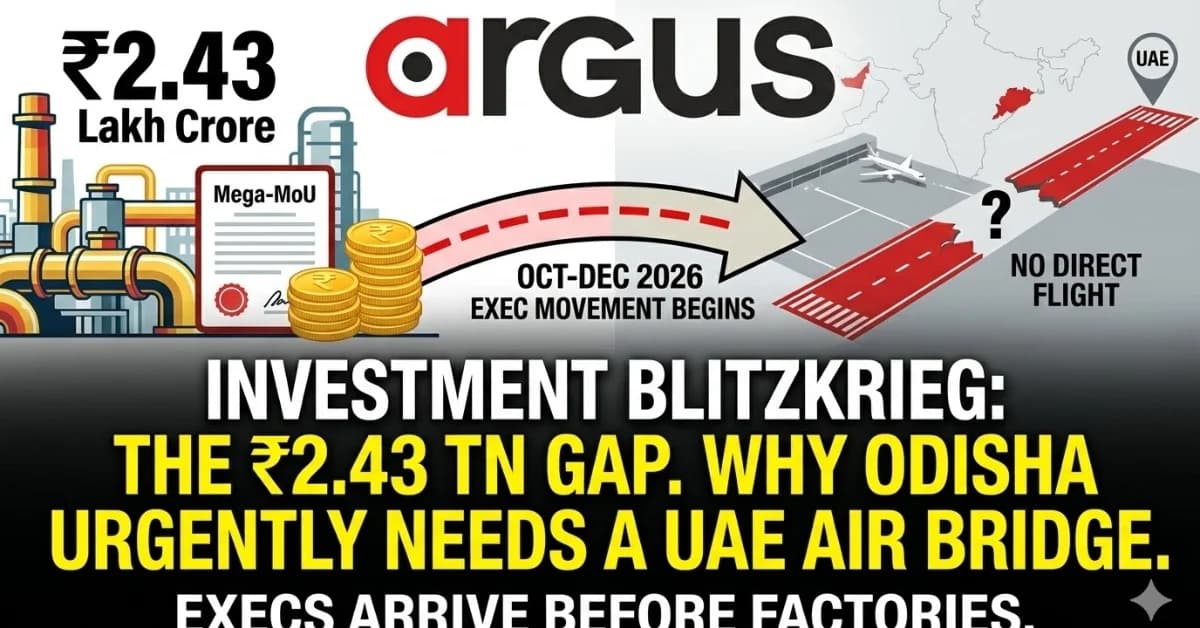
Bhubaneswar: Chief Minister Mohan Charan Majhi wrapped up his high-profile UAE investment pitch with a staggering headline figure of Rs2,43,162 crore. Yet, the State's biggest business requirement following this investment blitzkrieg may not be another MoU—it could be an aircraft.
Odisha’s aggressive push to UAE investors secured commitments across massive industrial and infrastructure projects, projecting the creation of over 6 lakh jobs. However, at precisely the moment when the State expects the first wave of executives, engineers, project managers, and corporate decision-makers to begin moving between the Gulf and Odisha, it faces a stark reality check: Bhubaneswar currently has no direct air connectivity with the UAE.
That structural mismatch is increasingly difficult to ignore.
The Chief Minister has, therefore, indicated that his government is actively considering and fast-tracking the reintroduction of direct flight connectivity between Odisha and the UAE.

📱 Get Argus News App
✨The issue, therefore, is no longer simply about passenger convenience. It has acquired a business dimension: if the investment pipeline is real, how quickly can Odisha create the physical connectivity needed to support it?
The State's own timeline points to the answer. Initial legal, engineering and site-reconnaissance teams are expected to begin travelling during October-December 2026, followed by project-management deployments between January and April 2027. By May 2027, the flow could increasingly involve senior executives and board-level oversight.
That gives Odisha a relatively narrow window to get the air bridge moving.
The investment blitzkrieg has created a new aviation urgency
The UAE outreach was conducted at high speed in September 2026, with the Chief Minister's schedule moving through Abu Dhabi and Dubai.
On September 9, the State announced the cornerstone Rs2.10 lakh crore mega-MoU covering 14 projects, involving the International Holding Company (IHC) and Adani Group. The larger investment tally of Rs2,43,162 crore was subsequently presented at the Odisha Investors' Meet–UAE 2026 in Dubai, where around 400 business leaders and delegates were addressed.
UAE investment outreach: the numbers now driving the aviation question
|
Investment metric |
|---|
What it means for Odisha
₹2.43 lakh crore
Overall UAE-linked investment pipeline presented during the outreach
₹2.10 lakh crore
Cornerstone mega-MoU covering 14 major projects
14 mega-projects
Projects spread across industrial, mineral, renewable and infrastructure sectors
6.18 lakh+ jobs
Large projected employment impact requiring sustained corporate and managerial presence
Around 400 delegates
Scale of the UAE investor outreach in Dubai
October-December 2026
First projected phase of legal, engineering and site-reconnaissance movement
January-April 2027
Expected project-management mobilisation
May 2027 onward
Senior executive and board-level oversight phase
The crucial point is that a mega-MoU does not translate overnight into a functioning plant. But neither does it mean executives can wait for the project to become operational before travelling.
The investment pipeline itself creates a mobility requirement before production begins.
The first executives could arrive before the first factories
The supplied project mobilisation plan suggests that the demand for air connectivity will emerge in stages.
The projected executive movement timeline
|
Phase |
Period |
Expected movement |
|---|---|---|
|
Phase 1 – Legal & Site Reconnaissance |
October-December 2026 |
Legal advisers, structural engineers and compliance teams; land-acquisition and site coordination |
|
Phase 2 – Project Management Units |
January-April 2027 |
Mid- and senior-level operations directors; corporate headquarters and project execution teams |
|
Phase 3 – Executive & Board Oversight |
May 2027 onward |
Managing directors, senior executives and sovereign/investor representatives; periodic project reviews |
The first phase is particularly important.
Even before construction starts, investors need people on the ground to examine land, clearances, technical requirements, environmental and compliance issues, logistics and government coordination.
For the Adani-IHC projects, that could mean regular movement into Odisha's industrial belts. For downstream chemical projects, technical and engineering teams will need to coordinate with agencies and existing industrial infrastructure around Paradip.
In other words, the passenger demand does not begin when the factory opens; it begins when the investment starts moving from paper to ground.
The missing link: Rs2.43 lakh crore on one side, no direct UAE flight on the other
This is where Odisha's investment narrative runs into an aviation reality.
The State can promote itself as an investment destination, offer land, provide policy incentives and build industrial infrastructure. But if a UAE-based executive has to depend on multi-stop connections to reach Bhubaneswar, the ease-of-doing-business proposition becomes more complicated.
The direct flight question is therefore increasingly tied to decision speed.
UAE investment partners and why executive mobility matters
|
UAE entity / partner |
Proposed facility / project scope |
Why executives need to travel |
Direct-flight imperative |
|---|---|---|---|
|
International Holding Company (IHC) & Adani Group |
14 mega-projects involving metal downstream, critical minerals/rare earths, renewable equipment and industrial infrastructure |
Site coordination, JV management and government oversight |
Multi-billion-dollar deployment requires rapid executive access |
|
Borouge International |
Large-scale chemicals downstream complex linked with IOCL's Paradip refinery |
Engineering coordination, stakeholder meetings and project approvals |
High-value petrochemical projects require quick field-level decision-making |
|
IBPG / IBPC |
Trade and contract-manufacturing bridge, including agro-export and manufacturing linkages |
Local liaison offices, trade councils and supply-chain monitoring |
Direct connectivity strengthens institutional confidence and reduces geographical friction |
For Odisha, therefore, the question is not simply whether a direct flight is commercially attractive today.
The more strategic question is:
Can the State afford to wait for passenger demand to become visible before providing the connectivity that helps create that demand?
But reopening the route is not as simple as announcing it
There is an important distinction between a State wanting a direct international route and a State being able to operationalise one.
International air services operate within bilateral arrangements, regulatory permissions, airport slots and airline commercial decisions. The State can facilitate, underwrite and negotiate—but it cannot unilaterally declare a route operational.
The four principal hurdles before a Bhubaneswar-UAE air bridge
|
Hurdle |
What it involves |
Impact on Odisha |
|---|---|---|
|
Bilateral Air Services Agreement ceiling |
India-UAE bilateral arrangements determine seat capacities and allocation points |
Major Indian metros consume significant bilateral capacity, making additional allocations difficult |
|
Operating authorisation |
International routes require appropriate DGCA approvals and airline operating permissions |
A previously suspended route cannot simply be switched back on |
|
Middle East airspace & safety considerations |
Flight paths, routing, fuel planning and operational restrictions can affect schedules |
Re-routing can increase flight time and complicate aircraft rotations |
|
Dubai/Abu Dhabi airport slots |
Foreign airport landing and departure slots must match the Indian-side approvals |
Even an Indian approval cannot guarantee an immediate UAE-side operating slot |
An assessment carried out points to the route's previous suspension and the need for fresh regulatory processes rather than treating resumption as an automatic restart.
That makes the early-2027 target significant.
Odisha has to move before the investment traffic peaks
The State's proposed sequencing is effectively a race between two timelines:
Investment mobilisation → executive movement → project construction → commercial operations
versus
Airline negotiations → regulatory clearance → airport slots → route resumption
If the second timeline begins too late, Odisha could find itself in the unusual position of having signed enormous investment commitments while executives continue to depend on connecting flights.
The State's own projected aviation-investment timeline envisages direct flights being targeted for resumption by early 2027, initially supporting administrative and corporate movement.
The proposed parallel rollout
|
Period |
Investment side |
Aviation side |
|---|---|---|
|
Late 2026 |
Land, legal and regulatory groundwork |
Airline negotiations and UAE airport slot discussions |
|
Early 2027 |
Project-management teams begin arriving |
Targeted resumption of direct connectivity |
|
2027 construction phase |
Groundbreaking and infrastructure development |
State-backed support may be needed if initial passenger loads remain low |
|
Later phase |
Plants and industrial facilities move towards operation |
Passenger traffic expected to mature organically |
|
Mature phase |
Regular corporate and industrial activity |
VGF/subsidy support can eventually be phased out |
This is the critical benchmark for the Majhi government's investment campaign: direct connectivity should ideally be operational before executive traffic becomes a routine project requirement, not after it.
The commercial problem: investors may come, but will they fill an aircraft?
Here lies the strongest argument against an immediate unconditional restoration.
An investment commitment of Rs2.43 lakh crore does not automatically translate into 2.43 lakh crore worth of aviation demand.
The physical execution of heavy industrial projects can take years. During the initial construction period, passenger volumes may be intermittent. Airline operators therefore face the classic problem of launching a route before its full demand base has matured.
Investment strength versus aviation reality
|
Headline investment signal |
Direct-flight challenge |
|---|---|
|
₹2.43 lakh crore investment pipeline |
The money will be deployed over multiple years rather than immediately |
|
6.18 lakh+ projected jobs |
Employment generation does not immediately create international executive traffic |
|
14+ mega-projects |
Project teams may initially travel in relatively small numbers |
|
Large industrial projects |
Construction cycles can take 24-36 months |
|
UAE corporate participation |
Passenger demand could initially be uneven |
|
Strategic need for connectivity |
Airlines still need commercially sustainable load factors |
|
State aviation support |
VGF may be required until traffic matures |
That is why Odisha's answer cannot simply be: restart the flight and hope passengers come.
It needs a structured demand-generation model.
The B-MAAN factor: Odisha now has a policy instrument to underwrite the risk
This is where the current government's aviation framework becomes important.
The Rs4,182-crore Building and Management of Aviation Assets and Network (B-MAAN) scheme gives the State a broader institutional framework for aviation support. According to the supplied material, the framework was approved in October 2025 and is designed to continue through 2030.
The State's aviation approach has consequently moved beyond simply providing emergency financial assistance to an airline.
Odisha's aviation-policy evolution
|
Attribute |
I-UDAN |
Earlier BJD VGF initiative |
B-MAAN under BJP government |
|---|---|---|---|
|
Inception |
2018 |
2017 / 2022 |
2025 |
|
Authority |
Ministry of Civil Aviation, GoI |
Former BJD State Cabinet |
Current BJP administration |
|
Financial scope |
Central budgetary allocations |
Ad-hoc emergency state funds |
₹4,182 crore, 2025-30 |
|
Primary objective |
Connect Indian hubs to international nodes |
Point-to-point flight survival support |
End-to-end aviation ecosystem + VGF buffer |
|
Status |
Active national framework |
Phased out/replaced |
Active & operational |
The distinction matters because the direct UAE route may need initial financial cushioning while corporate traffic is still building.
From subsidy to investment infrastructure
B-MAAN's significance is broader than a simple passenger-flight subsidy.
The framework links aviation to airport development, MRO, cargo and private-sector participation. The supplied material identifies three principal pillars: PPP/BOT infrastructure development, monetisation through MRO and cargo ecosystems, and fast-track regulatory coordination.
How B-MAAN could support the UAE connectivity push
|
Mechanism |
Potential relevance to UAE route |
|---|---|
|
VGF support |
Absorb initial load-factor risk |
|
Airport development |
Strengthen BPIA's ability to handle international growth |
|
MRO ecosystem |
Create additional aviation revenue beyond passenger tickets |
|
Cargo integration |
Support industrial and high-value cargo flows |
|
Single-window aviation coordination |
Reduce administrative friction between State agencies and central regulators |
|
Private-sector participation |
Bring airlines and airport developers into a longer-term commercial ecosystem |
This is the larger strategic shift: Odisha should not treat the Bhubaneswar-UAE flight as an isolated route; it should treat it as part of the investment infrastructure supporting the UAE industrial pipeline.
Odisha has already seen what happens when international routes lose their financial cushion
The Bhubaneswar-Dubai and Bhubaneswar-Singapore experience provides a cautionary benchmark.
Both routes were launched in 2023 and subsequently faced suspension, exposing the difficulty of sustaining international connectivity when load factors and financial support do not remain aligned.
Dubai versus Singapore: Bhubaneswar's international-route experience
|
Metric |
Bhubaneswar-Dubai |
Bhubaneswar-Singapore |
|---|---|---|
|
Launch date |
May 15, 2023 |
June 3, 2023 |
|
Primary airline |
IndiGo |
IndiGo |
|
First suspension |
October 2025 |
October 2025 |
|
Second suspension |
March 30, 2026 |
March 29, 2026 |
|
Current status, Sept 2026 |
Suspended / under active restoration |
Suspended / under review |
|
Core passenger base |
Blue-collar Odia workforce, Middle-East tourists and UAE investors |
IT professionals, institutional partners and transit traffic |
The lesson is uncomfortable but valuable.
International connectivity cannot survive on political enthusiasm alone.
It needs a predictable passenger base, an airline willing to deploy aircraft, airport slots, regulatory clearances and, where necessary, a mechanism to absorb the initial commercial risk.
What can Odisha learn from other States?
Odisha does not have to build the model from scratch.
An analysis of different models parcticed elsewhere in India identifies three broad approaches that could be adapted to the UAE route.
Three possible models for Odisha
|
Model |
How it works |
Suitability for Odisha |
|---|---|---|
|
Gujarat/GIFT City-style corporate charter model |
Government aggregates corporate demand and uses charter/block-seat arrangements for executives |
Best suited as an interim executive solution |
|
Karnataka/Telangana-style transit corridor |
Fast-track transit through major hubs with coordinated connections |
Immediately viable while direct flight is negotiated |
|
Maharashtra-style cargo-executive hybrid |
Non-scheduled operators combine executive movement with high-value cargo |
Moderately suited, particularly for industrial projects |
The most practical short-term approach, according to the assessment, would be to combine corporate charter capacity with frictionless transit arrangements through Mumbai or Delhi, while pursuing a scheduled direct flight.
That creates a bridge between today's connectivity gap and tomorrow's full-scale commercial route.
The Kerala lesson: create demand before asking airlines to trust the route
Kerala's Gulf connectivity offers another important lesson.
Instead of relying exclusively on government subsidy, the model can leverage a predictable Gulf-linked passenger base and corporate/community demand to create stronger airline economics.
For Odisha, available data identifies the 40,000+ Odisha Samaj UAE database as a potential source of demand aggregation, allowing block bookings and corporate travel commitments to be structured before asking an airline to bear the entire risk.
Lessons from other State models
|
State/model |
Core mechanism |
Odisha adaptation |
|---|---|---|
|
Kerala |
Diaspora-led predictable Gulf traffic |
Aggregate Odisha-linked UAE passengers and corporate demand |
|
Assam/North-East |
Central-State sharing under international connectivity programmes |
Seek greater Union participation in international-route support |
|
Karnataka/Tamil Nadu |
Corporate travel linked to industrial/tech investment |
Tie corporate travel commitments to UAE investment projects |
The third model may be the most directly relevant to Odisha's present situation.
If companies are committing billions to projects in Odisha, the State can explore whether a portion of their executive and corporate travel can be channelled into a specific Bhubaneswar-UAE service.
That changes the equation from:
"Please operate this route because Odisha needs it"
to:
"Here is the investment-linked corporate traffic base that can support the route."
The VGF evolution gives Odisha another lever
The State's VGF mechanism has also evolved.
Odisha VGF: from experimental support to institutional framework
|
Operational element |
Present position |
|---|---|
|
Inception |
2017, initially aligned with UDAN |
|
International expansion |
State policy evolved during 2022-23 |
|
October 2024 |
Integrated under New Destination Policy |
|
October 2025 |
Bundled into ₹4,182-crore B-MAAN |
|
January 2026 |
₹26.87 crore emergency international-loss buffer |
|
Current status |
Active and structurally upgraded |
|
Standard support |
₹5 lakh per domestic round trip; ₹10 lakh per international round trip |
That means Odisha already possesses a financial mechanism that can potentially be aligned with the early years of a revived UAE service.
But the objective should be to use VGF as a bridge, not as a permanent substitute for demand.
The best option: a three-stage UAE air-bridge strategy
For Odisha, the most practical route may therefore be neither an immediate large-scale subsidy nor waiting indefinitely for airlines to independently discover the market.
A three-stage strategy emerges from the above analysis.
Stage 1: Immediately create an executive bridge
October-December 2026
Begin formal airline negotiations.
Work with DGCA and the Union Civil Aviation Ministry on route permissions.
Pursue Dubai and Abu Dhabi slot availability.
Create a corporate travel database covering UAE-linked investors and Odisha business interests.
Establish a Bhubaneswar investment transit desk at Mumbai and Delhi.
Explore charter/block-seat options for critical executive movement.
Stage 2: Target direct scheduled connectivity
Early 2027
The State should seek to have the direct Bhubaneswar-UAE service operational around the point when project-management teams begin arriving.
This would make aviation part of the investment mobilisation package rather than a later response to passenger demand.
Stage 3: Gradually shift to organic commercial demand
2027 onward
As projects move from site preparation to construction and commissioning, the passenger base should broaden:
executives → engineers → contractors → corporate staff → workers → tourists → cargo-linked traffic.
The State can then progressively reduce VGF dependence as load factors improve.
The bigger question is not "Can Odisha get a flight?" but "Can it sustain one?"
That is the real aviation test.
Odisha has already experienced the vulnerability of international routes that depend heavily on initial enthusiasm and financial support. The UAE investment push creates a fundamentally different opportunity because there is now a large corporate-investment narrative around which recurring traffic can potentially be built.
But the Rs2.43 lakh crore headline itself cannot guarantee airline viability.
The State will need to convert investment commitments into actual corporate travel commitments.
What Odisha should put on the table before approaching airlines
|
Requirement |
Why it matters |
|---|---|
|
Corporate travel commitments |
Demonstrates real passenger demand |
|
UAE investor database |
Creates predictable traffic |
|
State VGF guarantee |
Protects airline during initial low-load period |
|
DGCA/Union coordination |
Addresses bilateral and regulatory hurdles |
|
Dubai/Abu Dhabi slot negotiations |
Secures the foreign airport side of the route |
|
Cargo strategy |
Adds another revenue stream |
|
MRO/airport ecosystem |
Builds long-term aviation economics |
|
Industrial project calendar |
Allows airline schedules to be aligned with investment mobilisation |
Bottomline
The UAE tour has produced the investment numbers Odisha wanted.
Now comes the less glamorous but equally important test: can Odisha build the connectivity that allows those investors to actually operate from the State?
A Rs2.43 lakh crore investment pipeline without a direct UAE air bridge creates a strange disconnect – capital has been invited to Odisha faster than corporate mobility infrastructure has caught up.
The
Majhi government's next benchmark could be the day a direct
Bhubaneswar-Dubai or Bhubaneswar-Abu Dhabi flight takes off again –
with an aircraft carrying the executives who will turn the UAE
investment announcements into projects on Odisha soil.
Also Read: EXCLUSIVE| Odisha's Global Business Diplomacy: CM Majhi vs. Former CM Naveen Patnaik Tied at 2 Foreign Trips, but Worlds Apart in Investment Scale