



EXCLUSIVE| Odisha's Global Business Diplomacy: CM Majhi vs. Former CM Naveen Patnaik Tied at 2 Foreign Trips, but Worlds Apart in Investment Scale
Key Points
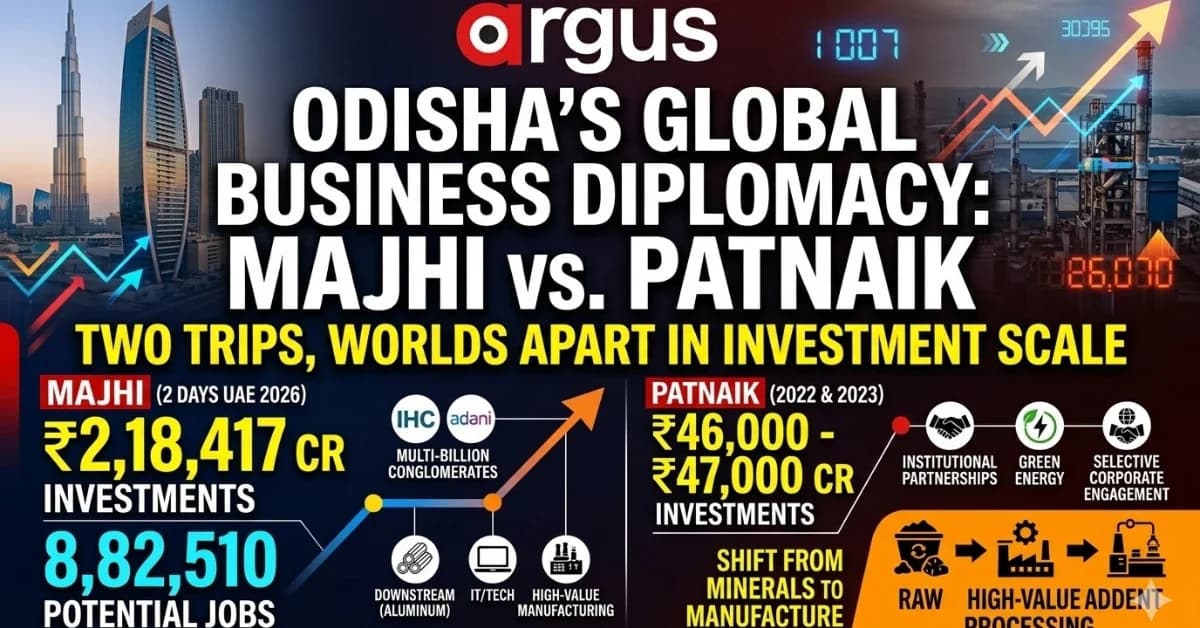
Chief Minister Mohan Charan Majhi’s two-day UAE mission yielded a massive investment pipeline of ₹2,18,417 crore and 8,82,510 potential jobs for Odisha.
The economic strategy evolved from mega-ticket industrial projects on Day 1 to downstream value addition, recycling, IT, and rare earths on Day 2.
The scale of investments matches the frequency of past foreign tours by Naveen Patnaik, highlighting a transition toward direct, transaction-driven capital mobilisation.
Bhubaneswar: Two days in the United Arab Emirates have given Chief Minister Mohan Charan Majhi a remarkably large business headline for Odisha – Rs2,18,417 crore in proposed investments and 8,82,510 potential jobs.
But the significance of Majhi’s second foreign tour is not confined to the headline number.
Across two days, the Odisha government used the UAE mission to pursue two distinctly different layers of industrial investment.
The first day was dominated by mega-ticket proposals involving global conglomerates and large infrastructure, metals and energy projects.

📱 Get Argus News App
✨The second day moved deeper into the value chain, bringing aluminium downstream industries, recycling, IT/ITeS, logistics, food processing, agriculture, real estate and rare-earth opportunities into the pitch.
The result was a foreign investment campaign that combined large capital mobilisation with an attempt to change what Odisha manufactures from its own mineral and industrial base.
UAE Mission: From Mega Projects to the Next Layer of Odisha’s Industrial Economy
The second day of the UAE visit added ₹8,417 crore to the investment pipeline through five MoUs worth Rs5,600 crore and eight expressions of interest worth Rs2,817 crore, with a potential employment generation of 14,310 jobs.
The composition of these proposals is significant.
While Day 1 was driven by major industrial and infrastructure players such as International Holding Company (IHC), Adani Ports, Adani Green and Borouge, Day 2 was more about building the ecosystem around Odisha's existing industrial strengths.
Majhi hosted a dedicated roundtable on aluminium downstream manufacturing, signalling that Odisha does not want its mineral advantage to end with alumina refining or aluminium smelting.
The Chief Minister's visit to Emirates Global Aluminium (EGA) also brought the downstream question into focus: how can Odisha capture a larger share of the value generated after minerals are extracted and processed?
The UAE campaign also opened another strategic front – the circular economy.
A roundtable with the Bureau of Middle East Recycling explored opportunities in recycling, resource efficiency and sustainable industrial growth, potentially connecting Odisha's mineral and manufacturing ecosystem with global practices in secondary materials.
At the same time, the investment pitch expanded beyond traditional heavy industry into IT/ITeS, real estate, logistics, food processing, agriculture and rare earths.
What Majhi’s Two-Day UAE Mission Delivered
|
Metric |
Day 1 |
Day 2 |
Combined |
|---|---|---|---|
|
Investment proposals |
₹2.10 lakh crore |
₹8,417 crore |
₹2,18,417 crore |
|
Potential jobs |
8,68,200 |
14,310 |
8,82,510 |
|
Investment character |
Mega-ticket projects |
Diversification & downstream |
Large industry + value chains |
|
Major focus |
Aluminium, infrastructure, energy, chemicals |
IT/ITeS, recycling, logistics, food processing, rare earths |
Broad industrial ecosystem |
|
Strategic objective |
Build industrial scale |
Retain more value inside Odisha |
Expand Odisha's economic value chain |
The numbers, however, should be read as proposed investment commitments and expressions of interest, not completed investments. The political and administrative test now shifts from signing agreements abroad to converting them into land allotments, clearances, construction, factories and actual payrolls in Odisha.
The Big Political Story: Majhi Has Now Drawn Level With Naveen on Foreign Tours
With the UAE mission completed, Mohan Charan Majhi has now undertaken two foreign business missions, putting him level with former Chief Minister Naveen Patnaik, who undertook two major foreign business trips during the final decade of his tenure – Dubai/Rome in 2022 and Japan in 2023.
The numerical parity is striking.
But the more interesting story begins after the count.
Because although both Chief Ministers now stand at two foreign business missions, the purpose, scale and economic pitch of those missions reveal two very different models of Odisha's international economic diplomacy.
Patnaik's foreign outreach was comparatively selective and institution-oriented. Majhi's approach has been more aggressively commercial, with international travel being used as a direct platform for investment mobilisation.
And the contrast becomes particularly visible when the investment numbers and strategic targets are placed side by side.
Two Chief Ministers, Two Foreign Investment Models
|
Dimension |
Naveen Patnaik |
Mohan Charan Majhi |
|---|---|---|
|
Foreign business missions considered |
2 |
2 |
|
Major foreign stops |
Dubai/Rome (2022), Japan (2023) |
UAE (2026 mission) |
|
Overall style |
Selective, institution-led international outreach |
Aggressive, investment-led outbound diplomacy |
|
Major investment yield cited |
Around ₹46,000–₹47,000 crore across Dubai and Tokyo missions |
₹2,18,417 crore from the two-day UAE campaign |
|
Investment emphasis |
Broad corporate engagement, green energy, technology and institutional partnerships |
Mega industrial projects, downstream manufacturing, infrastructure, energy and diversified sectors |
|
Core economic narrative |
Position Odisha as a globally recognised, well-governed investment destination |
Build a larger industrial and investment base through direct capital mobilisation |
|
Mineral strategy |
Stronger industrialisation and green-energy orientation |
Downstream value addition and greater value retention inside Odisha |
|
Diaspora/business outreach |
Culture, heritage, tourism and institutional/global engagement |
Business groups and commercial networks for exports and investment |
|
International engagement |
Global institutions, business associations and strategic corporate meetings |
Global conglomerates, sovereign-linked entities and sector-specific business groups |
The Scale Difference Is Impossible to Ignore
The most striking metric is the proposed investment value.
The two major foreign missions under Naveen Patnaik are cited at roughly Rs46,000–Rs47,000 crore in combined investment commitments, while Majhi's two-day UAE campaign has produced a stated ₹2,18,417 crore pipeline.
That puts the UAE figure at roughly 4.6–4.7 times the combined figure cited for Patnaik's Dubai and Tokyo missions.
But the difference is not simply about who secured the bigger number.
It reflects a change in the style of economic diplomacy.
Patnaik's international outreach sought to build Odisha's reputation through a combination of investment promotion, institutional partnerships, global governance credentials, technology and cultural diplomacy.
Majhi's approach is visibly more transactional: identify large pools of capital, bring global companies to the negotiating table and pitch Odisha as the location for large industrial assets.
That is why the UAE mission was not merely an investment roadshow.
It was effectively an attempt to place Odisha inside the business plans of some of the world's largest industrial and investment players.
From Attracting Capital to Capturing the Value Chain
There is another important shift beneath the investment numbers.
Odisha has historically possessed one of India's strongest mineral and metals bases. The challenge has been ensuring that the state captures enough economic value after extraction and primary processing.
Majhi's UAE pitch puts that issue directly on the table.
The aluminium downstream roundtable and the interaction with Emirates Global Aluminium point towards a strategy in which Odisha seeks to move beyond being primarily a producer of raw materials, alumina or primary aluminium.
The larger ambition is to attract industries that manufacture products from those materials.
That means more factories, more specialised manufacturing, more ancillary industries and potentially more jobs generated from every tonne of mineral processed.
The Strategic Shift
|
Earlier Industrial Model |
Emerging Pitch |
|---|---|
|
Mineral extraction |
Mineral + manufacturing |
|
Alumina/aluminium production |
Aluminium downstream products |
|
Primary processing |
Value-added manufacturing |
|
Large industrial plants |
Industrial ecosystems around anchor plants |
|
Export of commodities |
Export of higher-value products |
|
Energy generation |
Green-energy equipment and industrial applications |
|
Waste as liability |
Recycling and circular economy |
|
Heavy industry dominance |
Heavy industry + services + technology |
This is politically important because the success of an investment tour cannot ultimately be measured by the size of MoUs signed abroad.
It has to be measured by how much economic activity remains in Odisha after the investment arrives.
Day 1 Built the Industrial Base, Day 2 Tried to Build the Ecosystem
The two-day UAE campaign itself offers a miniature version of the Majhi government's economic strategy.
Day 1 was about scale.
With proposals involving IHC, Adani-linked businesses and Borouge, the focus was on large industrial infrastructure, aluminium, chemicals, ports and green energy.
Day 2 was about what comes around that scale.
The focus widened to recycling, downstream aluminium, IT/ITeS, logistics, food processing, agriculture, real estate and rare earths.
|
Day 1 |
Day 2 |
|---|---|
|
Mega-ticket capital |
Smaller but diversified proposals |
|
Primary industrial infrastructure |
Downstream and ancillary sectors |
|
Aluminium and energy |
Aluminium value addition |
|
Large conglomerates |
Sector-specific businesses |
|
Industrial geography |
Industrial ecosystem |
|
Capital mobilisation |
Value-chain expansion |
That sequencing could become important for Odisha's economy.
A large aluminium or energy project can create the anchor. But the economic multiplier comes when smaller manufacturers, logistics firms, technology companies, service providers and downstream industries begin operating around it.
The Political Question Now Moves From Dubai to Odisha
For the Majhi government, the UAE numbers create a major political opportunity, but also a major test.
The investment figures are large enough to become an important part of the government's 'Samrudha Odisha' narrative.
The BJP government can now argue that its foreign outreach has quickly produced an investment pipeline several times larger than the combined figure associated with the previous government's two major foreign business missions.
The real scoreboard will therefore be created over the coming years through land allocation, statutory clearances, financial closure, construction, commissioning and actual jobs.
The Real Comparison: Same Number of Tours, Different Economic Politics
The political symbolism is now clear.
Naveen Patnaik — 2 major foreign business missions.
Mohan Charan Majhi — 2 foreign business missions.
But the economic diplomacy behind those numbers is markedly different.
Patnaik's model placed greater emphasis on global positioning, institutional relationships, governance credentials, technology partnerships and selective investment promotion.
Majhi's model is emerging as a more direct capital-mobilisation strategy, with large-ticket industrial investments, downstream manufacturing and global supply-chain integration at its centre.
And that makes the UAE trip more than just another foreign tour.
It represents a political shift in how the Odisha government wants to sell the state to the world:
from
a well-governed investment destination to an aggressive destination
for global capital, manufacturing and value-chain expansion.
Also Read: Special Report| East or West, Odisha is the Best: Massive ₹2.10 Lakh Crore Investment Secured in UAE Campaign
Related Topics
Explore more stories