



Special Report| East or West, Odisha is the Best: Massive ₹2.10 Lakh Crore Investment Secured in UAE Campaign
Key Points
Odisha signed MoUs for 14 new projects worth ₹2.10 lakh crore with IHC and the Adani Group during its UAE investment campaign.
The massive influx of investments is projected to generate approximately 8,68,200 employment opportunities across multiple sectors.
Key developments include planned integrated aluminum units in Rayagada and Sundargarh, alongside strategic petrochemical and infrastructure tie-ups.
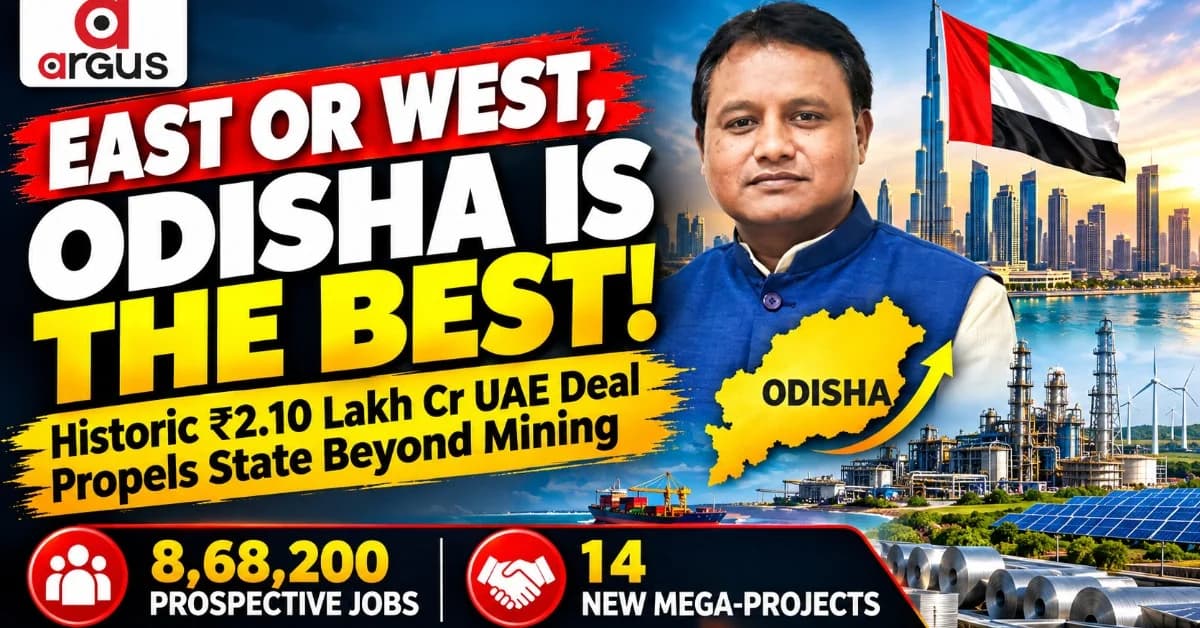
Bhubaneswar: Odisha has opened its UAE investment campaign with a staggering economic headline – Rs2.10 lakh crore in proposed investments and the potential to generate a whopping 8,68,200 jobs from 14 projects.
The scale of the opening-day haul gives Chief Minister Mohan Charan Majhi's UAE business mission an immediate significance that goes beyond another investment roadshow.
It places Odisha's industrial pitch directly before one of the world's most capital-rich business ecosystems and, more importantly, signals a deliberate attempt to take the state's economy beyond its traditional dependence on mining and primary metals.
From aluminium and critical minerals to renewable-energy equipment, petrochemicals, healthcare, tourism and sports infrastructure, the UAE campaign has attempted to build an investment basket that combines Odisha's traditional strengths with newer global industries.

📱 Get Argus News App
✨And that is what makes the opening day particularly significant.
Rs2.10 lakh crore in a single day
The cornerstone of the campaign was the signing/exchange of agreements involving 14 new projects with International Holding Company (IHC) and the Adani Group.
Together, the proposals represent an investment potential of Rs2.10 lakh crore, with an estimated 8,68,200 employment opportunities.
The numbers are significant not merely because of their size, but because of where the projects are aimed.
The investment pipeline includes large-scale industrial projects, downstream manufacturing, renewable-energy equipment, critical minerals, petrochemicals, healthcare, tourism and sports infrastructure.
In other words, Odisha is attempting to use its existing industrial base as the foundation for a much wider economic ecosystem.
From bauxite to aluminium: Odisha wants more value to stay in Odisha
One of the biggest strategic components of the UAE campaign is the proposed expansion of the aluminium value chain.
Land proposals have already been identified for an alumina refinery in Rayagada and an aluminium smelter in Sundargarh.
The significance is larger than simply adding another refinery or smelter.
Odisha possesses one of India's strongest mineral and metals ecosystems. But the larger economic challenge has always been how much value the state can capture after minerals leave the ground.
The new strategy is to push further down the value chain.
Instead of remaining primarily a source of raw minerals and basic metal, Odisha wants to attract processing, manufacturing and downstream industrial activity around those resources.
That potentially means more industrial output, larger supply chains, greater logistics activity and a broader employment base.
The involvement of IHC,Adani Ports and Adani Green Energy also brings together three critical components – capital, logistics and energy.
The petrochemical bet: Paradip could become more than an oil hub
The same strategy is visible in petrochemicals.
Odisha has invited UAE-based chemical major Borouge to explore a large downstream chemical complex linked to IndianOil's proposed Naphtha Cracker project at Paradip.
This could be one of the more important attempts to deepen Odisha's petrochemical ecosystem.
A naphtha cracker provides the basic building blocks for a wide range of chemicals and polymers. The economic opportunity therefore lies not merely in producing the feedstock but in creating industries around it.
If downstream investments materialise, Paradip could gradually evolve from being primarily an oil and port-linked industrial location into a larger petrochemical manufacturing cluster.
That would fit directly into Odisha's broader strategy of extracting greater economic value from infrastructure and raw materials already available within the state.
But this UAE campaign is not only about minerals
The bigger message from the campaign is that Odisha is not abandoning its traditional industrial strengths – it is trying to build new industries on top of them.
The investment basket extends into several sectors that have little to do with conventional mining.
Critical minerals and rare earths
Critical minerals have emerged as strategically important for semiconductors, electronics, aerospace, defence and clean-energy technologies.
For Odisha, entering this space could mean moving closer to the higher-value segments of global manufacturing supply chains.
Renewable-energy equipment
The focus is also shifting from simply generating renewable power to manufacturing equipment required for the green-energy transition.
That distinction is important.
A state that only generates renewable electricity participates in the energy transition.
A state that manufactures renewable-energy equipment can also participate in the industrial supply chain created by that transition.
Healthcare and advanced infrastructure
The UAE outreach has also sought investment in healthcare, advanced infrastructure, industrial technology and specialised sports infrastructure.
These sectors can potentially widen the economic impact beyond the conventional industrial districts and create new service-sector employment.
The other big development: Odisha wants a direct UAE market
One of the less spectacular but potentially consequential developments is the Memorandum of Cooperation with the Indian Business and Professional Group (IBPG).
This creates a potential bridge between Odisha's producers and the UAE market.
The objective includes facilitating exports of Odisha products such as spices and marine products, while also opening opportunities for contract manufacturing for major UAE brands.
That changes the nature of the UAE relationship.
The state is not simply asking foreign investors to bring money into Odisha.
It is also attempting to use the UAE as a market, logistics gateway and commercial partner for Odisha-based production.
For agricultural and marine producers, such access could be particularly important because the challenge is often not production alone but reaching high-value international markets.
UAE vs Singapore: Why the 'West' campaign stands out
The scale becomes clearer when compared with Chief Minister Majhi's earlier international outreach to Singapore.
The Singapore visit produced important strategic partnerships, particularly in areas such as technical education, skilling, green energy and smart-city infrastructure.
Eight MoUs were associated with that visit.
The UAE campaign, by contrast, has produced an opening-day investment proposition of ₹2.10 lakh crore through 14 projects, accompanied by the claimed potential for 8,68,200 jobs.
The distinction is therefore not simply East versus West.
It is strategic institutional partnerships versus large-scale capital mobilisation.
Both have different purposes.
Singapore helped strengthen Odisha's institutional and skills ecosystem.
The UAE campaign is demonstrating that the state can pitch its land, infrastructure, resources and workforce directly to large pools of international capital.
And then comes Utkarsh Odisha
The most striking comparison is with Odisha's flagship investment summit – Utkarsh Odisha: Make in Odisha Conclave 2025.
The conclave generated investment intentions of approximately Rs12.89 lakh crore through 145 MoUs across a much larger, multi-day domestic and international platform.
Against that backdrop, the Rs2.10 lakh crore proposed from the first day of the UAE campaign alone amounts to nearly one-sixth of the entire investment-intention figure generated at Utkarsh Odisha.
The comparison needs context: the two exercises are not identical.
Utkarsh Odisha was a massive state-wide investment summit involving hundreds of companies and a wide range of sectors.
The UAE number comes from a focused overseas business campaign.
But precisely because of that difference, the opening-day figure is noteworthy.
It suggests that Odisha's international investment strategy is becoming increasingly concentrated around large-ticket projects capable of changing the industrial geography of the state.
From mineral state to global industrial hub?
This is ultimately the larger test for the UAE campaign.
Odisha's industrial story has historically been built around its extraordinary mineral wealth.
Steel, aluminium, mining and power created the foundation.
But the next stage requires something more – value addition, manufacturing depth, technology, exports, services and global supply-chain integration.
The UAE campaign appears designed around that transition.
The state's mineral advantage remains at the centre of the strategy.
But around it, Odisha is attempting to build:
- Integrated aluminium manufacturing
- Critical-mineral industries
- Renewable-energy equipment manufacturing
- Petrochemical downstream industries
- Healthcare infrastructure
- Tourism
- Sports infrastructure
- Export-oriented manufacturing
- UAE-linked agricultural and marine exports
That is a substantially broader economic proposition than simply selling Odisha as a mining destination.
The real challenge begins after the MoUs
For all the headline numbers, the ultimate measure of success will not be the value announced in the UAE.
It will be the value that eventually reaches the ground in Odisha.
Large investment intentions have to pass through several stages – land acquisition and allotment, environmental and statutory approvals, financing, infrastructure creation, construction and finally commercial production.
The real transformation will therefore be visible only when the proposed projects move from MoUs to investment, from investment to construction and from construction to production and jobs.
For the Odisha government, the UAE campaign has nevertheless achieved something important on day one: it has demonstrated that the state's pitch can attract extremely large pools of capital while simultaneously widening the economic narrative beyond mining.
The message from the UAE is therefore bigger than Rs2.10 lakh crore.
It is a bet that Odisha can take its mineral wealth, ports, land, infrastructure and workforce, combine them with global capital and technology, and emerge as a diversified manufacturing and export hub.
East or West, the pitch from Odisha is increasingly the same: use the state's old industrial strengths to build its next economic future.
Related Topics
Explore more stories