



Special Report| Moving Beyond Earth Networks Deal: How Odisha's New IITM Pact Aims To Make State Lightning-Safe
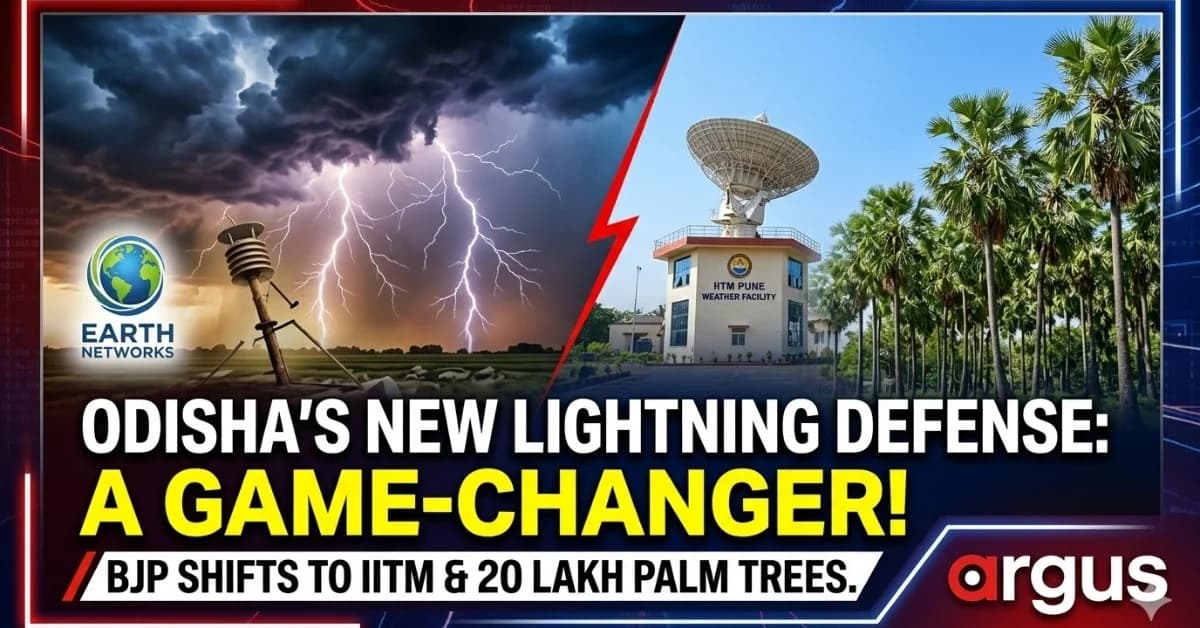
Key Points
Hyper-Local Forecasting: Expands monitoring hardware to 8 primary hubs, providing block and Gram Panchayat-level storm accuracy.
Public System Integration: Replaces private vendor contracts with seamless, free data integration into India’s DAMINI and Odisha's Satark apps.
The Ecological Shield: Deploys a ₹7 crore initiative to plant 20 million palm trees across high-risk rural belts to act as natural lightning arresters.
Bhubaneswar: In a significant development, Revenue and Disaster Management Minister Suresh Pujari announced that the state government is transitioning from a temporary, digital-alert model to a structural, public-sector defense framework. This new initiative is anchored by India’s premier weather modeling agency, the Pune-based Indian Institute of Tropical Meteorology (IITM).
In 2018, the then-BJD government signed an agreement with US-based Earth Networks to provide real-time lightning alerts to key hotspot districts. For years, lightning has remained one of Odisha's deadliest natural hazards, claiming over 400 lives annually across rural stretches, open paddy fields, and mineral-rich belts.
While the 2018 private agreement was for three years, the state has since banked heavily on DAMINI alerts from the Indian Meteorological Department (IMD). This raises a critical question: with the IMD's Damini app already active, how will a partnership with the IITM – another top-tier central weather modeling institute – change the game for Odisha?

📱 Get Argus News App
✨The Evolution of Safety: BJD Era vs. BJP Era
To understand the magnitude of this transition, it is helpful to look at how the state's approach has matured over time:
|
Metric / Aspect |
Previous BJD Government Approach (2018) |
Current BJP Government Move (IITM Partnership) |
|
Primary Technology Partner |
Private/Foreign Firm: Partnered with US-based commercial weather intelligence network Earth Networks.
National Premier Institute: Shifts to an institutionalized, public-sector R&D framework via government-backed IITM Pune.
Network Infrastructure & Scale
Relied on a pilot network of 6 wide-band sensors covering selected zones.
Doubled Hardware Scale: Expanding monitoring networks from 4 primary hubs to 8 across the state (adding Berhampur, Keonjhar, Balangir, and Angul).
System Integration
Focused heavily on commercial SMS alerts and localized outdoor siren towers.
Deeply integrated into India's central DAMINI network and Odisha's upgraded Satark Mobile App.
Scope of Mitigation
Targeted quick 30-to-45-minute advance warnings urging populations to move indoors.
Combines early alerts with geological mapping of micro-zones and long-term ecological defenses.
Why the IITM Move is a Structural Gamechanger
While the 2018 Earth Networks agreement introduced the vital concept of real-time alerting, it came with limitations. It relied heavily on smartphone applications and active cellular connectivity, leaving rural laborers, farmers, and poorer sections deep inside open fields vulnerable if they missed digital messages.
The new framework addresses these foundational gaps through four major pillars:
Hyper-Local Accuracy: Expanding the hardware network allows forecasts to drop from a general regional radius down to the block and Gram Panchayat levels, telling a farmer if lightning is hitting their specific village rather than just their general district.
Open Public Integration: Instead of proprietary data bound by a private commercial contract, IITM telemetry feeds directly into open-source public systems like DAMINI and the Satark App, ensuring permanent, free safety data.
Tackling Underground Conductors: Minister Suresh Pujari highlighted that Odisha’s heavy underground mineral density acts as a natural electrical conductor, drawing massive strikes. IITM atmospheric scientists are mapping these micro-zones to understand the root cause.
The Ecological Shield (20 Lakh Palm Trees): Moving beyond technology alone, the government has allocated Rs7 crores to plant 20 lakh (2 million) palm trees across high-vulnerability rural zones. Acting as natural, tall lightning arresters, these trees absorb high-voltage electrical discharges high in the air, protecting farmers standing in adjacent fields below.
The Numbers: Progress and the High-Risk Belt
Official records presented in the state assembly underscore a steady, encouraging downward trend in lightning fatalities over the last six financial years:
2019–20: 372 deaths (Most impacted: Mayurbhanj)
2020–21: 339 deaths (Most impacted: Mayurbhanj)
2021–22: 296 deaths (Most impacted: Keonjhar)
2022–23: 306 deaths (Most impacted: Mayurbhanj)
2023–24: 272 deaths (Most impacted: Balasore)
2024–25: 205 deaths (Most impacted: Mayurbhanj)
While
the cumulative drop demonstrates that early warnings save lives,
districts like Mayurbhanj, Keonjhar, Balasore, and Ganjam continue
to account for the bulk of casualties due to intense open-field
agricultural activities and unique geology. The partnership with IITM
aims to drive these figures down even further by combining
cutting-edge science with permanent ecological barriers.
Also Read:EXCLUSIVE| North East Monsoon Over Tamil Nadu Set for October 17: Upper-Level Winds Blow Away 'October Cyclone' Rumors Over Durga Puja in Odisha
Related Topics
Explore more stories